
10 Things to Do in Your Garden Before October
By Max Letek · Editor, Garden-Review
15+ years in UK garden & outdoor-equipment retail and publishing, including four years running content for the UK distributor of JCB and Hyundai garden machinery.
Published 23 September 2026 · Last reviewed 23 September 2026 · 9 min read
Quick answer
Before October, UK gardeners should:
1. Plant daffodil, crocus and hyacinth bulbs (save tulips for November)
2. Scarify and aerate the lawn
3. Repair bare patches and apply a low-nitrogen autumn feed
4. Divide congested perennials
5. Net ponds before leaf fall
6. Set up a leaf-mould bin
7. Clean the greenhouse and cold frames
8. Give hedges a final, bird-safe trim
9. Harvest potatoes and collect seed
10. Service mowers and garden machinery before winter storage
Why now? Soil is still warm, autumn rain is arriving, and the first frosts typically land in late October in Scotland and early-to-mid November across much of England.
Late September is the garden's hinge point. The grass is still growing, the soil still holds summer warmth, and the rain that returns in autumn does a lot of your watering for you. Leave these jobs until November and you're working in cold, sticky ground with a fraction of the daylight.
I've built this checklist from the Royal Horticultural Society's month-by-month advice, RSPB wildlife guidance and Met Office climate data, plus a long career spent on the machinery side of UK gardening, where the same autumn mistakes turn up in the spring repair queue every year. Every timing below is sourced; nothing here is guesswork.
Key takeaways
- The RHS advises planting most spring bulbs "preferably by the end of September", but tulips wait until November.
- September–October is the RHS-recommended window for scarifying, aerating and top-dressing lawns.
- Divide most summer-flowering perennials every 2–3 years, but not irises or tender plants in autumn.
- Active bird nests are protected by law all year: check hedges before any cut.
- Stale petrol left over winter is one of the most common reasons a mower won't start in spring.
The checklist at a glance
| # | Job | Why before October | Time |
|---|---|---|---|
| 1 | Plant spring bulbs | Warm soil = strong roots before winter | 1–3 hrs |
| 2 | Scarify & aerate lawn | Grass still growing fast enough to recover | Half a day |
| 3 | Repair patches & autumn feed | Seed needs warmth to germinate | 1–2 hrs |
| 4 | Divide perennials | Divisions root in before the cold | 1–2 hrs |
| 5 | Net the pond | Leaf fall starts in October | 30 mins |
| 6 | Build a leaf-mould bin | Be ready before the leaves drop | 30 mins |
| 7 | Clean greenhouse & cold frames | Tender plants move in before frost | Half a day |
| 8 | Final hedge trim | Tidy shape that holds all winter | 1–3 hrs |
| 9 | Harvest & collect seed | Slugs and wet weather spoil crops | 1–2 hrs |
| 10 | Service garden machinery | Avoid the spring non-start | 1 hr per machine |
1. Plant spring bulbs (but hold the tulips)
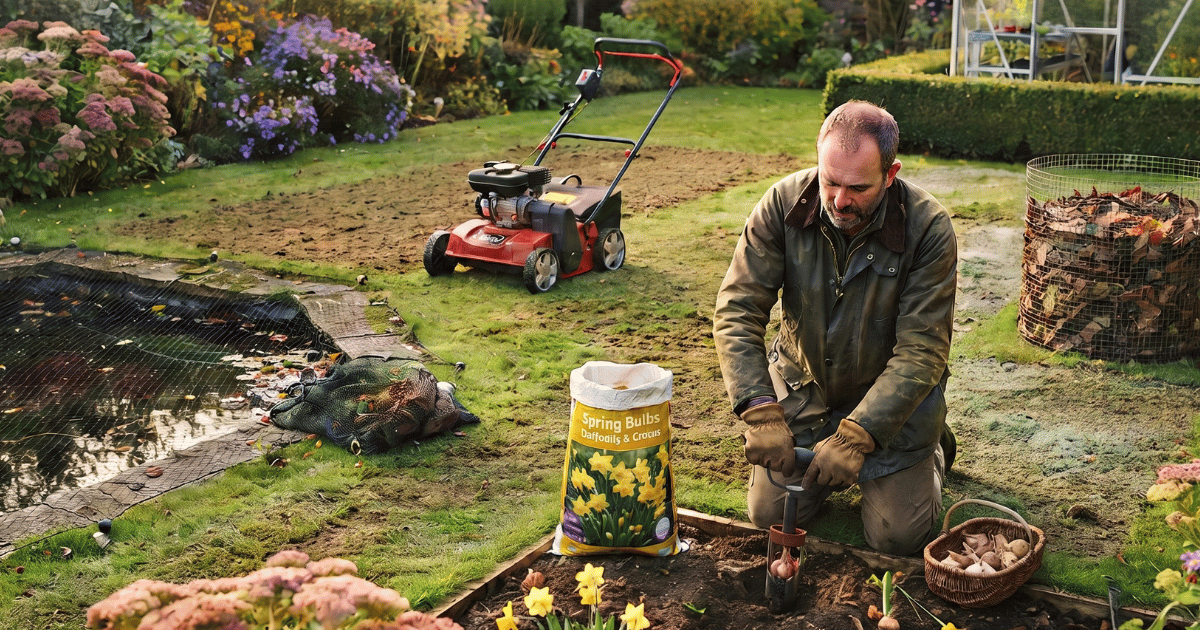
The RHS is specific here: plant spring-flowering bulbs such as daffodils, crocus and hyacinths "preferably by the end of September", and plant tulips in November. The early-planted bulbs get weeks of root growth in warm soil. Tulips wait because colder soil helps reduce the risk of tulip fire, a fungal disease.
How deep? The RHS rule of thumb is two to three times the bulb's own height, so a 5cm bulb goes in a hole 10–15cm deep, pointy "nose" upwards, spaced at least two bulb-widths apart.
Want a naturalised look? Scatter crocus and snowdrops into the lawn and leave that patch unmown in spring until the foliage dies back. Our guide to naturalising spring bulbs in your lawn covers it step by step, and the UK tulip growing guide is ready for November.
Kit that helps: a long-handled bulb planter saves your back if you're planting dozens into turf.
2. Scarify and aerate the lawn
September and October is the time for autumn lawn renovation. After summer, most lawns carry a layer of thatch (dead grass, moss and debris) that blocks water and air getting to the roots.
- Scarify: rake out thatch with a spring-tined rake, working in one direction and then across it. For anything bigger than a small lawn, a powered scarifier does the job in a fraction of the time.
- Aerate: push a garden fork in as deep as it will go, with holes 10–15cm apart. On clay or waterlogged ground the RHS suggests a hollow-tined aerator every 3–4 years.
- Top-dress: brush in 2–3kg per m² of a sandy loam, sharp sand and compost mix to fill the holes.
Expect the lawn to look rough for a fortnight. That's normal, and it recovers quickly while the soil is still warm. For machine choices, see our best lawn scarifiers for 2026 and best electric scarifiers, and our full September lawn care guide.
3. Repair bare patches and switch to an autumn feed
Scarifying shows you where the bare patches are, so fix them straight away. It's recommended to sow seeds onto damp soil after rain, or laying turf onto moist ground and keeping off it for several weeks. Drought-browned grass usually greens up by itself once the rain returns, so rake it before you reseed it.
If growth is poor, use an autumn lawn feed, not a spring one. Autumn feeds are low in nitrogen and higher in potassium and phosphorus, so they build roots and hardiness instead of soft top growth that frost will damage. The RHS suggests about a handful per m², applied just before rain is forecast. Skip feeding altogether in any area you're turning into wildflower meadow.
Keep the mower on a high setting for now. Our piece on whether to cut your lawn short before winter explains why scalping it now is a mistake.
4. Lift and divide congested perennials
If your asters, hardy geraniums or daylilies have gone bare in the middle and flowered less this year, they need dividing. The RHS recommends dividing most perennials every two to three years, and lists September–November as a good window for summer-flowering types.
- Lift the clump with a garden fork.
- Shake or hose off the soil so you can see the roots.
- Tease small plants apart by hand. Lever big clumps apart with two forks back to back, or use a sharp spade on woody crowns.
- Replant the healthiest outer sections and throw away the tired centre.
Don't divide in autumn: irises and other spring-flowering perennials (do them after flowering in summer), or tender perennials. Leave those until spring, and wait for spring in a very wet autumn too.
5. Net your pond before leaf fall
"Net ponds before leaf fall gets underway" is one of the RHS's September priorities, and it's much easier than fishing out soggy leaves in November. Rotting leaves release nutrients that feed algae and use up oxygen over winter. Stretch fine pond netting over the surface, pegged a little above the water, and leave a shallow edge clear so frogs and hedgehogs can still get out.
New to ponds? Start with our beginner's guide to garden ponds or creating a wildlife pond.
6. Set up a leaf-mould bin
In a few weeks you'll have more leaves than you know what to do with, and they make one of the best free soil improvers there is. The RHS method is simple: a chicken-wire cage held up by four stakes, or bin bags pierced with holes and tied loosely. Oak, beech and hornbeam leaves make the best leaf mould. Tough leaves like sycamore break down faster if you shred them first.
Tip: run a rotary mower over the leaves on the lawn. It shreds them and mixes in grass clippings, and both speed up decay. Keep the pile damp. Young leaf mould makes a good mulch within a year, and after about two years it's fine enough to use in potting mixes.
For large gardens, a blower-vac makes collecting much quicker. See our leaf blower buying guide, or go straight to cordless or petrol models. Evergreen leaves are better in the compost heap.
7. Clean the greenhouse and cold frames
Once the tomatoes are finished, empty the greenhouse and give it a proper clean. It lets the most light through during the dark months and removes the hiding places where pests and disease spores overwinter. The RHS routine:
- Take everything out, then sweep the floor and corners.
- Scrape moss and grime from between the overlapping panes with a flexible scraper.
- Wash the glazing with warm water and a soft cloth. The RHS says warm water is enough, no special products needed.
- Clear the gutters, replace cracked panes, oil the vents, and scrub staging and trays.
- Scrub out empty water butts so they're clean for the winter rain.
Then you're ready to bring in tender plants (pelargoniums, citrus, fuchsias) well before the first frost. Based on Met Office 1991–2020 averages, that's typically around late October in Scotland and early-to-mid November across most of England, and earlier in frost pockets and on high ground. If you're adding rainwater storage, our 3P Technik rain tank review is a good place to start.
8. Give hedges a final, bird-safe trim
A clean autumn trim keeps privet, beech, hawthorn and leylandii tidy all winter. The RSPB's advice is to avoid cutting hedges during the main breeding season and to keep trimming to the period from September to the end of February.
The law: under the Wildlife and Countryside Act 1981, it's an offence to intentionally take, damage or destroy the nest of any wild bird while it's in use or being built. That applies in any month. Some species, woodpigeons in particular, nest well into autumn, so look closely and listen before you start.
Sharp blades make a cleaner cut that heals faster and browns less, so check your trimmer before you start. If you want to do more for the birds that use your hedge over winter, our bird feeder and hedgehog house guide is a good next read.
9. Harvest the last crops and collect seed
The RHS advises digging up the remaining potatoes "before slug damage spoils them". Dry them for a few hours, then store them in hessian or paper sacks somewhere cool, dark and frost-free. Pick autumn raspberries as they ripen, and cover leafy crops such as kale and cabbages with bird-proof netting.
Now is also the time to collect seed from perennials and hardy annuals. Pick dry seed heads on a dry day, shake them into paper envelopes, label them, and store them somewhere cool. It costs nothing and you'll have plants for next year. For what to sow now, see what to plant in September and our best autumn flowers.
10. Service your mower and garden machinery
This is the job I know best. From my years on the distribution side of UK garden machinery, the same spring problem came up again and again: a petrol mower, strimmer or leaf blower put away with fuel in the tank, which then wouldn't start in April. Petrol goes stale over the winter and can gum up the carburettor.
Do these after the last cut, not before, since you'll still be mowing into October:
- Petrol machines: run the tank dry or add a fuel stabiliser, change the oil, and clean or replace the air filter and spark plug. Always follow your manufacturer's handbook.
- Blades and decks: disconnect the spark-plug lead or remove the battery, then scrape off dried grass and sharpen or replace blunt blades.
- Cordless tools: store lithium-ion batteries indoors, partly charged, away from frost. Check your manual for the recommended storage charge.
- Storage: keep machines dry, covered and off damp concrete if you can.
Our step-by-step guide on how to maintain your lawn mower covers the details, and how long lawn mowers last will tell you whether it's worth servicing or time to replace.
Leave something for wildlife
Tidy doesn't have to mean bare. A corner of leaves, a log pile or some uncut seed heads gives hedgehogs, insects and birds shelter and food through winter. It also means you don't need to scalp every border before October.
How we put this guide together
This is a research-based guide. Horticultural timings and techniques come from the Royal Horticultural Society's published advice, wildlife guidance from the RSPB, and frost averages from Met Office HadUK-Grid data (1991–2020). The machinery-care section draws on the author's professional background in UK garden machinery distribution. Always follow your equipment manufacturer's instructions. Some links are affiliate links: if you buy through them, Garden-Review may earn a small commission at no extra cost to you.
About the author
Max Letek is the editor of Garden-Review and has more than 15 years' experience in digital publishing and UK gardening, travel and hospitality.
Frequently Asked Questions
Tags
Comments
Join the conversation
Create a free account to leave comments, share photos, and connect with other gardeners.