
JCB Tools Inverter Generator Buying Guide 2026
JCB Tools' new inverter generator range runs from a 2kW camping unit to an 11kW three-phase site machine. Here's every model compared, what it will actually run, and which one is right for you.
Key takeaways
- We compare every JCB Tools inverter generator on power, runtime, noise, weight and price to help you pick the right one - and review each model in full.
- All six JCB models share the same core promise: pure sine wave output, a 3-year warranty, eco mode, USB/USB-C charging and automatic low-oil and overload protection.
- A conventional (open-frame) generator like the JCB-G3600P spins its engine at a fixed speed and produces raw AC output - powerful and simple, but noisy and rough enough that it can damage sensitive electronics.
- Most appliances draw more power to start than to run - this is the figure that catches people out.
- JCB-IG2000 - £549 · 2kW · 18kg · the entry point The lightest and cheapest model, built for camping and light caravan/motorhome loads.
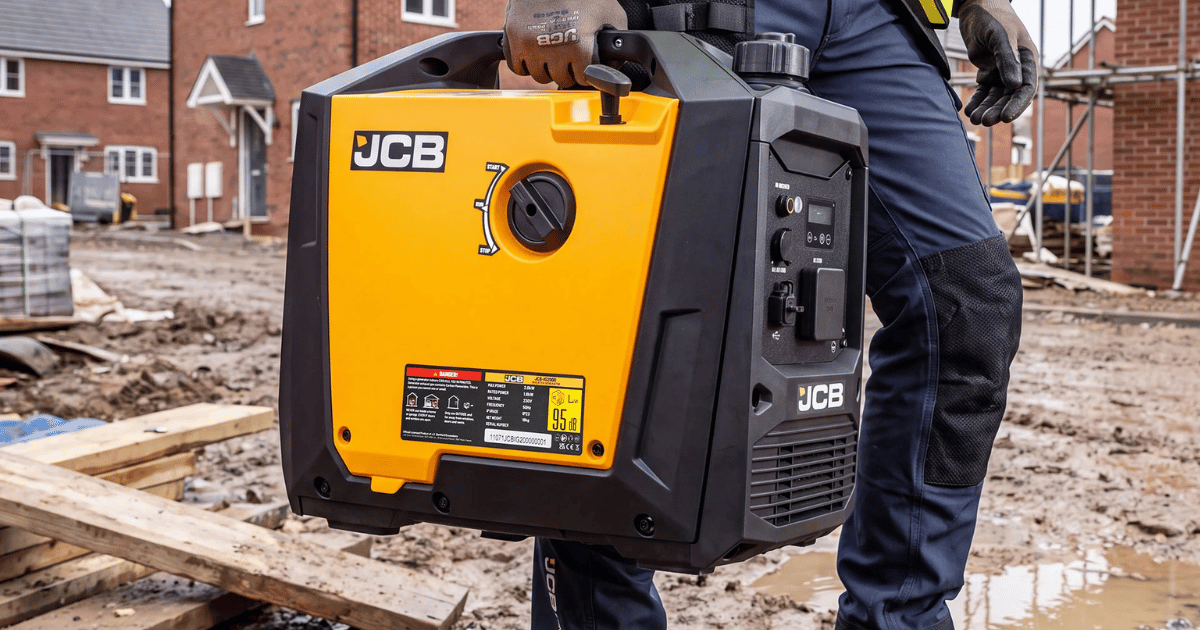
JCB Tools Inverter Generator Buying Guide
Six models, 2kW to 11kW three-phase. We compare every JCB Tools inverter generator on power, runtime, noise, weight and price to help you pick the right one - and review each model in full.
⚡ Quick Answer - Which JCB Inverter Generator Should You Buy?
For camping and basic backup, the JCB-IG2000 (£549) is the lightest and cheapest. For caravans and motorhomes, the JCB-IG3500E (£799) or JCB-IG4200E (£999) cover most set-ups with electric start and, on the 4200E, wheels as standard. For home backup or small-site work needing 110V tool power, the dual-voltage JCB-IG8500DVE (£1,199) is the pick. For serious trade or whole-home backup, step up to the JCB-IG12000DVE (£1,999), and only choose the three-phase JCB-IG12000DVE-3 (£2,199) if you specifically need a 400V supply.
In This Guide
1. About the JCB Tools Inverter Range
JCB Tools has sold open-frame site generators for few years now - we've reviewed the JCB-G3600P and JCB-G8000PE ourselves - but this is the brand's first dedicated inverter generator range, built for the quieter, portable end of the market: camping, caravans, events and emergency home power. We covered the launch in more detail in our news piece on the range, including why it's a logical move for distributor Genpower Ltd, which has been importing and supporting generators since 2006 and has held the global JCB Tools licence since 2023.
All six JCB models share the same core promise: pure sine wave output, a 3-year warranty, eco mode, USB/USB-C charging and automatic low-oil and overload protection. Where they differ is scale - from an 18kg camping generator to a 105kg three-phase site unit.
2. Why a JCB Inverter Generator?
A conventional (open-frame) generator like the JCB-G3600P spins its engine at a fixed speed and produces raw AC output - powerful and simple, but noisy and rough enough that it can damage sensitive electronics. An inverter generator instead generates AC, converts it to DC, then back to clean, regulated AC - "pure sine wave" - safe for laptops, phones, TVs and induction chargers. The trade-off is engine speed can vary with load (this is what "eco mode" controls), which is what makes inverter generators quieter and more fuel-efficient at partial load. Every JCB inverter model in this range uses this technology, with a claimed total harmonic distortion (THD) of 3% or less on the larger models - well within the tolerance of household electronics.
3. How Much Power Do You Actually Need?
Most appliances draw more power to start than to run - this is the figure that catches people out. As a rough guide:
| Appliance | Typical running watts | Typical starting watts |
|---|---|---|
| LED lighting circuit | 50-150W | Same |
| Laptop / phone charger | 30-90W | Same |
| Caravan/motorhome fridge (compressor) | 100-200W | 400-800W |
| Kettle | 2,000-3,000W | Same |
| Microwave | 800-1,200W | Same |
| Circular saw / SDS drill | 1,000-1,600W | 2,000-2,800W |
| Domestic fridge-freezer | 100-250W | 1,000-1,500W |
| Site 16A single-tool hookup | - | Up to 3,680W |
Figures are typical UK household/site ranges, not JCB-specific test data - always check your own appliance's rating plate. Add up your running watts, then check the highest single starting watts against the generator's max (surge) output, not its continuous rating.
4. The Six Models, One by One
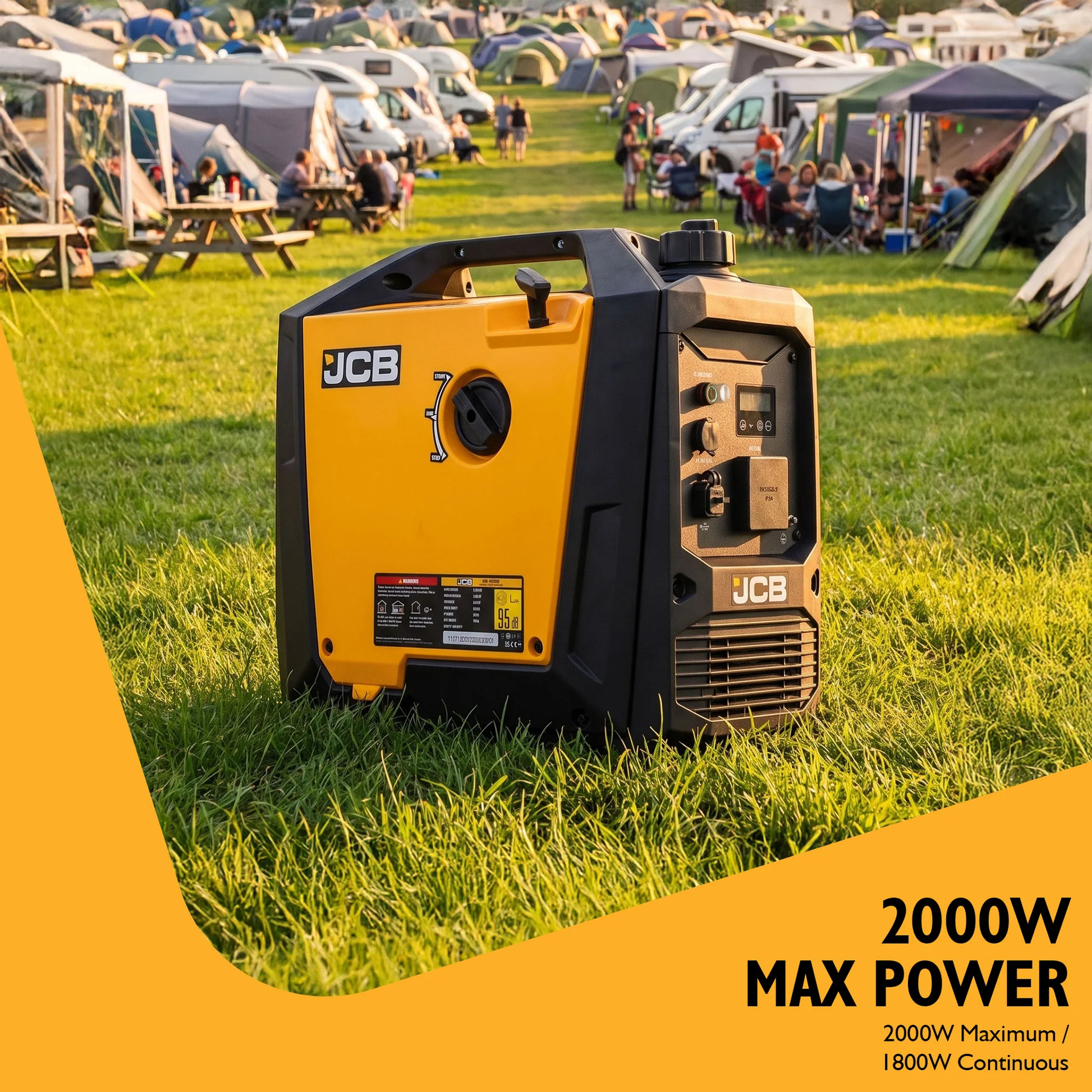
JCB Tools 2000W, 2kW Inverter Generator, Pure Sine Wave, Quiet & Lightweight
JCB-IG2000 - £549 · 2kW · 18kg · the entry point
The lightest and cheapest model, built for camping and light caravan/motorhome loads. One 13A socket, recoil start only, 58dB(A) - the quietest machine in the range on paper.
Read the full JCB-IG2000 review →
View more detail at JCB Tools >
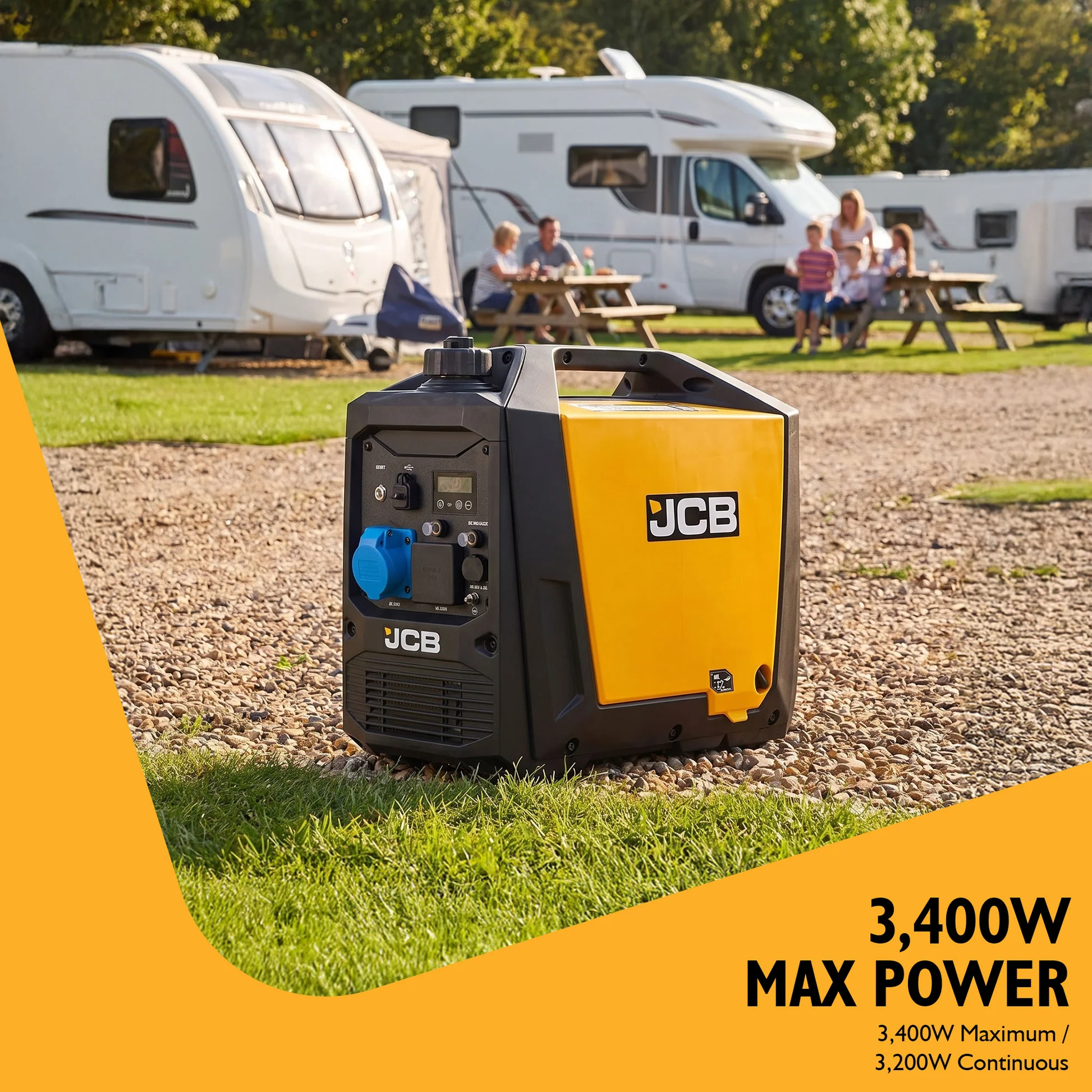
JCB Tools 3.4kW Inverter Generator, Pure Sine Wave, Electric Start
JCB-IG3500E — £799 · 3.4kW · 22kg · electric start
Adds electric start and a 16A industrial socket over the IG2000, for roughly £250 more. The natural upgrade if you want push-button starting or a second, heavier-duty outlet.
Read the full JCB-IG3500E review →
View more details on JCB Tools >
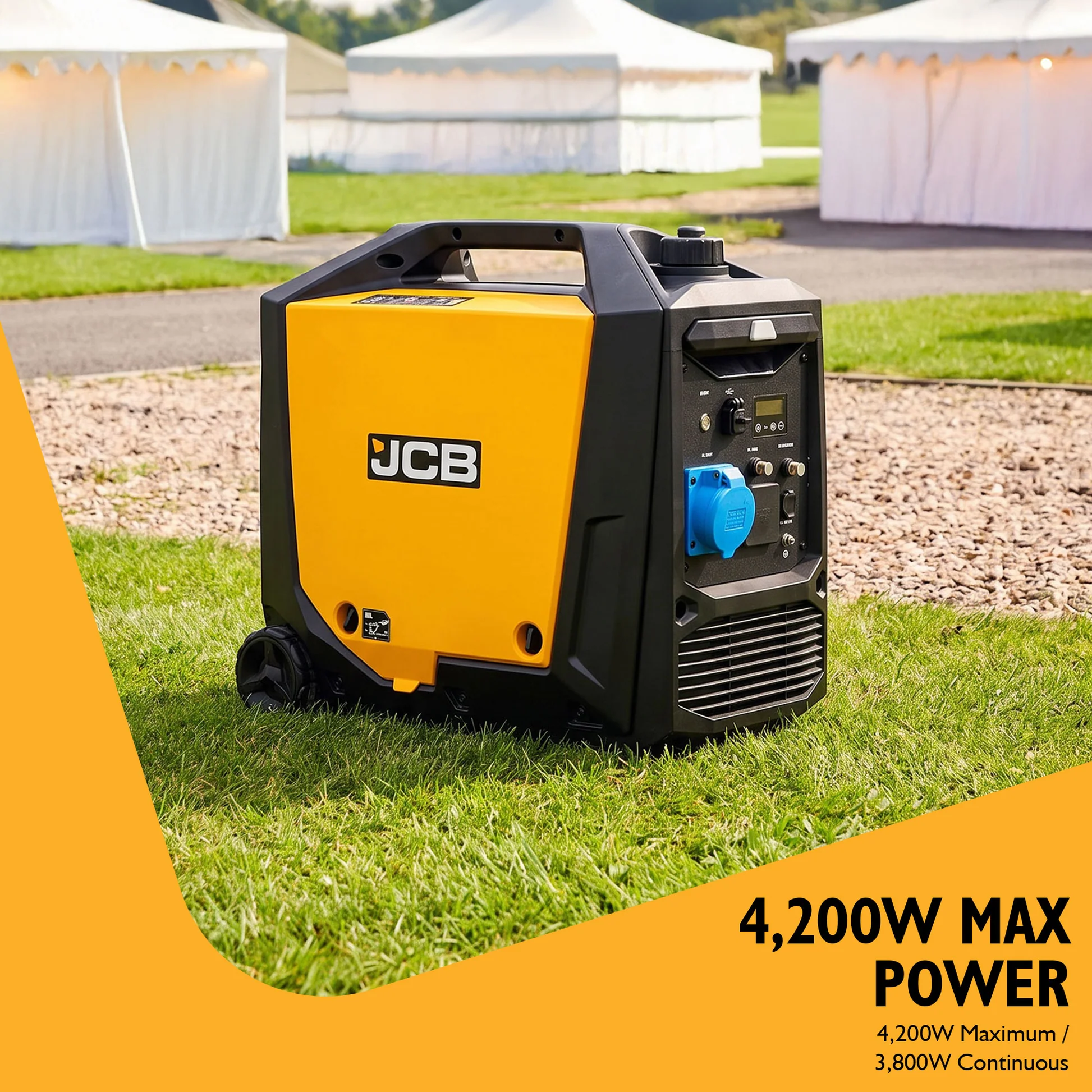
JCB Tools 4.2kW Inverter Generator, Electric Start with Wheels
JCB-IG4200E - £999 · 4.2kW · 29kg · wheels as standard
The largest single-voltage model, with a 32A industrial socket and wheels fitted as standard - worth it once weight passes ~25kg. Good ceiling for bigger caravans or multiple appliances.
Read the full JCB-IG4200E review →
View more details on JCB Tools >
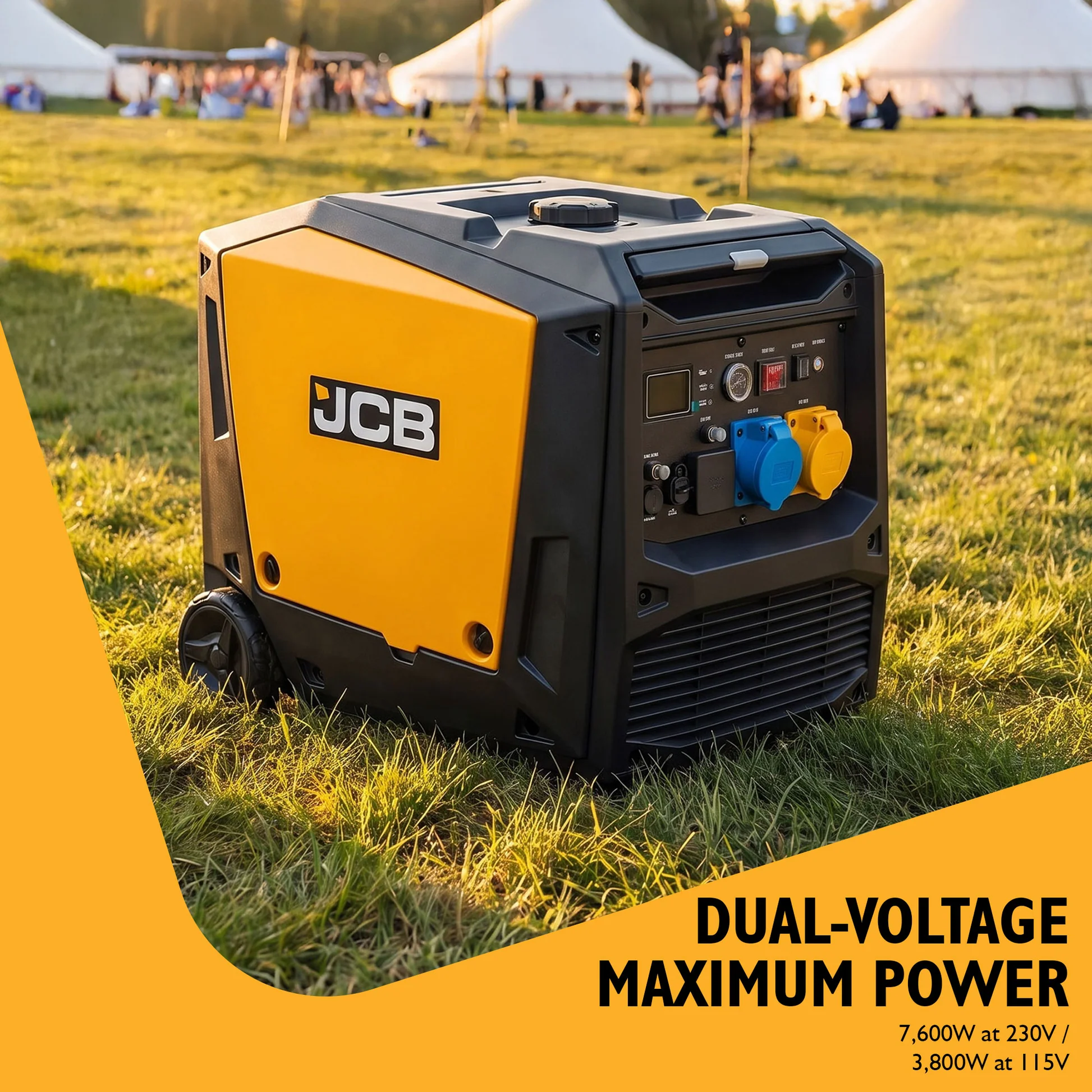
JCB Tools 7.6kW/3.8kW Dual-Voltage Inverter Generator, Remote Start
JCB-IG8500DVE — £1,199 · 7.6kW dual-voltage · 56kg · remote start
The step-change model: dual-voltage 230V/115V output for running 110V site tools safely, a key-fob remote start, LCD display and telescopic handle. The natural crossover point between leisure and trade use.
Read the full JCB-IG8500DVE review →
View more details on JCB Tools >
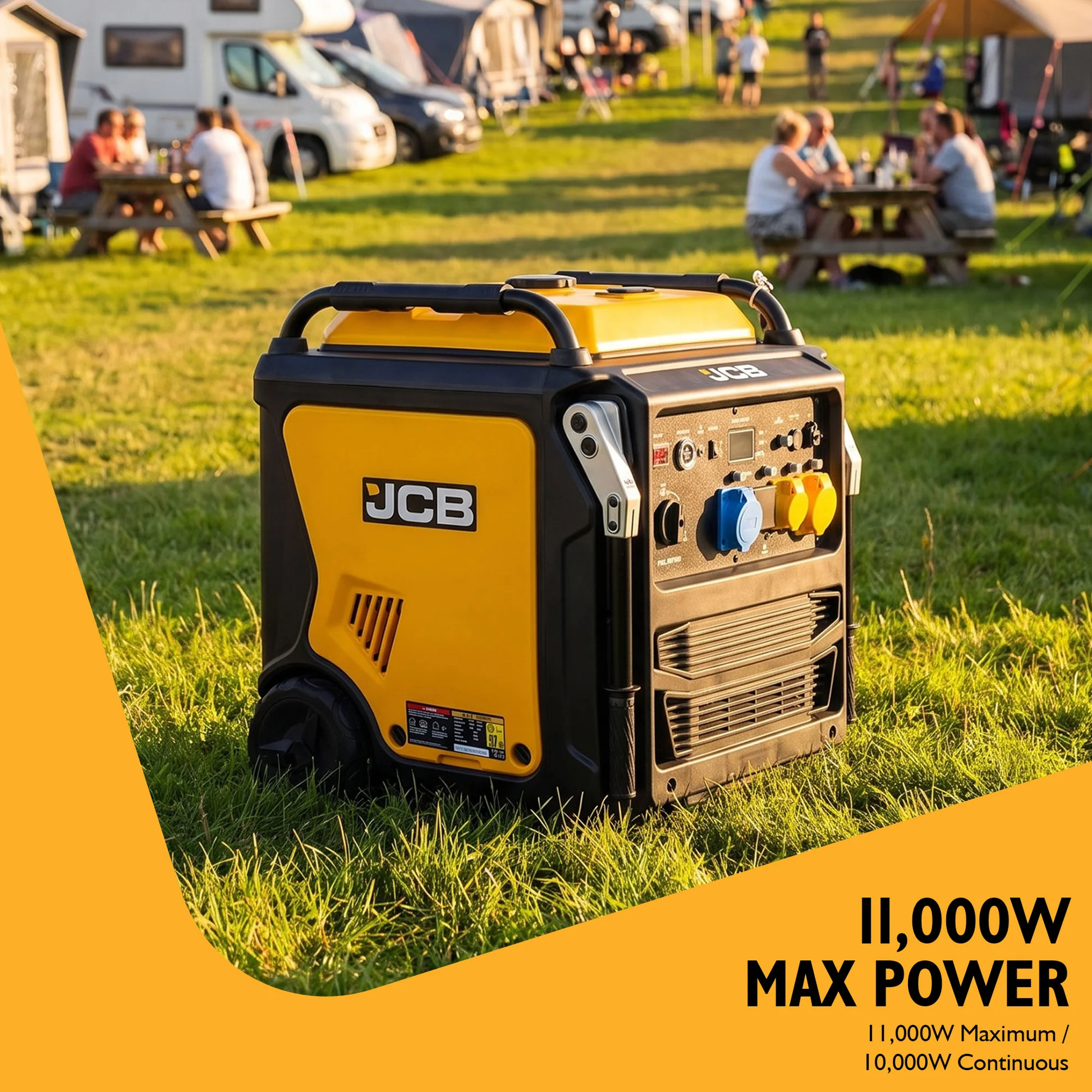
JCB Tools 11kW Dual-Voltage Inverter Generator, Remote Start, Wheels
JCB-IG12000DVE — £1,999 · 11kW · 105g · biggest single phase mode
A genuine whole-home backup or small-site machine, with a 32L tank giving up to 45.5 hours at light load. Four AC outletsacross 230V and 115V.
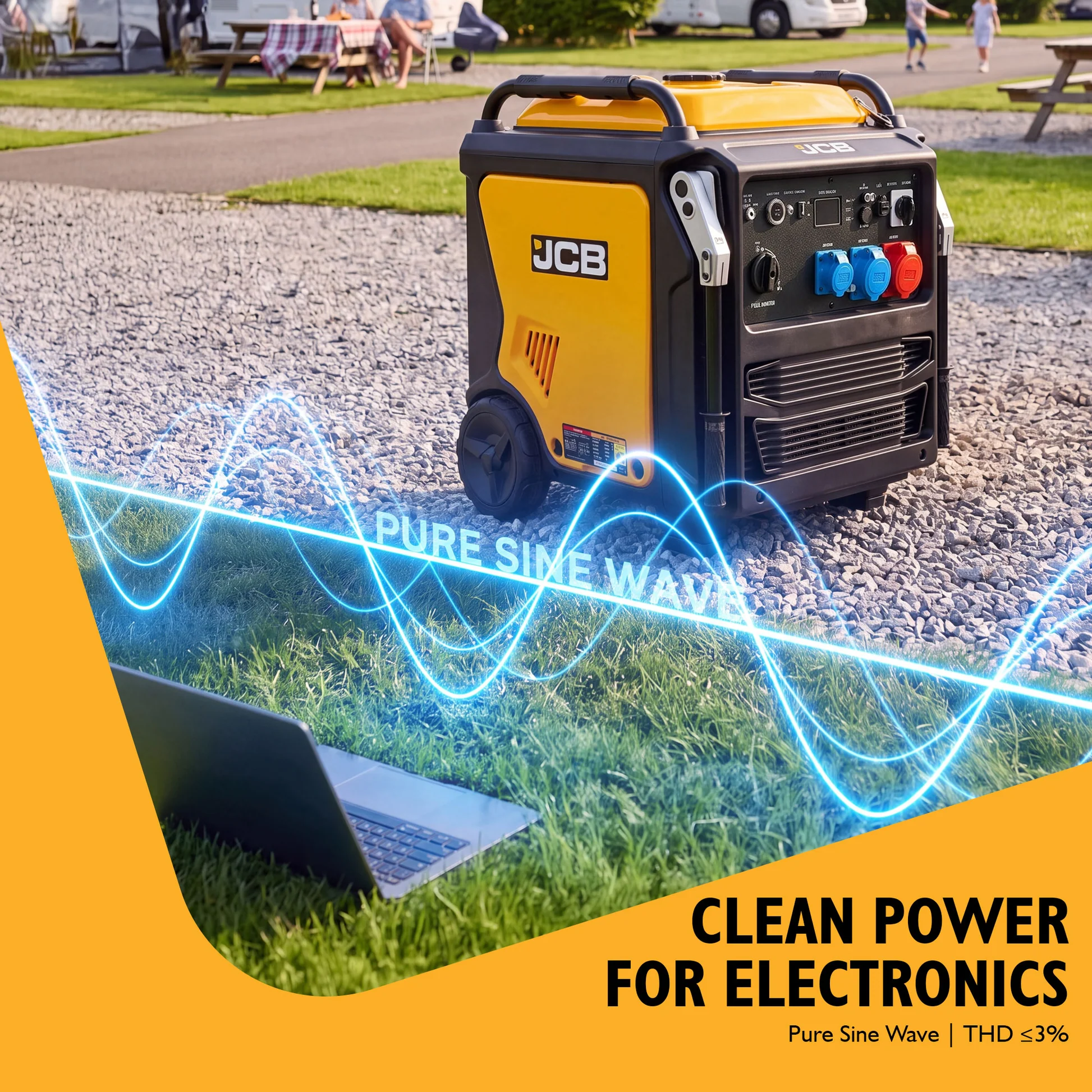
JCB Tools 11kW Three-Phase Inverter Generator, 400V/230V and Remote Start
JCB-IG12000DVE-3 — £2,199 · 11kW three-phase · 105kg · 400V supply
Mechanically identical to the IG12000DVE but with a 400V three-phase 32A output alongside 230V - for three-phase site equipment. A specialist choice, not a general upgrade.
Read the full JCB-IG12000DVE-3 review →
View more details on JCB Tools >
5. Full Comparison Table
| Model | Max/Cont. | Engine | Tank | Runtime | Weight | Start | Price |
|---|---|---|---|---|---|---|---|
| JCB-IG2000 | 2.0/1.8kW | 80cc | 5L | Up to 34.5h@10% load | 18kg | Recoil | £549 |
| JCB-IG3500E | 3.4/3.2kW | 149cc | 5L | Up to 19.5h@10% load | 22kg | Electric+recoil | £799 |
| JCB-IG4200E | 4.2/3.8kW | 174cc | 9L | Up to 7.5h@50% load | 29kg | Electric+recoil | £999 |
| JCB-IG8500DVE | 7.6/7.2kW* | 351.8cc | 16L | 4h@100% load | 56kg | Electric+remote | £1,199 |
| JCB-IG12000DVE | 11/10kW | 550cc | 32L | Up to 45.5h@10% load | 105kg | Electric+remote | £1,999 |
| JCB-IG12000DVE-3 | 11/10kW | 550cc | 32L | ~5h continuous (manual) | 105kg | Electric+remote | £2,199 |
*7.6kW is the 230V rating; the IG8500DVE also supplies 3.8kW max/3.6kW continuous at 115V. Noise figures are omitted from this table because they're measured two different ways across the range - see the safety section below.
View the full range at JCB Tools >
6. Which Model for Which Use
- Tent camping / small backup: JCB-IG2000 - lightest, cheapest, quiet enough for most campsites.
- Caravan or motorhome (single hook-up): JCB-IG3500E or JCB-IG4200E - electric start matters more here than raw power.
- Home emergency backup (essentials, not whole house): JCB-IG4200E or JCB-IG8500DVE, run through a properly installed transfer switch - never straight into your consumer unit.
- Small trade / site work needing 110V tools: JCb-IG8500DVE - the only model in the range with a 115V output.
- Outdoor events, market stalls, larger backup: Jcb-IG12000DVE.
- Sites specifically requiring a 400V three-phase supply: JCB-IG12000DVE-3 only - don't pay the premium unless you actually need three-phase.
7. Running Costs
Estimated fuel cost per hour, calculated from JCB's own published tank and runtime figures at £1.55/litre unleaded (September 2026 UK average - check current pump prices):
| Model | Light load (~10%) | Heavy load |
|---|---|---|
| JCB-IG2000 | ~£0.22/hr | ~£1.03/hr at 50% |
| JCB-IG3500E | ~£0.40/hr | Not published at 50%+ |
| JCB-IG4200E | Not published at 10% | ~£1.86/hr at 50% |
| JCB-IG8500DVE | Not published | ~£6.20/hr at 100% |
| JCB-IG12000DVE | ~£1.09/hr | ~£5.22/hr at 50% |
| JCB-IG12000DVE-3 | Not published | ~£9.92/hr continuous (load unspecified) |
8. JCB vs Hyundai, Honda & Champion
Because the same distributor, Genpower Ltd, handles both JCB Tools and Hyundai Power Products in the UK, the two brands' inverter ranges sit unusually close together on paper. Hyundai's HY3250SEi (3,200W) and HY3900Si (3,300W) compete almost directly with the JCB-IG3500E, while Hyundai's HY6250SEi sits between the JCB-IG4200E and JCB-IG8500DVE. In practice the choice often comes down to which brand's dealer network and warranty terms you trust more, since both are backed by the same company - see our wider verdict on whether Hyundai generators are any good for that side of the comparison.
Honda remains the reliability benchmark in this category, generally commanding a price premium of 30-50% over both JCB and Hyundai for comparable output, built on decades of proven engine longevity. Champion, reviewed in our own Champion generator buying guide, undercuts JCB slightly at the entry end and offers dual-fuel LPG variants that JCB's launch range doesn't - worth considering if gas-switching capability matters to you. JCB's pitch against both is brand recognition (from its tools and plant machinery) combined with pricing that sits between Champion and Honda.
9. Safety & UK Rules
Carbon monoxide: every generator in this range is petrol-engined and produces CO, an invisible, odourless, lethal gas. Per HSE guidance, always run generators outdoors in the open air, well away from windows, doors and vents - never in a tent, awning, garage or other enclosed or semi-enclosed space.
Noise labelling isn't consistent across the range. JCB quotes the IG2000, IG3500E and IG4200E in dB(A) measured at 25% load, 7 metres away - a "how loud does it sound to a bystander" figure. The IG8500DVE and IG12000DVE-3 are instead labelled with a 97 dB(A) guaranteed sound power level (LWA) under EU Noise Directive 2000/14/EC, which measures total acoustic energy emitted by the machine, not perceived loudness at a distance - LWA figures always read higher than a 7-metre dB(A) reading for the same generator, so the two aren't directly comparable on the spec sheet.
Campsites: generator policies vary by site. The Camping and Caravanning Club and similar operators typically restrict generator use to set hours and, increasingly, to inverter-only or below a stated dB threshold - check before you travel, particularly with the larger models in this range.
Never wire a generator into your consumer unit (fuse board) without a properly installed transfer/changeover switch fitted by a qualified, Part P-registered electrician. Connecting a generator directly risks back-feeding power into the grid, which can be fatal to engineers working on the supply line.
10. Garden-Review Verdict
JCB's first inverter generator range is a sensible, well-specified line-up rather than a flashy one - no dual-fuel option, no battery-hybrid halo model, just six honestly differentiated petrol generators covering camping through to three-phase site power, all backed by a 3-year warranty and a distributor with two decades of generator experience behind it. For most buyers the IG3500E or IG4200E will be the sweet spot; trade users who need a 110V supply should go straight to the IG8500DVE.
Read our individual reviews for the full verdict on each model: JCB-IG2000, JCB-IG3500E, JCB-IG4200E, JCB-IG8500DVE, JCB-IG12000DVE and JCB-IG12000DVE-3.
Shop the JCB Tools Inverter Generator Range →
Specifications and pricing sourced from jcb-tools.co.uk (September 2026); running costs are estimates calculated from JCB's own published tank/runtime data at an assumed £1.55/litre - verify before relying on them. Mark Moore is Power Tools Specialist at Garden-Review.co.uk and has no commercial relationship with JCB Tools, JCB Ltd or Genpower Ltd beyond Garden-Review's Awin affiliate partnership.
What warranty do JCB inverter generators have?
Tags
Comments
Join the conversation
Create a free account to leave comments, share photos, and connect with other gardeners.