
Solar generator vs petrol generator: which is better for UK gardens?
Solar or petrol generator for your garden? Compare noise, fuel costs, maintenance and performance.
Key takeaways
- Loud enough to prompt neighbour complaints and restrict hours of use.
- The headline difference between a petrol and a solar generator isn't cost or power - it's noise, and the practical constraints that noise creates in a UK residential setting.
- The upfront purchase price of a petrol generator can look attractive - a 2kW inverter model costs £300–£500, which is less than most comparable solar generators.
- It wouldn't be a fair comparison without acknowledging where petrol wins.
- Jackery makes three models that cover the realistic range of garden and shed power needs.
Jim Fellows - Garden-Review, Outdoor Power Equipment Specialist
Petrol generator costs verified against UK retailer data · Noise figures sourced from manufacturer specifications · Fuel cost calculations based on June 2026 UK petrol prices · Updated June 2026
The verdict up front
For UK garden use - sheds, allotments, greenhouses, and outdoor entertaining - a solar generator wins on almost every metric that matters to a homeowner: it's silent, produces no fumes, needs no fuel, requires no maintenance, and won't land you in trouble with neighbours or the council. A petrol generator delivers more raw power, but that advantage is irrelevant if you don't actually need to run a kettle or a circular saw in the middle of your garden. We compare them honestly across eight categories below.
When most people think "generator for the garden," they still picture a petrol unit, loud, heavy, fuel-smelling, and stored in the corner of a garage between uses. But the growth of high-quality solar generators (a rechargeable battery and solar panel combined) has changed the calculation significantly, particularly for the kind of low-to-mid power tasks that UK gardeners actually need.
This comparison covers both types honestly. A petrol generator is genuinely better in some scenarios. But for most garden uses in a typical UK residential setting, the solar generator isn't just competitive, it's the more sensible choice, and we'll show you exactly why.
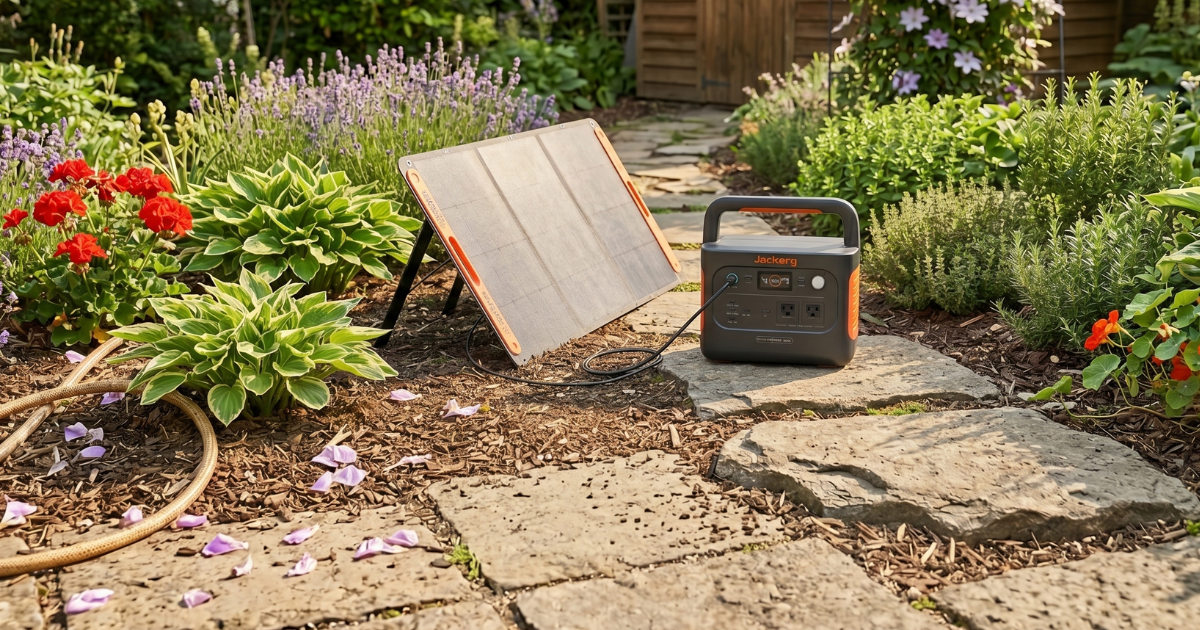
Solar generator used in this comparison
Jackery Solar Generator 1000 v2
1,070Wh LiFePO4 · 1,500W AC output · 6,000-cycle battery · SolarSaga 200W panel included · from £899
1,070Wh
Capacity
1,500W
AC output
0 dB
Operating noise
£0
Fuel cost
5 yrs
Warranty
Head-to-head comparison: 8 categories
| Petrol generator | Solar generator | |
| Noise |
58–97 dB Comparable to a power drill. Loud enough to prompt neighbour complaints and restrict hours of use. |
0 dB — completely silent No moving parts. No noise restrictions apply. Use at 6am or midnight without disturbing anyone. |
| Fumes & emissions |
CO, NOx, hydrocarbons Must never be run indoors or in enclosed spaces. Produces carbon monoxide — a serious safety hazard in or near a shed or greenhouse. |
Zero emissions Can be used inside the shed, greenhouse, or any enclosed space without ventilation concerns. |
| Purchase cost |
£200–£800 A decent 2kW petrol inverter generator costs £300–£500. Budget units are cheaper but noisier and less reliable. |
£449–£999 (bundle) Explorer 500 v2 (£449) for lighter use; Solar Generator 1000 v2 bundle from £899 for all-day garden power. |
| 5-year running cost |
£300–£900+ Petrol at ~£1.45/litre; a 2kW unit uses roughly 0.5–0.8 litres/hour. Annual servicing (oil, spark plug, air filter) adds £50–£100/yr. |
Near zero Solar charging is free. Occasional mains top-ups cost pence. No servicing, no oil changes, no consumables. |
| Maintenance |
Annual servicing required Oil changes, air filter, spark plug, fuel stabiliser if stored. Petrol goes stale in 3–6 months — a unit left over winter may fail to start. |
None No moving parts to service. Store at partial charge, pick it up in spring and it works exactly as before. |
| Safety |
Significant hazards Carbon monoxide risk, fire risk from stored petrol, hot exhaust, and refuelling around sparks. Must be used outdoors only with adequate clearance from structures. |
No combustion hazards LiFePO4 battery chemistry is thermally stable. No flammable fuel storage. Safe to use in any space, indoors or out. |
| Portability |
Heavy — 15–30kg typical Two-person lift for many models. Awkward to transport in a car due to fuel spillage risk. Not suitable for camping or flying. |
5.7–14.5kg One-person carry. Takes it camping, to the allotment, in the car boot, or as home backup — all without modification. |
| Raw power output |
Petrol wins: 2,000–3,500W Handles UK kettles, large heaters, angle grinders, circular saws — anything requiring sustained high wattage. |
500–2,200W (model dependent) Explorer 500 v2 covers most garden tasks. Explorer 2000 v2 (2,200W) handles most power tools short of the largest grinders. |
Why noise is the deciding factor for most UK gardeners
The headline difference between a petrol and a solar generator isn't cost or power - it's noise, and the practical constraints that noise creates in a UK residential setting.
A typical petrol inverter generator, the quieter variety marketed for domestic use - operates at 58–65 dB at 7 metres. That's comparable to a normal conversation, or a busy restaurant. A cheaper, non-inverter model runs at 72–97 dB. For context, noise becomes potentially problematic under UK environmental health guidelines when it exceeds 34 decibels measured from inside a neighbour's property, a threshold most petrol generators exceed at the boundary of a typical UK garden.
In the UK, noise levels are limited to 34 dBA after 11pm, or 10 dBA above the level of background noise if that exceeds 24 dBA. Running a petrol generator in the evening, on a Sunday morning, or during a bank holiday is an invitation for a complaint to the Environmental Health Officer and councils do take action under the Environmental Protection Act 1990.
Carbon monoxide warning
Petrol generators produce carbon monoxide and must never be operated inside a shed, garage, greenhouse, or any enclosed or semi-enclosed space. CO is colourless and odourless, deaths from petrol generator use in enclosed spaces occur every year in the UK. A solar generator produces no emissions and can safely be used anywhere.
A solar generator - which has no engine, no combustion, and no moving parts - produces zero noise and zero emissions. Use it at 6am on a Sunday, inside the greenhouse, with the windows shut. There are no restrictions, no complaints, and no hazards to navigate.
The real cost of running a petrol generator over 5 years
The upfront purchase price of a petrol generator can look attractive - a 2kW inverter model costs £300–£500, which is less than most comparable solar generators. But the total cost of ownership over five years tells a different story.
| Cost item | Petrol generator | Solar Generator 1000 v2 |
| Purchase price | £350 (mid-range 2kW) | £899 (bundle with panel) |
| Fuel cost (est. 50hrs/yr × £1.45/l × 0.6 l/hr) | ~£218 over 5 years | £0 |
| Annual servicing (oil, plug, filter × 5 yrs) | ~£250–£350 | £0 |
| Fuel stabiliser / storage costs | ~£50 | £0 |
| 5-year total cost (estimate) | £870–£970 | £899 |
The numbers over 5 years
A mid-range petrol generator looks cheaper to buy but costs a similar total amount to own over five years — without the free fuel or the silence. Beyond year five, the solar generator's running cost stays near zero indefinitely (its LiFePO4 battery is rated to 6,000 cycles), while the petrol unit continues to accumulate fuel and service costs annually.
When a petrol generator is still the right choice
It wouldn't be a fair comparison without acknowledging where petrol wins. There are genuine use cases where a petrol generator is the better tool - and we should say so clearly. Read our generator guides to help you choose a petrol generator >
Heavy power tools
Angle grinders (1,200W+), circular saws, concrete mixers, large compressors — any tool that draws sustained high wattage is better served by a petrol generator's continuous output. The Explorer 2000 v2 covers most tools up to 2,200W, but a petrol unit gives unlimited runtime for marathon building sessions.
Remote sites without any charging option
If you're working on a site with no mains access, no nearby property to charge overnight, and extended periods of heavy UK cloud cover, a petrol generator's on-demand fuel supply is more reliable than solar top-up alone.
Very high sustained load for long periods
Running a 3kW electric heater continuously for 8 hours, for example, requires either a very large solar battery or a petrol unit. For most UK gardeners, this scenario simply doesn't arise in practice.
Which Jackery solar generator for UK garden use?
Jackery makes three models that cover the realistic range of garden and shed power needs. Here's how to choose:
Light shed / allotment use
Explorer 500 v2
£449
512Wh · 500W output · 5.7kg. Lighting, fans, tool charging, propagators, laptop. The right starting point for most gardeners.
View Explorer 500 v2 →Best all-day garden power
Solar Generator 1000 v2
From £899
1,070Wh · 1,500W output. Covers everything the 500 v2 does plus most power tools, larger heaters, and a full day of shed work. Replaces a petrol generator for 90% of garden use cases.
View Solar Generator 1000 v2 →Workshop & home backup
Explorer 2000 v2
£1,399
2,042Wh · 2,200W output. For serious workshop use, greenhouse heating backup, or replacing a petrol generator entirely on a larger scale.
View Explorer 2000 v2 →Final verdict: which should you choose?
For a typical UK homeowner using a generator for garden, shed, allotment, or greenhouse power: choose a solar generator. The absence of noise, fumes, fuel costs, and maintenance requirements isn't a marginal advantage — it's a fundamental quality-of-life improvement. You can use it without worrying about neighbours, without ventilating the shed, without scheduling an annual service, and without keeping a jerry can of petrol that goes stale over winter.
The five-year total cost of ownership is comparable once fuel and servicing are included, and the solar generator's LiFePO4 battery will outlast most petrol engines by a decade or more with typical garden use.
If you genuinely need to run heavy power tools at sustained high wattage on a site without mains access — and many people don't — a petrol generator remains the pragmatic choice. But be honest with yourself about whether that's actually your use case, or whether it's an assumption from an older era of garden power equipment.
Our recommended solar generators for UK gardens
All models available from Jackery UK with free delivery, a 5-year warranty, and a 30-day money-back guarantee.
Affiliate disclosure: This article contains affiliate links to Jackery UK. Garden-Review may earn a commission on purchases made through these links at no additional cost to you. Petrol generator cost and noise figures are sourced from UK retailer listings and manufacturer specifications current as of June 2026. Five-year cost estimates are illustrative and based on 50 hours of annual use at typical UK petrol prices - actual costs will vary. Jim's editorial opinions are independent.
Jim Fellows is a garden machinery and outdoor power equipment specialist at Garden-Review.co.uk with over 15 years of hands-on experience testing products across residential and professional garden settings.
Frequently Asked Questions
Are solar generators better than petrol generators for UK gardens?
Can a solar generator replace a petrol generator?
What are the disadvantages of a petrol generator?
Is it safe to use a generator inside a shed or greenhouse?
Which is cheaper to run: a petrol generator or a solar generator?
What size solar generator do I need for a garden shed or allotment?
Tags
Comments
Join the conversation
Create a free account to leave comments, share photos, and connect with other gardeners.