
JCB-G3600P & JCB-G8000PE Petrol Site Generators Reviewed
The JCB-G3600P and JCB-G8000PE are two powerful petrol site generators built for UK trades, construction sites, workshops, and backup power use. In this expert review, we compare performance, fuel economy, runtime, portability, and 110V site compatibility to help you choose the right JCB generator for your workload in 2026.
Key takeaways
- Two JCB site generators - one compact and highly portable, one heavy-duty flagship - reviewed head-to-head.
- ★ Expert Verdict - JCB G3600P A well-specified compact site generator that stands out primarily for its exceptional fuel economy and runtime.
- ★ Expert Verdict — JCB G8000PE A serious site generator for serious site work.
- Both the JCB-G3600P and JCB-G8000PE use AVR (Automatic Voltage Regulation) alternators.
- Wattages shown are approximate running loads, motor-driven tools have starting surge currents of 2–4× their running load, so always leave 20–25% headroom in your load calculations.
Our Rating
JCB-G3600P & JCB-G8000PE Petrol Site Generators Reviewed
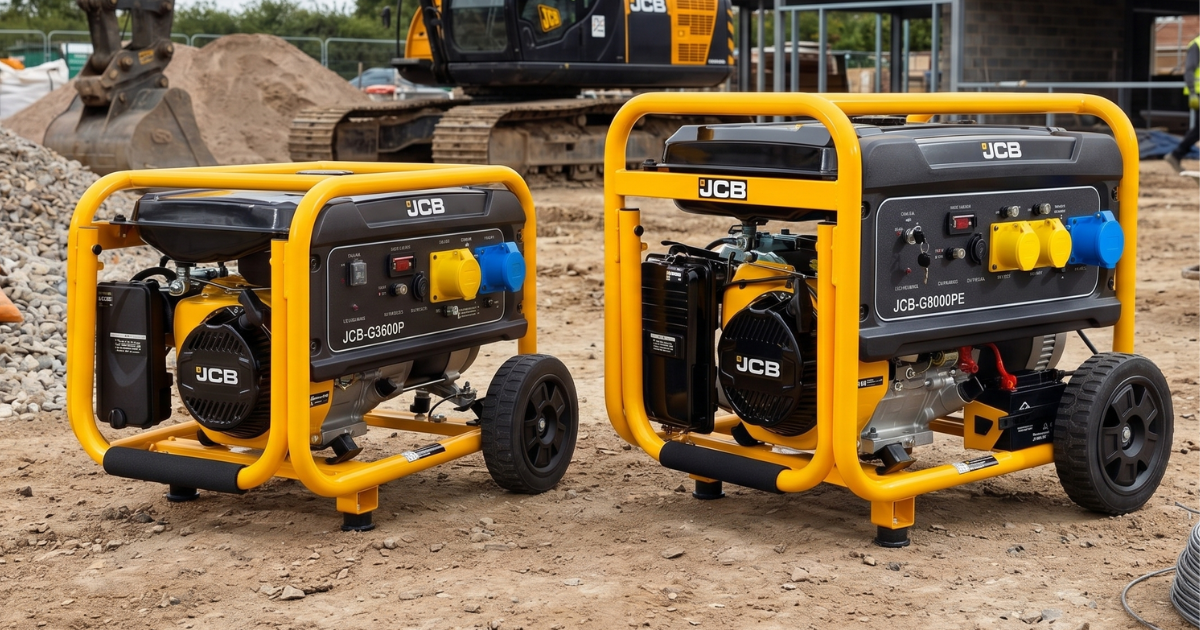
JCB-G3600P & JCB-G8000PE Petrol Site Generators Reviewed
Two JCB site generators - one compact and highly portable, one heavy-duty flagship - reviewed head-to-head. Both run on the same open-frame platform philosophy with JCB Tools' own petrol engines, AVR alternators and 3-year warranty. We cover every specification, real-world use case, running costs and who should buy which.
⚡ Quick Answer — Which JCB Generator Should You Buy?
Choose the JCB-G3600P if you need a portable site generator for one or two tools simultaneously - small construction tasks, van power, farm/smallholding use, outdoor events, or light-duty site work. At 50kg with a 13-hour runtime from its 15-litre tank, it is genuinely practical to move and economical to run. Choose the JCB G8000PE if you need to power multiple heavy tools concurrently - compressors, welders, SDS breakers, lighting rigs, or whole-site power on a medium construction job. At 7.9kW max with a 25-litre long-run tank and electric start, it operates at a completely different capacity level. There is no overlap: these two machines serve genuinely different workloads.
JCB G3600P
3.6kW · 224cc · Recoil Start
Small site, portable, van use, one or two tools
View at JCB Tools →JCB G8000PE
7.9kW · 457cc · Electric + Recoil
Heavy site use, multiple tools, full-day operation
View at JCB Tools →In This Review
- Full Side-by-Side Specifications
- JCB G3600P — Full Review
- JCB G8000PE — Full Review
- AVR Explained — Why It Matters
- What Can Each Generator Power?
- Running Costs & Fuel Economy
- Use Cases — Which Machine for Which Job
- Pros & Cons — Both Models
- UK Site Regulations (110V)
- Competitor Comparison
- Frequently Asked Questions
- Our Verdict
1. Full Side-by-Side Specifications
| Specification | JCB G3600P | JCB G8000PE |
|---|---|---|
| Engine Model | JCB-EG225P | JCB 457cc OHV |
| Engine Type | 4-stroke OHV single cylinder | 4-stroke OHV single cylinder |
| Displacement | 224cc | 457cc |
| Engine Power | 7.5HP | 15HP |
| Emissions | Euro V | Euro V |
| Max Output | 3.6kW / 4.5kVA | 7.9kW / 9.8kVA |
| Continuous Output | 3.2–3.3kW / 4kVA | 7.5kW / 9.4kVA |
| Rated Speed | 3,000 RPM | 3,000 RPM |
| Frequency | 50Hz | 50Hz |
| Phase | Single phase | Single phase |
| Voltage Output | 115V / 230V | 115V / 230V |
| Outlets | 1× 230V/16A (Blue) · 1× 115V/16A (Yellow) · 1× 12V DC 8.3A | 1× 230V/32A (Blue) · 2× 115V/16A (Yellow) · 1× 12V DC 8.3A |
| Alternator | AVR (Automatic Voltage Regulator) | AVR (Automatic Voltage Regulator) |
| Starting System | Recoil pull-start (nylon mesh cord) | Electric key start + recoil pull-start backup |
| Fuel Tank | 15 litres | 25 litres |
| Runtime @ 50% Load | 13+ hours | 8+ hours |
| Fuel Consumption @ 50% Load | ~1.15 L/hr | ~3.1 L/hr |
| Fuel Consumption @ 100% Load | ~2.0 L/hr | ~5.0 L/hr (est.) |
| Engine Oil Type | 10W-30 / SAE 15W40 | 10W-30 / SAE 15W40 |
| Oil Capacity | 600ml | 600ml |
| Low Oil Shutdown | ✓ Yes | ✓ Yes |
| Overload Protection | ✓ Built-in | ✓ Built-in |
| Noise @ 7m | 70 dB(A) | 70 dB(A) |
| Frame | 32mm tubular steel open frame | 32mm tubular steel open frame |
| Wheels / Mobility | Puncture-proof wheels + wheel kit | Puncture-proof wheels + soft-grip ergonomic handle |
| Net Weight | 50kg | 94kg |
| Dimensions (H×W×L) | 540 × 580 × 610 mm | Larger — confirm with JCB Tools |
| E10 Petrol Compatible | Use with high-quality unleaded only + fuel stabiliser | Use with high-quality unleaded only + fuel stabiliser |
| Warranty | 3 years (domestic) / 1 year commercial | 3 years (domestic) / 1 year commercial |
| Price (JCB Tools) | ~£280–£340 | ~£750–£950 |
2. JCB G3600P - Full Expert Review
★ Expert Verdict - JCB G3600P
A well-specified compact site generator that stands out primarily for its exceptional fuel economy and runtime. 13 hours from a 15-litre tank at 50% load is among the best in its class. The 224cc 7.5HP engine has more than enough power for one or two site tools, the AVR alternator protects sensitive equipment, and the 50kg weight makes it practical to move by hand or two people. No electric start is the only meaningful limitation - for many site applications, this is a non-issue.
4.0 / 5 — Recommended for light to medium site use
JCB G3600P - 3.6kW / 4.5kVA Petrol Site Generator
224cc 7.5HP · Recoil Start · 15L Tank · 13hr Runtime · 50kg · ~£280–£340
Engine & Power Output
The 224cc JCB-EG225P OHV four-stroke engine is the same engine family used across multiple JCB site tools - a platform choice that speaks to parts availability and service continuity. At 7.5HP it produces a peak output of 3.6kW (4.5kVA) and a continuous rated output of 3.2–3.3kW. In practical terms, 3.2kW continuous gives you enough clean power to run a 110V SDS drill plus lighting, or a small site compressor up to approximately 2HP, or a 2kW heater with headroom for additional lights and device charging. Attempting to run two high-draw tools simultaneously (a compressor and a grinder together, for example) risks tripping the overload protection, which it does automatically to protect the alternator rather than the machine failing.
The generator runs at 3,000 RPM (50Hz) producing standard UK-frequency AC - compatible with all site tools and domestic appliances rated for 50Hz supply. Euro V certification means lower hydrocarbon emissions and better fuel efficiency than older generation machines - directly reflected in the remarkable runtime figures.
Is 13-Hour Runtime good for a generator?
13 hours at 50% load from a 15-litre tank is the standout specification on the G3600P. To contextualise: 50% load means running at approximately 1.6–1.7kW continuously - typical for a 110V SDS drill in active use, or a lighting rig, or a mix of lower-draw tools. At this load rate, fuel consumption is approximately 1.15 litres per hour. A full 15-litre tank carries you through an entire working day and most of an evening without refuelling, which on a remote site is a significant operational convenience.
At 100% load - running at or near the 3.6kW maximum continuously - consumption rises to approximately 2 litres per hour, reducing runtime to around 7–8 hours. Still a solid full working day on a single tank. The practical reality on most sites is that load varies throughout the day, so effective runtime will sit between these two figures depending on the mix of tools in use.
Build Quality & Portability
The 32mm tubular steel open frame is the industry standard for site generators in this class - robust enough to withstand the knocks and drops of a working site, open enough to allow adequate cooling air circulation around the engine and alternator. At 50kg net weight, the G3600P is at the upper limit of what two reasonably fit people can lift comfortably - the wheel kit makes repositioning across flat ground easy, and the tubular frame provides natural handholds for lifting in and out of vans or pick-ups.
Puncture-proof tyres are a practical necessity for site generators - ordinary pneumatic tyres get destroyed on construction sites within weeks. The sealed, solid-fill design means you never deal with a flat at the wrong moment. The assembled dimensions of 540×580×610mm fit within a standard van load area without requiring dedicated generator storage.
Outlets & What You Can Connect
The G3600P provides three output options: a 230V/16A blue CEE connector (the standard site socket for 230V tools), a 115V/16A yellow CEE connector (the site-standard 110V centre-tapped earth supply), and a 12V DC 8.3A auxiliary outlet for vehicle-style devices and battery charging. The 230V output is rated at 16A - sufficient for most portable power tools and equipment up to the generator's rated output. The 115V outlet runs at 16A (1.8kW at 115V), making it compatible with standard UK site tools.
⚠ 110V Site Note
The G3600P provides a 115V/16A output suitable for 110V centre-tapped-earth site tools. Note that dual-voltage generators operating on 115V typically deliver approximately 50–60% of their rated kW output on that voltage. For full 3.6kW output, use the 230V socket. For 110V site compliance, use the 115V socket understanding the reduced available wattage.
Noise Level
70 dB(A) measured at 7 metres is notably low for an open-frame petrol generator of this output — comparable to a busy road at that distance. This is achieved through Euro V engine calibration and optimised exhaust design rather than acoustic enclosure, which would add weight and cost. At typical operating distances on a site (10–15 metres from where operators are working), the noise level is manageable and well below the 80 dB(A) lower action value under the Control of Noise at Work Regulations 2005. Nevertheless, hearing protection should always be worn in the immediate vicinity of any running generator.
3. JCB-G8000PE - Full Expert Review
★ Expert Verdict — JCB G8000PE
A serious site generator for serious site work. 7.9kW peak from a 457cc 15HP engine, backed by electric start, a 25-litre long-run tank, and JCB's three-socket output arrangement covering all standard UK site requirements. The 94kg weight puts it beyond casual single-operator portability — this machine goes somewhere and stays there. At that price point and specification level it competes credibly with Honda EU70 and similarly-specced Hyundai DHY models, with the JCB brand's significant construction credibility behind it.
4.5 / 5 — Highly Recommended for heavy-duty site & trade use
JCB G8000PE — 7.9kW / 9.8kVA Petrol Site Generator
457cc 15HP · Electric + Recoil Start · 25L Tank · 8hr Runtime · 94kg · ~£750–£950
Engine & Power Output
The 457cc OHV four-stroke engine is the same displacement used in JCB's CH150120PE wood chipper- a proven platform in JCB's own equipment lineup. At 15HP it is a substantial engine for a generator, delivering 7.9kW (9.8kVA) peak and 7.5kW (9.4kVA) rated continuous output. To put 7.5kW in practical context: this is enough to simultaneously run a 3HP air compressor (approximately 2.2kW), a 230V angle grinder (approximately 1.5kW), a halogen site lighting rig (approximately 1kW), and still have approximately 2.8kW of headroom for additional tools or a welder. Multiple-tool operation on a medium construction site becomes genuinely viable rather than a constant juggling act.
The electric key startm with full recoil pull-start backup - is the feature that most clearly distinguishes the G8000PE from the G3600P in day-to-day operation. A 457cc engine in cold conditions can require significant effort on a recoil cord; the electric start eliminates that entirely. Key on, engine fires. The recoil cord remains as a fully functional backup for situations where the starter battery is depleted — an important safety feature on a machine of this size that ensures you're never stranded on site without power.
The 25-Litre Long-Run Tank
The 25-litre fuel tank is described as a "long-run" design- and at 50% load (approximately 3.9kW continuous) the runtime exceeds 8 hours on a single fill. At 100% load running near the 7.9kW maximum, the tank runs approximately 5 hours before requiring refuelling. For a generator this size, this is a realistic working day of sustained operation at moderate loads without interruption. On-site refuelling with a 20-litre jerry can is simple given the accessible tank cap position.
Outputs --A Practical Assessment
The three-socket output configuration addresses the full range of UK site requirements. The 230V/32A blue socket is the heavy-hitter - 32A at 230V allows connection of single high-draw tools rated up to the generator's continuous output (approximately 7.5kW / 32.6A). The two 115V/16A yellow sockets allow simultaneous connection of two 110V site tools — standard UK construction site practice where 110V centre-tapped earth supply is the required safe voltage for portable tools. The 12V DC auxiliary port completes the picture for battery maintainers, small DC equipment, and vehicle charging.
Having both a 32A 230V socket and dual 115V sockets in one generator significantly reduces the number of adaptors and distribution boards needed on a small to medium site, which in practice means fewer potential failure points and a tidier, safer power distribution setup.
Build & Frame at 94kg
At 94kg the G8000PE is not a machine you lift - you wheel it. The puncture-proof tyres and ergonomic soft-grip handle handle site terrain comfortably, and the 32mm tubular steel frame provides the robustness expected of a machine bearing the JCB name. What this weight means in practice is that the machine needs a designated position: in a site compound, a fixed outbuilding, or the bed of a pickup or flatbed trailer. Getting it in and out of a van requires a ramp and at least two people - plan for this before purchasing.
4. AVR Explained — Why It Matters for Both Generators
Both the JCB-G3600P and JCB-G8000PE use AVR (Automatic Voltage Regulation) alternators. This is worth understanding rather than treating as marketing language, because it directly determines what equipment you can safely power from the generator.
In a generator without AVR, the output voltage fluctuates with engine load, when a tool starts up and draws a surge of current, the voltage momentarily drops; when the load decreases, voltage rises. These fluctuations damage sensitive electronics: laptops, battery chargers, inverter welders, modern power tool electronics, phone chargers, and anything with a switching power supply can suffer premature failure or data loss from unstable voltage.
AVR continuously monitors output voltage and adjusts field excitation in the alternator to compensate in real time, keeping output within approximately ±2–3% of the rated 230V regardless of load changes. The practical result: you can charge a laptop, run a modern inverter welder, and operate a battery charger from either of these generators without concern about voltage spikes damaging the equipment. For professional tradespeople who increasingly rely on electronic tools and chargers on site, this is a non-negotiable feature - and both JCB generators include it as standard across the range.
5. What Can Each Generator Power?
Use this as a practical reference. Wattages shown are approximate running loads, motor-driven tools have starting surge currents of 2–4× their running load, so always leave 20–25% headroom in your load calculations.
| Tool / Equipment | Typical Running Wattage | G3600P (3.2kW cont.) | G8000PE (7.5kW cont.) |
|---|---|---|---|
| 110V SDS rotary hammer drill | 800–1,100W | ✓ Yes | ✓ Yes |
| 110V site lighting rig (500W) | 500W | ✓ Yes | ✓ Yes |
| 110V angle grinder (2HP) | 1,400–1,800W | ✓ Yes | ✓ Yes |
| 230V site compressor (2HP) | ~1,500W running | ✓ Yes | ✓ Yes |
| 230V site compressor (3HP) | ~2,200W running | ⚠ Possible — limited headroom | ✓ Yes |
| MIG/MMA welder (130–160A) | 2,500–3,000W at duty | ⚠ Light use only | ✓ Yes |
| SDS + compressor (2HP) + lighting simultaneously | ~3,000W+ | ✗ Overloads | ✓ Yes |
| Multiple tools + full site setup | 5,000–7,000W+ | ✗ Exceeds capacity | ✓ Yes |
| Laptops, phone chargers, LED lighting | Under 200W | ✓ AVR-safe | ✓ AVR-safe |
| Site kettle / 2kW heater | 2,000–2,500W | ⚠ Single load — limited remaining capacity | ✓ Yes |
6. Running Costs & Fuel Economy
| Scenario | G3600P — Cost | G8000PE — Cost |
|---|---|---|
| Fuel @ 50% load (petrol ~£1.55/L) | ~£1.78/hr | ~£4.80/hr |
| Fuel @ 100% load | ~£3.10/hr | ~£7.75/hr (est.) |
| Full tank @ 50% load | ~£23.25 (13 hrs) | ~£38.75 (8+ hrs) |
| 8-hour working day @ 50% load | ~£14.24 | ~£38.40 |
| Cost-per-kWh delivered (50% load) | ~£1.11/kWh | ~£1.23/kWh |
The G3600P's fuel economy advantage is significant - at approximately £14 per 8-hour working day versus roughly £38 for the G8000PE, the smaller machine is meaningfully cheaper to run on tasks that fall within its capacity. The G8000PE's higher running cost reflects its larger engine and higher output, the cost is justified when you need the power, and uneconomical when you don't. Buying the larger machine for a job the smaller one can handle is a common and expensive mistake.
7. Use Cases - Which Machine for Which Job
G3600P — Ideal
Solo Tradespeople & Van Work
Electricians, plumbers, joiners, and decorators who need power for one or two tools on locations without mains supply. The 50kg weight and runtime make it ideal for daily van carry.
G3600P — Ideal
Small Construction & Renovation
Garden construction, small extension work, renovation of properties without live mains. One heavy tool or two lighter tools running simultaneously — well within the G3600P's 3.2kW continuous rating.
G3600P — Ideal
Farms & Smallholdings
Power for remote outbuildings, water pumps, electric fencing energisers, workshop tools, and animal housing lighting where mains is not available. The 13-hour runtime at low load makes it excellent for continuous low-draw applications.
G3600P — Ideal
Outdoor Events & Catering
Market stalls, small outdoor events, food vans, and catering setups. The 70 dB @ 7m noise level is manageable for event use; the AVR output protects till systems and electronic equipment.
G8000PE — Ideal
Medium Construction Sites
Sites with 3–6 workers running multiple tools simultaneously. Compressors, grinders, SDS drills, and site lighting all running from one generator rather than bringing multiple smaller units.
G8000PE — Ideal
Workshops & Garages
Working garages, fabrication workshops, or bodyshops without adequate mains supply or where standby power is needed for compressors, welders, and equipment simultaneously.
G8000PE — Ideal
Remote & Off-Grid Power
Holiday lets, glamping sites, remote properties, rural businesses — where the G8000PE's 7.5kW continuous output can power a full domestic or light commercial electrical load including heating, refrigeration, and appliances.
G8000PE — Ideal
Standby & Emergency Power
Properties prone to power cuts, farms with critical refrigeration or livestock heating, businesses needing backup power. 7.9kW covers the typical UK domestic or small business load including heating controls, refrigeration, and essential lighting.
8. Pros & Cons — Both Models
✓ JCB-G3600P — Strengths
- Exceptional 13-hour runtime from 15L tank
- 50kg — manageable portability for van-based work
- Low fuel cost at approximately £14/8hr working day
- 70 dB @ 7m — low noise for an open-frame machine
- AVR output — safe for sensitive electronics
- 115V and 230V outputs as standard
- Euro V — clean, efficient engine
- Low oil shutdown — engine protection built in
- 3-year warranty — strong for this category
- Compact 540×580×610mm assembled footprint
✗ JCB-G3600P — Limitations
- No electric start — recoil only
- 3.6kW max — not enough for multiple heavy tools simultaneously
- 230V/16A socket only — cannot power 32A loads
- Only one 115V socket — single site tool at 110V
- Not suitable as primary power for a full construction site team
- E10 petrol requires high-quality fuel + stabiliser if stored
✓ JCB-G8000PE — Strengths
- 7.9kW peak — genuine multi-tool site capability
- Electric key start — critical on a 457cc engine
- Recoil backup — never stranded if battery depleted
- 25-litre long-run tank — 8+ hours at 50% load
- 230V/32A socket — for high-draw single loads
- Dual 115V/16A sockets — two tools at site voltage simultaneously
- 12V DC auxiliary outlet included
- AVR — stable output for all connected equipment
- 70 dB @ 7m — same low noise as smaller model
- 3-year warranty — strong for a machine this size
✗ JCB-G8000PE — Limitations
- 94kg — requires ramp or lifting equipment for van loading
- Higher fuel cost (~£4.80/hr at 50% load)
- Significantly higher purchase cost than G3600P
- Open-frame design — not weatherproof; needs shelter or cover
- Still single-phase — cannot power three-phase equipment
- E10 petrol requires high-quality fuel + stabiliser if stored
- Overkill and uneconomical for single-tool light-duty use
9. UK Site Regulations & the 110V Requirement
On UK construction sites, HSE guidance strongly recommends — and many principal contractors mandate — the use of 110V centre-tapped earth (CTE) supply for portable tools rather than 230V. The reason is safety: if a 110V CTE cable is cut or damaged, the maximum shock voltage to earth is 55V rather than 230V, significantly reducing the risk of fatal electrocution. Both JCB generators comply with this requirement by providing a 115V/16A yellow socket alongside the 230V output.
The practical implication is that if you are working under CDM (Construction Design and Management) regulations or on a contractor-managed site, you will likely be required to use the 115V output for portable hand tools. Both generators support this without additional equipment.
ⓘ Note on 115V Output Capacity
When running on the 115V socket, both generators deliver approximately 50–60% of their rated kW output — this is standard physics for dual-voltage generators, not a product limitation. The G3600P provides roughly 1.8kW at 115V; the G8000PE provides roughly 4.0–4.7kW at 115V. For accurate load calculations when using 110V tools, apply this 50–60% reduction to the headline kW figure.
10. Competitor Comparison
| Model | Max kW | Engine | Start | Tank | Weight | Price |
|---|---|---|---|---|---|---|
| JCB G3600P ★ | 3.6kW | 224cc / 7.5HP | Recoil | 15L | 50kg | ~£280–£340 |
| JCB G8000PE ★ | 7.9kW | 457cc / 15HP | Electric + Recoil | 25L | 94kg | ~£750–£950 |
| Hyundai DHY4000SE | 3.2kW | 212cc / 7HP | Electric + Recoil | 15L | ~55kg | ~£350–£450 |
| Hyundai DHY8000SELR | 5.8kW | 450cc / 12HP diesel | Electric + Recoil | 25L | ~155kg | ~£1,100–£1,250 |
| Clarke IG3600 Open | 3.0kW | 208cc | Recoil | 15L | ~45kg | ~£300–£350 |
| Stephill SE6000D (diesel) | 5.5kW | Diesel | Electric | 12L | ~120kg | ~£1,400+ |
The G3600P holds its own against the Clarke IG3600 on output (3.6kW vs 3.0kW) and matches it on fuel capacity, while adding Euro V efficiency and a more impressive 13-hour runtime claim. Against the Hyundai DHY4000SE (broadly comparable output at ~3.2kW) the JCB is less expensive but sacrifices electric start — a genuine trade-off rather than a clear winner.
The G8000PE sits in a gap between mid-range diesel generators (£1,100+) and lower-output petrol alternatives. For buyers who need 7–8kW but prefer petrol over diesel's higher purchase cost and fuel management complexity, the G8000PE offers a credible and meaningfully cheaper entry point into high-output site generation with the JCB brand's construction credentials behind it.
11. Frequently Asked Questions
12. Our Verdict
These two generators are well-designed partners in the JCB site tools range, clearly engineered with a specific user in mind for each machine.
The G3600P earns its place as the go-to portable petrol generator for sole traders, van-based trades, small farm operations, and light construction work. The 13-hour runtime is genuinely exceptional for a 15-litre machine, better than most competitors at this output level — and the 70 dB @ 7m noise performance is impressive for an open-frame unit. The absence of electric start is its only meaningful compromise; the heavy-duty nylon recoil cord fires the 224cc engine reliably, and for most buyers in this category it is a perfectly acceptable trade-off for the lower purchase price.
The G8000PE is a serious machine for serious site work. 7.9kW from a 457cc engine, electric start, a 25-litre long-run tank, dual 115V sockets, and a 230V/32A output add up to a genuinely capable generator for medium construction sites, working workshops, and remote power applications that demand sustained multi-tool operation. At the price point it represents credible value relative to equivalent-output alternatives from established brands, and the JCB name, well-recognised across the UK construction sector, provides confidence in parts availability and long-term service support.
Neither machine is a compromise choice. Match your workload to the output level, and either generator will serve you reliably.
★ Garden-Review Recommendations
JCB G3600P
Best for: Solo trades, van work, small sites, farms, outdoor events — where one or two tools run from a portable machine with exceptional runtime
View JCB G3600P →JCB G8000PE
Best for: Medium construction sites, multi-tool operation, garages, workshops, remote power and standby applications requiring sustained 7+ kW output
View JCB G8000PE →⚠ Critical Safety Warning: Never operate any petrol generator indoors, in a garage, tent, or any enclosed or semi-enclosed space. Carbon monoxide (CO) is produced by combustion and is invisible, odourless, and lethal. Always site generators outdoors in open air, a minimum of 1.5 metres from building openings. Fit a CO alarm in any adjacent structure. This is non-negotiable for both generators reviewed here.
Specifications sourced from JCB Tools UK (jcb-tools.co.uk), Tools4Trade, Generator Pro, Generators Direct, and MachineDirect — all authorised JCB distributors. Weight confirmed at 50kg (G3600P) and 94kg (G8000PE) from multiple authorised listing sources. Running cost calculations use £1.55/litre petrol — verify current fuel costs for accurate projections. Fuel consumption at 100% load on the G8000PE is an estimate based on engine size and class comparators; confirm with JCB before purchase. James Hartley is Workshop Tools Editor at Garden-Review.co.uk. He holds City & Guilds Level 3 Engineering and has no commercial relationship with JCB Tools or JCB Ltd.
Tags
Comments
Join the conversation
Create a free account to leave comments, share photos, and connect with other gardeners.
Related Articles
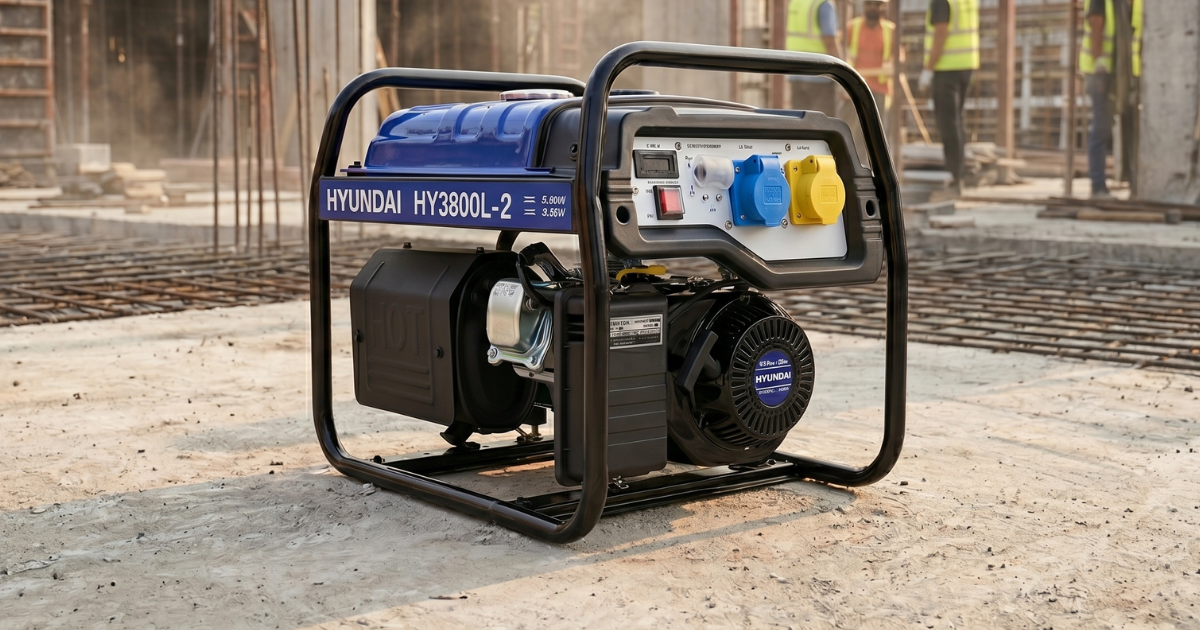
Hyundai HY3800L-2 Review - 3.2kW Petrol Site Generator Expert UK Verdict 2026
A strong machine at the price, held back from a perfect score by the missing wheel kit (a real daily frustration at 45.7kg for solo workers) and recoil-only start. Both are honest, specific limitations rather than general caution.
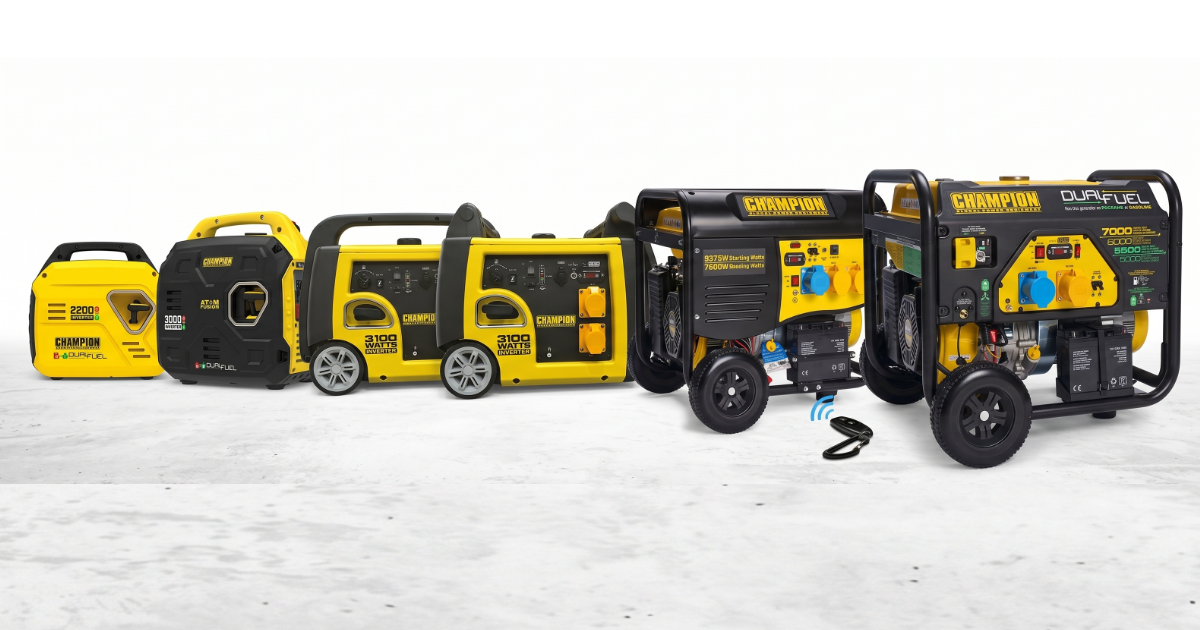
Champion Generator Buying Guide
Which Champion generator is right for you? Camping, caravan, home backup or trade - a plain-English guide to every model in the range
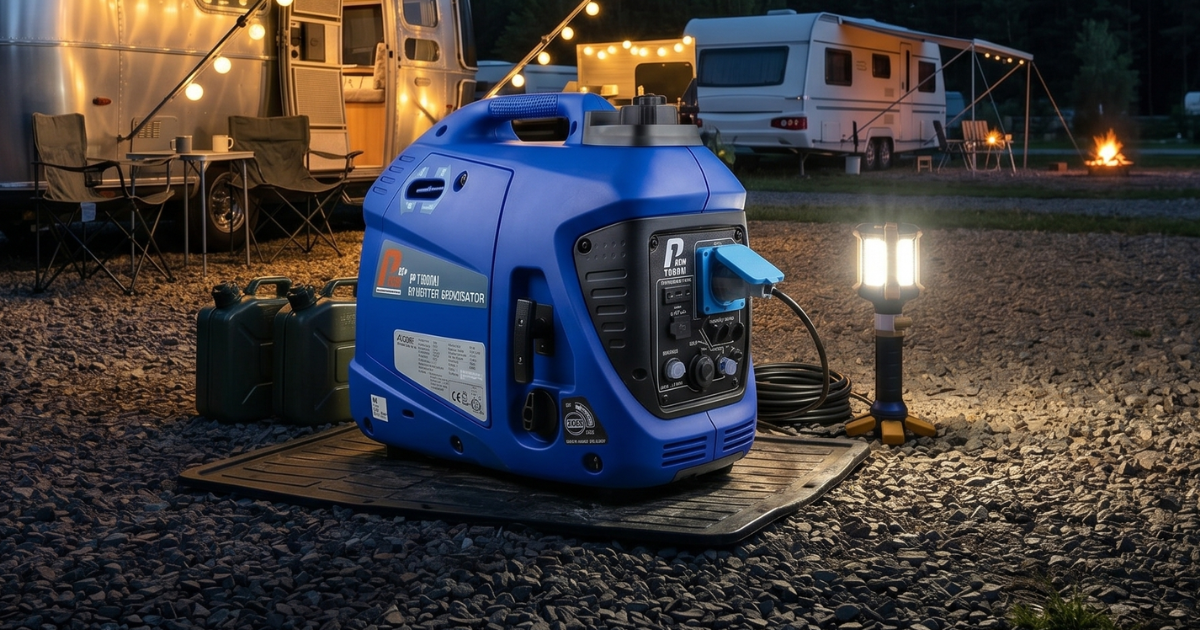
P1 P1000i 1000W Petrol Inverter Suitcase Generator Review
The P1 P1000i is a lightweight and affordable inverter generator designed for low-power applications. It’s ideal for charging electronics and running small appliances while camping, but its limited output means it won’t handle high-demand devices.
Hyundai DHY18COM-1 Review: 17kW / 20.4kVA* Compact Diesel Generator, S 1500rpm, Single Phase
A compact, professionally specified 17kW diesel generator with a 4-cylinder water-cooled engine, DSE6120 MKIII control panel, AVR alternator, ATS compatibility, and red diesel approval - engineered for prime power and serious standby use.
Hyundai Inverter Generator Buying Guide (2026)
Discover the latest Hyundai inverter generator range for 2026 in this comprehensive buying guide, covering everything from ultra-portable camping models to powerful home backup units. Whether you need quiet, fuel-efficient power for caravans, van life, or off-grid living, Hyundai’s inverter generators deliver clean pure sine wave electricity for safe use with sensitive electronics. Explore detailed comparisons, key specifications, and expert mini-reviews to help you choose the perfect generator for your needs.
Gorilla Power GP8300E-DF Review (2026) - 8.3kW Dual-Fuel Generator
Gorilla Power GP8300E-DF delivers 8kW true sine wave, dual fuel, and remote start for serious whole-home or site backup power in the £900–£1,100 bracket.