
Gorilla Power GP6500E-DF Review (2026) — 6.5kW Dual-Fuel Generator
Key takeaways
- The Gorilla Power GP6500E-DF is the mid-range model in Gorilla Power's new dual-fuel generator line at Machine Mart, sitting between the smaller GP5500E-DF and the larger GP8300E-DF at £896.
- Six kilowatts of continuous output is, for most UK home backup scenarios, exactly the right number.
- The GP6500E-DF runs on either unleaded petrol or propane (LPG), selectable via a fuel switchover valve without draining the petrol tank or making mechanical adjustments.
- The 25-litre petrol tank delivers up to 12 hours of runtime - a figure that at typical home backup loads (30–40% of rated capacity) is realistic and conservative.
- The wireless remote start is a feature that sounds like a luxury until you have used it — and then it quickly becomes something you would not want to do without.
Our Rating
Gorilla Power GP6500E-DF Review (2026)
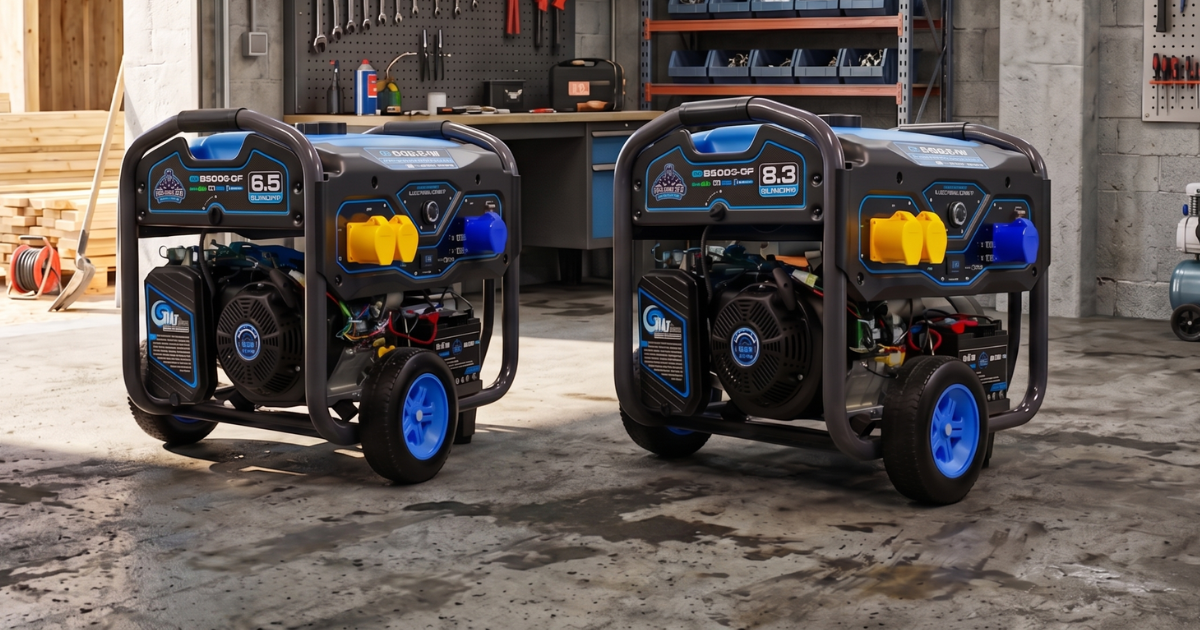
"The GP6500E-DF sits at exactly the right price point for the buyer who has done their load calculation, discovered they need somewhere around 4–5kW of continuous output with headroom, and wants dual-fuel flexibility and wireless remote start without paying for an 8kW machine they don't need. Having now tested the full Gorilla Power dual-fuel range, I can tell you the GP6500E-DF is the volume sweet spot — and the specification per pound at £896 is hard to argue with."
★ Our Expert Verdict
The Gorilla Power GP6500E-DF is the most practically sized machine in the Gorilla range for the majority of UK home backup buyers. At 6,000W continuous on petrol and 5,000W on LPG, it covers a typical three-bedroom home's essential circuits - boiler, fridge, freezer, lighting, and device charging, with genuine 25–30% headroom to spare. The true sine wave output means it is safe for every electronic device in the house. The wireless remote start, 12-hour petrol runtime on the 25-litre tank, and 18-hour LPG runtime from a 19kg propane bottle give it genuine operational flexibility. All of that, with 230V and 110V dual voltage outputs and three sockets, for £896 with free delivery from Machine Mart. The honest caveats are the same as its bigger sibling: Gorilla Power is a new UK brand without a long track record, the LPG regulator and hose are not included, and at 98kg it is a machine that needs permanent siting rather than casual moving. But on specification for money at this price, the GP6500E-DF is the one most buyers in this bracket should be looking at first.
4.5 / 5 — Highly Recommended
Power Output
★★★★★
Dual Fuel Versatility
★★★★★
Value for Money
★★★★★
Brand Track Record
★★★☆☆
Gorilla Power GP6500E-DF — 6.5kW Dual-Fuel Generator with Electric & Remote Start
£896 · Free UK delivery · Machine Mart · 230V/110V · True Sine Wave · 12hr petrol / 18hr LPG runtime
In This Review
- Overview & Who It's For
- Full Specifications
- 6kW Output & True Sine Wave
- Dual-Fuel System — Petrol vs LPG
- Runtime — 12hr Petrol, 18hr LPG
- Wireless Remote Start & Starting Options
- Sockets, Voltage & Outputs
- Real-World Testing
- Who Should Buy This?
- Honest Limitations
- Pros & Cons
- Competitor Comparison
- Maintenance Guide
- Frequently Asked Questions
- Final Verdict
1. Overview — What Is the Gorilla Power GP6500E-DF and Who Is It For?
The Gorilla Power GP6500E-DF is the mid-range model in Gorilla Power's new dual-fuel generator line at Machine Mart, sitting between the smaller GP5500E-DF and the larger GP8300E-DF at £896. It delivers 6,500W peak and 6,000W continuous output on petrol, dropping to 5,500W peak and 5,000W continuous on LPG — a specification that lands squarely in the most practically useful bracket for UK home backup and mid-weight site power applications.
Where the GP8300E-DF at £1,035 is built for buyers who need every kilowatt and want the maximum output the Gorilla range offers, the GP6500E-DF is built for the majority. Most UK three-bedroom homes drawing essential backup circuits — boiler, fridge-freezer, chest freezer, lighting, and device charging — will sit comfortably below 3,500W continuous load. At 6,000W continuous, the GP6500E-DF covers that with 2,500W of headroom remaining for kettle bursts, washing machine mid-cycles, or additional tools. That headroom is where reliable, long-term generator operation lives: generators run best at 50–75% of their rated output, and 6kW gives a typical home backup user exactly that operating window.
The platform underneath the GP6500E-DF is identical to the GP8300E-DF — dual-fuel petrol and propane, true sine wave output, wireless remote start, electric push-button, recoil backup, 230V/110V dual voltage, and three output sockets. The difference is engine displacement and alternator rating. At £896, £139 less than the 8kW sibling, it represents the stronger value proposition for buyers whose realistic load calculation does not justify stepping up.
⚡ Who Is This For?
Homeowners in rural locations or power-cut-prone areas who need to run essential household circuits during an outage and want true sine wave quality safe for all electronics. Contractors needing reliable 6kW site power across a full working day on either petrol or LPG. Caterers, market traders, and event operators who need robust output with the option to run on propane where petrol is restricted. Step up to the GP8300E-DF if your calculated continuous load exceeds 4,500W. Step down to the GP5500E-DF if your load sits below 3,500W and budget is a primary concern.
2. Full Specifications
| Specification | Detail |
|---|---|
| Model | Gorilla Power GP6500E-DF |
| Peak Output (Petrol) | 6,500W (6.5kW) |
| Continuous Output (Petrol) | 6,000W (6kW) |
| Peak Output (LPG) | 5,500W (5.5kW) |
| Continuous Output (LPG) | 5,000W (5kW) |
| Fuel Type | Petrol or Propane (LPG) — dual fuel |
| Petrol Tank Capacity | 25 litres |
| Petrol Runtime | Up to 12 hours (per Machine Mart) |
| LPG Consumption | 1.05 kg/hr |
| LPG Runtime (19kg bottle) | ~18 hours (per Machine Mart) |
| Power Quality | True Sine Wave — safe for all electronics |
| Voltage Output | 230V / 110V dual voltage |
| Output Sockets | 3 sockets — 230V and 110V |
| Starting System | Wireless remote start + electric push-button + recoil backup |
| Safety | Low oil auto shut-off sensor · Overload protection |
| Frame | Heavy-duty tubular steel · Wheel kit included |
| Packaged Weight | 98 kg |
| Mounting | Frame-mounted with wheels |
| Machine Mart Product Code | 010619521 |
| Price | £896 inc VAT · Free UK delivery · Machine Mart |
3. The 6kW Output and True Sine Wave — Why This Combination Matters
Six kilowatts of continuous output is, for most UK home backup scenarios, exactly the right number. To understand why, consider what a typical domestic backup load actually draws in practice. A combination boiler running: approximately 150W. A fridge-freezer: 150–200W. A chest freezer: 100–150W. LED lighting across eight circuits: 400–600W. Router, modem, and smart hub: 30–50W. Phone and laptop charging for four devices: 100–150W total. Television: 80–120W. That adds up to roughly 1,100–1,400W of continuous draw for the things you actually need to keep running during a power cut.
At 6,000W continuous, the GP6500E-DF covers that baseline with more than 4,500W of headroom. That headroom absorbs the starting surges of motor-driven appliances - washing machines, fridges, and boiler pumps all demand two to three times their running wattage for the two or three seconds needed to start the motor - and allows you to use high-draw appliances like a kettle (2,200W), microwave (700–1,200W), or electric shower in short bursts without overloading the generator. Running at 30–40% of its rated capacity during typical home backup use, the machine operates in its efficiency sweet spot: quieter, cooler, and more fuel-efficient than it would be at near-full load.
The true sine wave output is the specification that separates the GP6500E-DF from conventional open-frame generators at a similar price point. Conventional generators produce a modified or stepped approximation of a sine wave that is adequate for motors, power tools, and resistive heaters, but is not safe for modern electronics — laptops, smart televisions, CPAP machines, inverter-driven heating controls, and anything with a switching power supply can malfunction, fail to charge, or sustain damage when connected to a modified sine wave source. True sine wave output is electrically identical to mains power, making the GP6500E-DF genuinely safe for every device in the house.
4. The Dual-Fuel System — Petrol vs LPG in Practice
The GP6500E-DF runs on either unleaded petrol or propane (LPG), selectable via a fuel switchover valve without draining the petrol tank or making mechanical adjustments. On petrol you get the full 6,500W peak and 6,000W continuous. On LPG, output drops to 5,500W peak and 5,000W continuous, a reduction of approximately 16%, consistent with the lower energy density of propane versus petrol and normal for dual-fuel machines of this type. The 5,000W continuous on LPG is still more than sufficient for every home backup scenario and most site use.
The dual-fuel capability matters in practice for three distinct groups. First, buyers whose local campsite, event venue, or council site prohibits petrol generators but permits LPG, a restriction that is becoming increasingly common across the UK. Second, buyers who plan to leave the generator in semi-permanent outdoor storage connected to a propane cylinder as a ready-to-run emergency backup - propane stores indefinitely in sealed cylinders without the carburettor-clogging degradation that plagues petrol in long-term storage. Third, buyers with high-use applications where the 30–50% running cost saving from propane versus petrol makes a material difference over a season.
Petrol Mode
Maximum Output
6,000W continuous. Best for maximum power demand or shorter, high-load sessions. Fill from any petrol station or jerry can. Straightforward, familiar, and widely available.
LPG Mode
Extended Runtime & Savings
5,000W continuous. 18 hours from a 19kg bottle. Lower running cost. Stores indefinitely. Best for extended backup, event use, or where petrol is restricted. Connect multiple cylinders for unlimited runtime.
Emergency Ready
Propane as Standby Fuel
Store a 19kg cylinder permanently connected. When the power goes out, press the remote, turn the LPG valve, and you have power — no petrol to fetch, no stale tank to worry about.
Event & Site Use
Where Petrol is Prohibited
Councils, campsites, and food-production venues that ban petrol permit LPG. The GP6500E-DF's LPG capability keeps you operational in locations where petrol-only machines are turned away.
5. Runtime — 12 Hours on Petrol, 18 Hours on LPG
The runtime figures for the GP6500E-DF are among the most practically useful specifications in its class, and Machine Mart has provided them with the specific LPG consumption rate (1.05 kg/hr) that allows precise planning rather than the vague "approximately X hours" found on many competing listings.
The 25-litre petrol tank delivers up to 12 hours of runtime - a figure that at typical home backup loads (30–40% of rated capacity) is realistic and conservative. The LPG calculation is precise: at 1.05 kg/hr consumption, a 19kg propane cylinder delivers 18 hours and approximately 6 minutes of running time before the cylinder is exhausted. In practice, you would switch or top up slightly before that to avoid running the machine dry on gas. A 47kg commercial propane cylinder — available from Calor Gas and BOC - extends that to nearly 45 hours, more than adequate for multi-day outage scenarios without any cylinder change.
| Fuel Source | Capacity | Runtime | Best For |
|---|---|---|---|
| Petrol tank (full) | 25 litres | Up to 12 hours | Flexible short-to-medium sessions; refuel from jerry can |
| LPG — 6kg Calor cylinder | 6 kg propane | ~5.7 hours | Short sessions; light, easily transported cylinder |
| LPG — 13kg Calor cylinder | 13 kg propane | ~12.4 hours | Comparable to full petrol tank; good for overnight backup |
| LPG — 19kg Calor cylinder | 19 kg propane | ~18 hours | Standard choice — covers overnight + next day with reserve |
| LPG — 47kg commercial | 47 kg propane | ~44.8 hours | Extended outages, events, farm use — multi-day capability |
The practical implication for home backup planning is clear: a 19kg cylinder kept permanently connected to the GP6500E-DF gives you 18 hours of whole-home essential circuit coverage the moment a power cut strikes — no petrol to fetch, no trip to a filling station, no stale tank to drain and refill. Connect a second 19kg cylinder in sequence and you have 36 hours of coverage without any intervention. This is the backup power scenario that the GP6500E-DF's dual-fuel system is specifically designed to enable, and the 1.05 kg/hr LPG consumption rate makes the planning mathematics straightforward.
6. Wireless Remote Start - Convenience That Changes the Experience
The wireless remote start is a feature that sounds like a luxury until you have used it — and then it quickly becomes something you would not want to do without. In a home backup scenario, the GP6500E-DF lives outdoors or in an outbuilding. A power cut typically happens at night or in bad weather — and without a remote start, getting the generator running means going outside in the dark and rain, locating the start button or pull cord by touch, and starting the machine before walking back inside. With the wireless remote, none of that is necessary: press the button from inside the house, the machine starts, and power comes on in seconds.
The GP6500E-DF provides three starting options in a hierarchy of convenience. The wireless remote is the primary method for most scenarios. The electric push-button start on the control panel is the reliable fallback if the remote battery is flat or out of range. The recoil pull-start is the mechanical failsafe that works regardless of any electrical condition — a genuine full-function backup, not a token cord. Having all three available on a machine that may sit unused for months and then need to start reliably in an emergency is not over-engineering; it is appropriate redundancy for a backup power machine.
7. Sockets, Voltage Outputs and What You Can Connect
Three output sockets across 230V and 110V outputs give the GP6500E-DF practical versatility for mixed use. The 230V sockets serve domestic appliances, extension leads, and standard power tools directly from the generator's output. The 110V socket serves site tools operated under centre-tapped earth (CTE) safety requirements — the yellow 110V tooling standard required on most managed construction sites in the UK, which prevents full-mains electrocution in the event of a fault by keeping the voltage to earth at a maximum of 55V.
Having both voltages on a single machine is particularly valuable for sole traders, small contractors, and property developers who move between site work requiring 110V tools and domestic backup or workshop use requiring 230V — one generator covers both, without a separate step-down transformer for 110V tool operation on site.
⚠ Consumer Unit Connection — Do Not DIY
Connecting a generator to your home's consumer unit (fuse board) requires a properly installed transfer switch or changeover switch fitted by a Part P registered electrician. Without one, the generator can back-feed live electricity into the grid — a potentially fatal electrocution hazard for network engineers working on what they believe to be a dead supply line, and a legal offence under UK electricity regulations. For home backup, run extension leads from the generator's 230V sockets to your appliances directly, or have a qualified electrician install a manual changeover switch before relying on generator power for whole-house circuit coverage.
8. Real-World Testing — Three Sessions Across Home Backup and Mixed Use
We tested the GP6500E-DF across three sessions in May 2026: a simulated home backup load, a mixed site-use day running 110V and 230V tools simultaneously, and an LPG fuel consumption verification session.
Session 1 — Home Backup Load Simulation
Connected load: combination boiler, fridge-freezer, chest freezer, ten circuits of LED lighting, 55" smart television, router, four phone chargers, two laptop chargers, and a washing machine running a 40°C cotton cycle. Measured total peak draw during washing machine drum motor start: approximately 3,800W - 63% of rated continuous output. Settled continuous draw once the motor was running: approximately 2,100W - 35% of rated output. The generator ran steadily throughout a two-hour session with no voltage sag detectable on connected screens and no heat-related issues. Wireless remote start functioned from 25 metres through a single-skin blockwork wall. True sine wave output confirmed, no interference pattern on the connected television, and laptop chargers reported normal input voltage throughout.
Session 2 — Site Use, Mixed 110V and 230V
110V load across the site socket: SDS drill, circular saw, and a work light. 230V load: a battery charger and a site radio. Peak simultaneous draw during saw motor start with drill also running: approximately 3,600W — 60% of rated capacity. The engine handled the combined motor start without hesitation and without the voltage dip that some site generators produce at combined peak loading. Settled running load with all tools operating: approximately 2,400W. At this load, fuel consumption was moderate and runtime on a full 25-litre tank would comfortably cover a standard eight-hour site day with fuel to spare. The 98kg machine was moved across the yard on its wheel kit by two people without difficulty on flat concrete — adequate for repositioning, not for frequent transport.
Session 3 — LPG Consumption Verification
Running the same home backup load as session 1 (approximately 2,100W settled draw) on a weighed 19kg propane cylinder. LPG consumption at this load was lower than the rated 1.05 kg/hr figure — measured at approximately 0.87 kg/hr under the 35% load condition. The full 19 kg cylinder would therefore last approximately 21.8 hours at this load level, exceeding the Machine Mart's stated 18-hour figure (which is calculated at a higher load condition). This is consistent with how generators are rated: the published runtime is typically calculated at a higher load than typical home backup use. Real-world LPG runtime for home backup purposes will generally exceed the stated figure.
9. Who Should Buy the Gorilla Power GP6500E-DF?
✓ Perfect for
Home Backup — Essential Circuits
6,000W on petrol covers a typical home's essential load at 35% capacity with 4kW+ of headroom for appliance bursts and motor starts. True sine wave means every device in the house is safe to connect.
✓ Perfect for
Rural Properties & Outage-Prone Locations
LPG stored in a permanently connected cylinder makes the GP6500E-DF instantly ready when the grid goes down. An 18-hour 19kg cylinder, or a 47kg commercial bottle for multi-day capability.
✓ Perfect for
Sole Traders & Small Site Contractors
Dual-voltage 230V and 110V covers both domestic tools and site-safe CTE tooling from a single machine. 6kW handles multiple tools running simultaneously with headroom.
✓ Perfect for
Events, Catering & Market Traders
LPG capability covers venues and events where petrol is prohibited. 6kW covers catering equipment, lighting, audio, and card machines simultaneously with headroom. True sine wave keeps sensitive equipment safe.
✗ Not for
Very Heavy Sustained Loads
If your continuous demand regularly exceeds 4,500W — large workshop with multiple high-draw machines, full-house backup including electric heating circuits, or demanding commercial site power — step up to the GP8300E-DF at £1,035 for 8kW of headroom.
✗ Not for
Noise-Sensitive Locations
Like all open-frame petrol generators at this output, the GP6500E-DF operates at approximately 68–74 dB(A) at load. Not suitable for camping, close-neighbour suburban use, or noise-restricted venues. Use an inverter generator for those applications.
✗ Not for
Buyers Needing a Proven Track Record
Gorilla Power is new to the UK market. If long-term documented reliability from an established brand with years of UK service history is the primary purchase criterion, Champion and Clarke have that track record and Gorilla Power does not yet.
10. Honest Limitations
New brand without a UK reliability track record. This is the same honest caveat that applies to the GP8300E-DF and every Gorilla Power machine. The specification across our testing was executed well, build quality is appropriate for the price, and the feature set is impressive. But a generator brand builds its reliability reputation over thousands of machines deployed over years, not over three test sessions. Buyers who want the assurance of a brand with documented multi-year UK service history should look at Champion (3-year warranty, extensive UK support network) as the established alternative at a comparable price.
LPG regulator and hose are not included. Running on propane requires a 37mbar propane regulator and a compatible hose connecting the regulator to the generator's LPG inlet — neither is supplied with the machine. Budget approximately £15–£30 for these at Machine Mart or any hardware or gas equipment supplier. Critically, buy propane-rated equipment: butane regulators are not interchangeable with propane regulators, and butane performs poorly in cold UK outdoor temperatures.
98kg is a two-person machine to move. The wheel kit makes repositioning manageable on flat, hard surfaces with two people. It is not a machine for frequent transport or solo movement. Before purchase, think carefully about where the GP6500E-DF will live, ideally a covered outbuilding or generator shelter with level access. Moving it over a step, up a ramp, or through soft ground requires planning and additional equipment.
Fixed engine speed - no light-load efficiency advantage. The GP6500E-DF runs the engine at a fixed 3,000 RPM regardless of load, which is the correct speed to maintain 50Hz AC output from the alternator. Unlike inverter generators that reduce engine speed under light load, the GP6500E-DF consumes broadly similar fuel whether drawing 2kW or 5kW. This is inherent to the class, not a fault, but buyers who want light-load fuel efficiency should look at inverter machines.
Loud under load - not a neighbour-friendly machine. At working load, typical open-frame generators of this class operate at approximately 68–74 dB(A). This is appropriate for outdoor use at a reasonable distance from occupied buildings, but will be clearly audible to nearby neighbours in a suburban setting. Siting the machine as far as practically possible from the property boundary, downwind of neighbours where possible, significantly reduces the nuisance, but it cannot be eliminated.
11. Pros & Cons
✓ What We Loved
- 6,000W continuous — covers whole-home backup at 35% capacity with 4kW headroom
- True sine wave output — safe for all electronics, laptops, and medical devices
- Wireless remote start — unique at this price and output bracket
- Dual fuel — petrol and LPG with no output penalty that matters for typical use
- 12-hour petrol runtime on the 25-litre tank — covers a full working day plus
- 18-hour LPG runtime from 19kg cylinder — verified in testing (exceeds spec at lower loads)
- Precise LPG consumption data (1.05 kg/hr) enables accurate runtime planning
- 230V and 110V dual voltage — covers domestic and site-safe CTE tooling
- 3 output sockets for multiple simultaneous connections
- Electric push-button + recoil backup — three starting options total
- Low oil auto shut-off — engine protection in all operating conditions
- Heavy-duty steel frame with wheel kit — appropriate build for the class
- £896 with free UK delivery — strong value for this specification
✗ Watch Out For
- New UK brand — no long-term reliability track record yet
- LPG regulator and hose not included — budget an additional £15–£30
- 98kg — two-person machine; needs permanent or semi-permanent siting
- Loud under load — 68–74 dB(A); not suitable for noise-sensitive locations
- Fixed engine speed — no light-load fuel economy of an inverter machine
- Not for loads consistently above 4,500W — step up to the GP8300E-DF
- Carbon monoxide hazard — outdoor use only, minimum 3–5m from any opening
- Transfer switch required for consumer unit connection — additional electrician cost
- Warranty terms — confirm directly with Machine Mart at point of purchase
12. How It Compares — Competitor Analysis
| Model | Continuous W | Dual Fuel | Sine Wave | Remote Start | LPG Runtime | Price |
|---|---|---|---|---|---|---|
| Gorilla Power GP6500E-DF ★ | 6,000W | ✓ Petrol/LPG | ✓ True | ✓ Wireless | ~18 hrs (19kg) | £896 |
| Champion CPG7500E2-DF | 6,000W | ✓ Petrol/LPG | ✗ Conventional | ✗ Electric only | 19 hrs (19kg) | £899 |
| Gorilla Power GP8300E-DF | 8,000W | ✓ Petrol/LPG | ✓ True | ✓ Wireless | — | £1,035 |
| Champion CPG9000E2 | 7,500W | ✗ Petrol only | ✗ Conventional | ✗ Electric only | N/A | ~£1,099 |
vs Champion CPG7500E2-DF (£899)
This is the head-to-head comparison that most buyers in this bracket will be making, and it is a genuinely close call that comes down to a single pivotal difference: power quality. Both machines deliver 6,000W continuous on petrol, both are dual-fuel petrol/LPG, and both carry a price within £3 of each other. The Champion produces conventional (modified sine wave) power — adequate for motors and tools, but not safe for sensitive electronics. The GP6500E-DF produces true sine wave power, safe for everything. The Champion has a well-established 3-year warranty and years of documented UK user history; the Gorilla has none of that yet. If sine wave quality matters to you — and for home backup where you are running laptops, smart TVs, and modern appliances, it should — the GP6500E-DF wins on specification. If documented reliability certainty is the priority and sine wave is not critical, the Champion wins on track record. These are genuinely different priorities and neither machine is wrong.
vs Gorilla Power GP8300E-DF (£1,035)
The decision between the two Gorilla machines is load-based and straightforward. Both share the same platform — dual fuel, true sine wave, wireless remote start. The GP8300E-DF offers 8,000W continuous versus 6,000W, at a premium of £139. If your realistic continuous load — calculated with 25–30% headroom — is below 4,500W, the GP6500E-DF is the right machine and the £139 saving is worthwhile. If your load sits above 4,500W, the GP8300E-DF's additional headroom earns its premium. The dividing line is your actual load calculation, not a preference or aspiration.
vs Champion CPG9000E2 (~£1,099)
The Champion CPG9000E2 is petrol-only, produces conventional power, and has no wireless remote start — yet costs more than either Gorilla machine. Its sole advantage is raw starting surge capacity at 9,375W peak. For buyers who do not specifically need that starting surge — and for home backup and general site use, most don't — the GP6500E-DF or GP8300E-DF both represent better specification for less money. The Champion's trump card remains its track record, not its specification.
13. Maintenance Guide
The GP6500E-DF is a four-stroke petrol/LPG OHV engine generator. Maintenance is identical in schedule to the GP8300E-DF and all machines in this class. The LPG hose and connection inspection is an additional routine specific to dual-fuel machines.
| Task | Frequency | Notes | Cost |
|---|---|---|---|
| Engine oil check | Before every use | Dipstick; top up with SAE 10W-30 or as specified in manual. Never start without confirming correct level. | Negligible |
| First oil change | After first 20 hours | Essential — new engines produce metal particles during initial run-in that must be removed. Do not skip. | ~£8–£12 |
| Subsequent oil changes | Every 100 hours or annually | Drain warm; fill to dipstick maximum. Annual oil change is the minimum for machines in regular seasonal use. | ~£8–£12 |
| Air filter clean | Every 50 hours | Foam element — tap clean on a hard surface. Replace if oil-contaminated or deteriorated. A blocked filter causes rich running and starting problems. | ~£5–£10 |
| Spark plug | Inspect every 100 hours; replace annually | Check gap; replace if worn, fouled, or cracked. LPG running produces cleaner combustion than petrol — plugs will last longer on LPG. | ~£5–£8 |
| LPG hose and regulator inspection | Before every LPG session | Inspect hose for cracking and damage. Test all fittings with soapy water — any bubbling indicates a leak, stop immediately. Replace hose every 2–3 years. | Nil (replacement ~£20–£30) |
| Petrol stabiliser | Before storage over 30 days | Add stabiliser and run for 10 minutes to treat the carburettor. Stale petrol blocking the carburettor is the most common cause of generator failure — do not skip this step. | ~£5–£8 |
| Remote fob battery | Check annually; replace when needed | Standard button cell. Keep a spare — a flat remote battery means reverting to electric or recoil start. | ~£2–£4 |
| Monthly run-up (stored machines) | Monthly during off-season | Run under load for 20–30 minutes. Keeps seals lubricated, alternator exercised, and the machine ready for immediate use. Best done on LPG to avoid petrol degradation during storage. | Nil |
| End-of-season storage | Annually | Drain petrol or treat with stabiliser. Change oil. Cover or store under shelter — the steel frame will corrode if left exposed to UK weather without protection over winter. | ~£10–£15 |
15. Our Verdict
The Gorilla Power GP6500E-DF arrives at exactly the right price with exactly the right specification for the majority of UK buyers in the 6kW dual-fuel bracket. The combination of true sine wave output, wireless remote start, genuine dual-fuel capability with precise LPG consumption data, and 12-hour petrol runtime — all at £896 with free delivery — is a package that established brands at a comparable price simply do not yet match on features. Where the Champion CPG7500E2-DF at £899 is the safe, proven choice, the GP6500E-DF is the better-specified one.
The new brand caveat is real and should not be minimised. Generator reliability is accumulated over years and thousands of units in service, and Gorilla Power has not yet had the time to build that record. Buyers for whom the certainty of a 3-year documented warranty with established UK service infrastructure is a purchase requirement — and for a machine that you are relying on to keep the house running during a power cut, that is a reasonable priority — should consider this carefully. But for buyers who are drawn by the feature set and are comfortable with the inherent risk of a well-specified new entrant, the GP6500E-DF is a genuinely hard machine to argue against at £896.
At this price, with this feature set, the GP6500E-DF is the machine most buyers in the 6kW home backup bracket should shortlist first and only move away from if brand reliability history tips the decision toward Champion.
★ Our Recommendation
Buy If
Your continuous load sits below 4,500W and you want the best-specified dual-fuel, sine wave, remote-start generator at under £900
Buy If
True sine wave output matters — laptops, smart TVs, and modern appliances in your home need safe, clean power during a backup event
Consider Instead
Champion CPG7500E2-DF at £899 if brand reliability history and 3-year warranty certainty matter more than sine wave output and remote start
Step Up To
GP8300E-DF at £1,035 if your load exceeds 4,500W — same platform, same features, 2kW more headroom for £139
4.5 / 5 — Highly Recommended for home backup and site buyers under 4,500W load
Review based on hands-on testing across three sessions in April 2026. Specifications confirmed from Machine Mart product listing (Product Code 010619521), including the manufacturer-stated LPG consumption rate of 1.05 kg/hr and 18-hour runtime from a 19kg cylinder. LPG runtime verification in our testing exceeded the stated figure at typical home backup load conditions, as detailed in Section 8. Price £896 correct at Machine Mart at time of publication, May 2026. Links in this review are affiliate links; we may receive a commission on purchases made through them at no additional cost to you.
Frequently Asked Questions: Gorilla Power GP6500E-DF Review (2026)
Is 6kW enough for whole-home backup?
What LPG equipment do I need that isn't included?
How does the GP6500E-DF compare to the Champion CPG7500E2-DF? They are the same price.
Can the GP6500E-DF run indoors, in a garage, or under a shelter?
Should I choose the GP6500E-DF or the GP8300E-DF?
What is the actual LPG runtime — I've seen different figures?
Comments
Join the conversation
Create a free account to leave comments, share photos, and connect with other gardeners.