
Air Compressor Buyer’s Guide for 2026
Air Compressor Buyer’s Guide UK 2026: Learn CFM, PSI, tank sizes and the best compressor for DIY, garages and workshops.
Key takeaways
- ⚡ Quick Answer For most UK DIYers and home garages, a 24–50 litre oil-free silent compressor with 3–5 CFM FAD handles tyre inflation, nailers and airbrushing comfortably.
- CFM stands for Cubic Feet per Minute and measures how much air your compressor can deliver continuously.
- Pressure - measured in PSI (pounds per square inch) or Bar - describes the force of the compressed air.
- Tank size is measured in litres and determines your air reserve — how long you can work before the pump needs to cycle on again.
- UK buyers will encounter four main compressor designs in the domestic and light-commercial market.
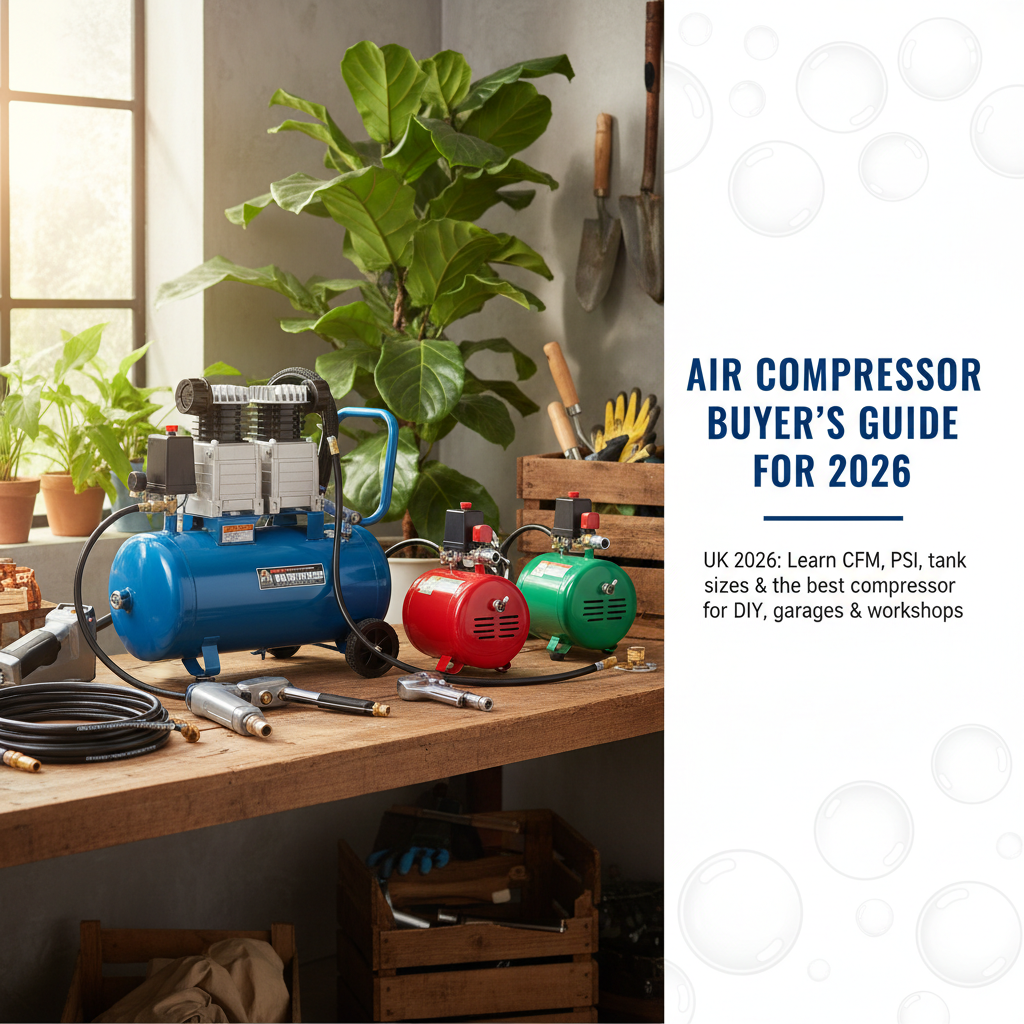
Air Compressor Buyer's Guide UK 2026
Everything you need to choose the right air compressor for UK garages, workshops and trades in 2026 - from understanding CFM, PSI and tank size to comparing drive types, noise levels, UK regulations, and which machine suits which job.
⚡ Quick Answer
For most UK DIYers and home garages, a 24–50 litre oil-free silent compressor with 3–5 CFM FAD handles tyre inflation, nailers and airbrushing comfortably. For a working garage or workshop running impact wrenches and spray guns, you need a 50–150 litre belt-drive oil-lubricated machine with 8–14 CFM. For professional bodyshops or running multiple tools simultaneously, step up to a 150–200 litre two-stage belt-drive or rotary screw compressor. In every case: match CFM first, then choose tank size — not the other way around.
In This Guide
- CFM - The Spec That Actually Matters
- PSI & Bar - Pressure Explained
- Tank Size - How Much Do You Need?
- Types of Air Compressor
- Oil-Lubricated vs Oil-Free
- Noise Levels & UK Regulations
- UK Power Supply & Voltage
- CFM Tool Requirements Chart
- Budget Guide by User Type
- UK Legal Requirements
- 5 Mistakes to Avoid
- Maintenance & Running Costs
- Frequently Asked Questions
1. CFM - The Spec That Actually Matters Most
CFM stands for Cubic Feet per Minute and measures how much air your compressor can deliver continuously. It is, without question, the most important specification to understand - and the one most UK buyers either misunderstand or ignore in favour of tank size and horsepower figures that are more prominently marketed.
The clearest way to understand it: your tank is a reservoir, and CFM is the flow rate. A large tank with insufficient CFM is like a swimming pool with a tap - once the air in the tank is used up, you wait while the pump slowly refills it. With adequate CFM, the pump can keep up with your tool's demand in real time. This is the difference between a compressor that feels effortless to work with and one that forces you to stop every 30 seconds.
Displacement CFM vs Free Air Delivery (FAD)
There are two CFM figures you will encounter, and the distinction is critical:
Displacement CFM
The theoretical maximum output if the pump were 100% efficient. Always higher than reality. Often the figure used in marketing. Do not base your buying decision on this number alone.
Free Air Delivery (FAD)
The actual volume of air delivered at a specified working pressure. Typically 60–75% of displacement CFM. This is the figure to match against your tool requirements.
As a rule of thumb: a compressor with a displacement CFM of 14 will have a FAD of approximately 8–10 CFM at 6 bar. Always ask for, or look for, the FAD figure - and if a manufacturer only quotes displacement, apply a 65–70% conversion to estimate real-world output.
ⓘ Duty Cycle — The Hidden CFM Multiplier
Duty cycle is the percentage of time a compressor can run continuously before needing to rest. Most oil-free direct-drive compressors run at 50% duty cycle - meaning for every minute running, they need a minute off. A belt-drive machine typically achieves 80–90% duty cycle. To find the continuous CFM output: multiply FAD by the duty cycle. Example: 10 CFM FAD at 50% duty cycle = 5 CFM continuous. A belt-drive at 10 CFM FAD and 85% duty cycle = 8.5 CFM continuous. This explains why a belt-drive machine with the same headline CFM outperforms a direct-drive unit in sustained use.
2. PSI & Bar - Pressure Explained
Pressure - measured in PSI (pounds per square inch) or Bar - describes the force of the compressed air. In the UK you'll encounter both units: bar is the more common technical measurement, PSI is widely used in tool specifications, particularly from US-designed products.
Conversion: 1 bar = approximately 14.5 PSI. A compressor rated at 8 bar delivers approximately 116 PSI. For a quick mental conversion, multiply bar by 15 to get a close PSI approximation.
Most pneumatic hand tools require 5–7 bar (70–100 PSI) to operate correctly. The compressor's maximum pressure should exceed the tool's working pressure - you use a regulator to reduce the output to the correct working pressure for each tool. A compressor rated at 8 bar (116 PSI) covers every common pneumatic tool with room to spare. You only need higher pressures (10+ bar / 145+ PSI) for specific applications like professional spray painting, sandblasting, or two-stage compression.
| Max Pressure | PSI Equivalent | Typical Use |
|---|---|---|
| 6 bar | ~87 PSI | Nailers, tyre inflation, blow guns — adequate for light tools |
| 8 bar | ~116 PSI | All common workshop tools — the sweet spot for most UK buyers |
| 10 bar | ~145 PSI | Spray guns, sandblasting, professional garage use |
| 14+ bar | ~200+ PSI | Two-stage industrial compressors — commercial/industrial only |
3. Tank Size - How Much Do You Actually Need?
Tank size is measured in litres and determines your air reserve — how long you can work before the pump needs to cycle on again. It is the second most important specification (after CFM) and the one most overemphasised by marketing. A very large tank with insufficient CFM will empty faster than the pump can refill it; a modest tank with adequate CFM will feel effortless in use.
The relationship between tank and CFM is this: the tank stores your buffer. For intermittent tools — nailers that fire a shot every few seconds — a smaller tank with good CFM is fine because the tank refills between shots. For continuous tools — spray guns, sanders, grinders that draw air constantly — you need a larger tank and enough CFM to replenish it faster than the tool drains it. Tank size alone does not solve a CFM deficit.
6–24 Litres
Home & Portable
Tyre inflation, blow guns, small nail guns, airbrushing. Lightweight and portable. Not suitable for spray guns or sustained air tool use. Ideal price: £60–£250.
50 Litres
Home Workshop
Impact wrenches, larger nail guns, intermittent spray painting (touch-ups), general garage use. The sweet spot for serious DIY. Ideal price: £150–£400.
100–150 Litres
Professional Workshop
Sustained spray painting, DA sanders, air chisels, running two tools. Working garages, bodyshops, professional trades. Ideal price: £400–£900.
200+ Litres
Industrial / Commercial
Multiple simultaneous tools, full vehicle spraying, commercial production. Often three-phase supply required. Ideal price: £800–£3,000+.
4. Types of Air Compressor - Which Design Is Right for You?
UK buyers will encounter four main compressor designs in the domestic and light-commercial market. Each has a distinct engineering philosophy and optimal use case.
5. Oil-Lubricated vs Oil-Free - Which Should You Choose?
This is one of the most frequently asked questions in air compressor buying decisions and one where the right answer depends clearly on your use case. Here is the honest breakdown:
Oil-Lubricated
Oil circulates through the pump to lubricate pistons, bearings and cylinder walls. Runs cooler, lasts significantly longer, handles sustained heavy loads better. The industry standard for professional and commercial use.
Advantages:
- Longer service life — 10,000+ hours possible with maintenance
- Higher sustained output and duty cycle
- Runs quieter under load than oil-free equivalents
- More cost-effective for heavy daily use long-term
Considerations:
- Requires regular oil level checks and annual oil changes
- Oil-contaminated condensate must be disposed of correctly — never down a drain
- Cannot be used on its side or at extreme angles
- Slight oil vapour in output air — use inline oil separator for spray painting
Oil-Free
Pistons use PTFE-coated rings or brushless motors to run without oil lubrication. Zero maintenance, clean air output, can run in any orientation. The right choice for occasional use, clean-air applications, and noise-sensitive environments.
Advantages:
- Zero maintenance — no oil checks, changes or disposal
- Clean, dry air output — ideal for painting and airbrushing
- Can be used in any orientation, including on its side
- No risk of oil contamination in the air line
Considerations:
- Shorter working life than oil-lubricated under heavy use
- Lower duty cycle (typically 50%)
- Can be noisier than oil-lubricated at equivalent CFM
- Pump replacement costs can be high relative to machine value
6. Noise Levels - What's Acceptable and What UK Law Requires
Noise is one of the most practical specifications for UK buyers, particularly in residential areas where early-morning or extended compressor use can cause genuine neighbour disputes, and in workplaces where the Health and Safety Executive's noise regulations apply.
| Noise Level | Equivalent Sound | Typical Compressor Type | UK Residential Suitability |
|---|---|---|---|
| 60–65 dB | Normal conversation | Silent oil-free (e.g. Hyundai HY5508X) | ✓ Excellent — daytime use fine |
| 72–78 dB | Vacuum cleaner | Larger silent / quiet oil-free | ✓ Good — reasonable daytime use |
| 80–86 dB | Busy restaurant / lawn mower | Belt-drive oil-lubricated | △ Acceptable in detached/rural settings |
| 87–97 dB | Motorcycle / lawnmower close | Typical direct-drive piston | ✗ Not ideal for residential — hearing protection required |
| 97+ dB | Industrial machinery | Large direct-drive, site compressors | ✗ Workshop/commercial only |
UK Legal Requirements for Noise
Under the Control of Noise at Work Regulations 2005, UK employers must take action to protect workers from noise exposure. The two key thresholds are:
- Lower exposure action value: 80 dB(A) — employers must provide hearing protection and inform workers of the risk
- Upper exposure action value: 85 dB(A) — hearing protection is mandatory; exposure must be controlled
For self-employed tradespeople, the same regulations apply in spirit — working regularly at 90+ dB without ear defenders is causing provable long-term hearing damage. Class 5 ear defenders reduce exposure by approximately 30 dB, bringing a 97 dB compressor into a safe working range.
7. UK Power Supply & Voltage - What You Need to Know
This is a specifically UK consideration that many generic guides overlook. The UK's standard domestic supply is 230V single-phase on a 13-amp ring-main circuit. Most compressors up to approximately 2.5HP run fine from a standard 13A socket, but larger machines have specific requirements.
| Motor Size | Typical Supply Needed | Notes |
|---|---|---|
| Up to 2HP (1.5kW) | Standard 13A UK socket | No special wiring needed — plug and go |
| 2–3HP (1.5–2.2kW) | 230V 16A dedicated circuit | Run from a dedicated 16A circuit or 13A on its own breaker — no other heavy loads sharing the circuit |
| 3–5.5HP (2.2–4kW) | 230V 32A dedicated circuit | Requires electrician installation of dedicated 32A circuit with appropriate MCB |
| 5.5HP+ (4kW+) | 400V three-phase | Commercial/industrial supply only — not available in most domestic UK properties |
⚠ Starting Current Spike
Induction motors draw 3–7 times their running current at start-up. A 3HP compressor drawing 13A running may demand 30–50A at the moment of starting. This starting spike is why 3HP machines can trip domestic 13A breakers even when they run fine once started. The solution is a dedicated 16A or 32A circuit — not a higher-rated extension lead, which only increases fire risk.
8. CFM Requirements by Air Tool - UK Reference Chart
Use this chart to identify the CFM your tools require. Always match your compressor's FAD (Free Air Delivery) to the most air-hungry tool you plan to run, and add 20–25% buffer for comfortable performance as the machine ages. If you want to run multiple tools simultaneously, add their CFM requirements together and apply the same 20–25% buffer.
| Tool | CFM Required (FAD) | Working Pressure | Use Pattern |
|---|---|---|---|
| Tyre inflator | 1–3 CFM | 3–7 bar | Intermittent |
| Blow gun / air duster | 1–3 CFM | 3–7 bar | Intermittent |
| Brad nailer (18 gauge) | 1–2 CFM | 5–7 bar | Intermittent |
| Framing nailer / first-fix | 2–4 CFM | 6–8 bar | Intermittent |
| Air ratchet | 3–5 CFM | 6–7 bar | Intermittent |
| ½″ impact wrench | 4–6 CFM | 6–7 bar | Intermittent |
| ¾″ impact wrench | 7–9 CFM | 6–7 bar | Intermittent |
| Airbrush (hobby/art) | 0.5–1.5 CFM | 1–3 bar | Sustained (low) |
| HVLP spray gun (DIY) | 7–10 CFM | 2–3 bar | Sustained |
| Automotive spray gun | 10–14 CFM | 2–4 bar | Sustained continuous |
| Orbital / DA sander | 6–9 CFM | 6–7 bar | Sustained |
| Die grinder / angle grinder | 7–10 CFM | 6–7 bar | Sustained |
| Small sandblasting cabinet | 15–20 CFM | 5–7 bar | Sustained — demands belt-drive |
| Breaker / demolition hammer | 25–35 CFM | 6–7 bar | Sustained — requires large belt-drive or screw |
⚠ Check CFM at the Right Pressure
CFM output decreases as working pressure increases. A compressor delivering 10 CFM at 0 bar may only deliver 6 CFM at 7 bar. Always verify CFM figures at 6–7 bar for workshop tools, or at the specific working pressure your tool requires. Figures quoted at 0 bar or very low pressure are misleading for real-world tool use.
9. Budget Guide by User Type - What to Expect at Each Price Point
Budget — £60–£150
Occasional Home Use
Small direct-drive machines, typically 6–24L, 1–3 CFM FAD. Suitable for tyre inflation, blow cleaning, and very light nailer use. Brands: Clarke Bandit range, Einhell entry-level, Draper small models.
Expect:
- Oil-free direct drive
- 90–97 dB — loud
- 50% duty cycle
- 1–2 year lifespan under regular use
Mid-Range — £150–£400
Serious DIY / Home Workshop
Silent 24L oil-free or standard 24–50L direct-drive. 3–7 CFM FAD. Handles nailers, impact wrenches, and light spray work. Brands: Hyundai HY7524X (silent), Clarke Cobra/Ranger, Airmaster Tiger range.
Expect:
- Oil-free or oil-lubricated options
- 60–90 dB depending on type
- Adequate for all common home air tools
- 5–10 year lifespan with care
Professional — £400–£900
Working Garage / Trade
Belt-drive oil-lubricated machines, 50–150L, 8–14 CFM FAD. Handles all workshop tasks including sustained spray painting and multiple tools. Brands: Airmaster 14/150, Clarke Boxer II, Hyundai HY3150SX, Wolf Dakota.
Expect:
- Oil-lubricated belt-drive
- 75–85 dB
- 80–90% duty cycle
- 10+ year service life
Commercial — £900–£3,000+
Bodyshop / Industrial
Large belt-drive two-stage or rotary screw machines, 150–270L+ tanks, 15–100+ CFM. Multiple simultaneous tools, full-day operation. Brands: ABAC Pro, Ingersoll Rand, CompAir, Atlas Copco.
Expect:
- Two-stage or rotary screw
- Often three-phase supply required
- 100% duty cycle (screw types)
- 15–25+ year service life
10. UK Legal Requirements for Air Compressors
UK buyers operating air compressors in a commercial or workplace context have specific legal obligations. These are frequently overlooked - particularly by small garage owners, sole traders and self-employed tradespeople who may not be aware that their equipment falls under workplace health and safety legislation.
Pressure Systems Safety Regulations 2000 (PSSR)
The PSSR 2000 applies to any pressure system used at work containing a relevant fluid at a pressure greater than 0.5 bar above atmospheric. For most air compressors used commercially, this means:
- A Written Scheme of Examination must be prepared by a competent person (typically a pressure vessel engineer)
- The compressor must be examined periodically in accordance with the Written Scheme - typically every 12–26 months depending on the system
- Records of examinations must be kept and made available to the HSE on request
- Any defects found during examination that pose danger must be reported immediately
For domestic home use (not commercial), the PSSR 2000 does not apply - but the machine must still meet CE/UKCA marking requirements, and the safety valve and pressure relief systems must be maintained in working order.
UKCA Marking (Post-Brexit)
Since January 2021, equipment sold in the UK must carry UKCA (UK Conformity Assessed) marking in addition to or instead of CE marking. When buying an air compressor in 2026, look for UKCA or CE markings on the machine, this confirms it meets applicable UK/EU pressure equipment and machinery directives. Do not buy unmarked industrial pressure vessels from non-reputable sources.
Tank Drain - Safety and Corrosion Prevention
Condensation accumulates in the receiver tank every time the compressor runs. This moisture, if left undrained, causes internal corrosion that progressively weakens the tank wall, eventually creating a potential for catastrophic tank failure. For all compressors in all settings, domestic or commercial, drain the tank via the drain valve after every use. On commercial machines subject to PSSR, tank thickness is checked during statutory examination, a corroded tank will fail inspection.
⚠ Tank Failure Is Catastrophic — Not Theoretical
A corroded air receiver tank under 10 bar (145 PSI) of pressure stores considerable energy. Tank failure is not like a flat tyre — it is an explosive event that can cause severe injury and property damage. Never use a compressor with a visibly corroded, dented, or damaged receiver. If you are unsure of a tank's condition, have it examined by a competent person before use. Drain it after every session. This is the single most important safety action for any air compressor owner.
11. Five Mistakes UK Buyers Make - and How to Avoid Them
After twelve years of testing and advising on air compressor purchases, these are the mistakes we see repeatedly — almost always avoidable with a little pre-purchase clarity.
Choosing tank size before CFM
The tank is where you store air. CFM is how fast you replenish it. A 100-litre tank with 3 CFM FAD will still leave you waiting when running a spray gun — it just takes longer to become frustrating. Always identify the CFM your intended tools require first, then choose the tank size that prevents excessive cycling.
Trusting displacement CFM instead of FAD
A compressor marketed as "14 CFM" may only deliver 8–9 CFM Free Air Delivery at working pressure. This is not deceptive marketing - displacement is a real measurement - but it is not the number that tells you what your tools will actually receive. Look for FAD, or apply a 65–70% conversion factor to displacement figures when FAD isn't quoted.
Underestimating noise in a residential setting
A 97 dB direct-drive compressor in an attached or semi-detached garage is heard clearly in the adjacent house and two properties along the terrace. Before buying, consider where you will store and operate the machine and who lives nearby. A silent 60 dB compressor costs more per litre of tank, but the ability to use it at 8am on a Saturday without neighbour complaints is worth real money in a residential UK setting.
Plugging a 3HP machine into an existing ring-main socket
The starting current surge of a 3HP induction motor on an existing ring-main circuit - shared with other loads - trips breakers, causes voltage dips across the circuit, and can damage other connected equipment. If you buy a machine above approximately 2HP, have an electrician install a dedicated 16A or 32A circuit for it. The cost is modest relative to the machine cost and it avoids weeks of nuisance tripping.
Never draining the tank
We see this constantly: a compressor brought in for inspection with several litres of rusty water sloshing around inside the tank because the drain valve has never been opened. Internal corrosion weakens the tank. Drain it after every session - the drain valve is there for a reason. On an oil-lubricated machine, also dispose of the drained condensate correctly - it contains oil residue and must not go into a drain or the ground.
12. Maintenance & Running Costs
A well-maintained air compressor will outlast an unmaintained one by a decade. The maintenance requirements depend on whether your machine is oil-free or oil-lubricated - but both need regular attention in certain areas.
| Task | Frequency | Oil-Free | Oil-Lubricated | Approx Cost |
|---|---|---|---|---|
| Drain tank condensate | After every session | ✓ Required | ✓ Required | Nil |
| Check oil level | Before every session | N/A | ✓ Required | Negligible |
| Clean air filter | Monthly or every 50 hrs | ✓ Required | ✓ Required | £3–£15 to replace |
| Change oil | Annually / every 300 hrs | N/A | ✓ Required | £8–£20 oil + disposal |
| Check belt tension (belt-drive) | Monthly / every 100 hrs | N/A | ✓ Required | Nil (adjustment) |
| Replace belt (belt-drive) | Every 2–4 years | N/A | ✓ Required | £15–£40 |
| Test safety valve | Monthly | ✓ Required | ✓ Required | Nil |
| PSSR statutory examination (commercial) | Every 12–26 months | ✓ If commercial | ✓ If commercial | £80–£200 |
Approximate Annual Running Costs
Oil-Free (occasional)
£5–£15/yr
Filters + electricity only
Oil-Lubricated (home)
£20–£50/yr
Oil, filter + electricity
Belt-Drive (professional)
£40–£120/yr
Oil, filter, belt + electricity
Commercial (incl. PSSR)
£200–£500/yr
Service, exam + electricity
💡 Quick Decision Guide
Tyre inflation & blow cleaning
6–24L oil-free · 2–3 CFM FAD · ~£80–£200
Nailers, ratchets & light impact
24–50L oil-free or oil-lube · 4–6 CFM FAD · ~£150–£400
Spray painting & workshop tools
50–150L belt-drive oil-lube · 8–14 CFM FAD · ~£400–£900
Multi-tool commercial use
150L+ two-stage or rotary screw · 15+ CFM · ~£900–£3,000+
CFM and tool requirement figures represent typical ranges across common UK pneumatic tools - always verify the specific requirements for your tools from the manufacturer's documentation. UK regulatory references (PSSR 2000, Control of Noise at Work Regulations 2005) are summarised for guidance - consult HSE guidance at hse.gov.uk or a qualified health and safety advisor for authoritative compliance advice specific to your workplace. James Hartley is Workshop Tools Editor at Garden-Review.co.uk. He holds City & Guilds Level 3 Engineering and has no commercial relationship with any compressor manufacturer mentioned in this guide.
Frequently Asked Questions
What size air compressor do I need for a UK home garage?
Can I run a 3HP air compressor from a standard 13A plug?
How often should I drain the tank on my air compressor?
Do I need a PSSR examination for my compressor?
Is an oil-free compressor better than oil-lubricated?
Can I spray paint a car with a home compressor?
What accessories do I need to buy with an air compressor?
Tags
Comments
Join the conversation
Create a free account to leave comments, share photos, and connect with other gardeners.
Related Articles
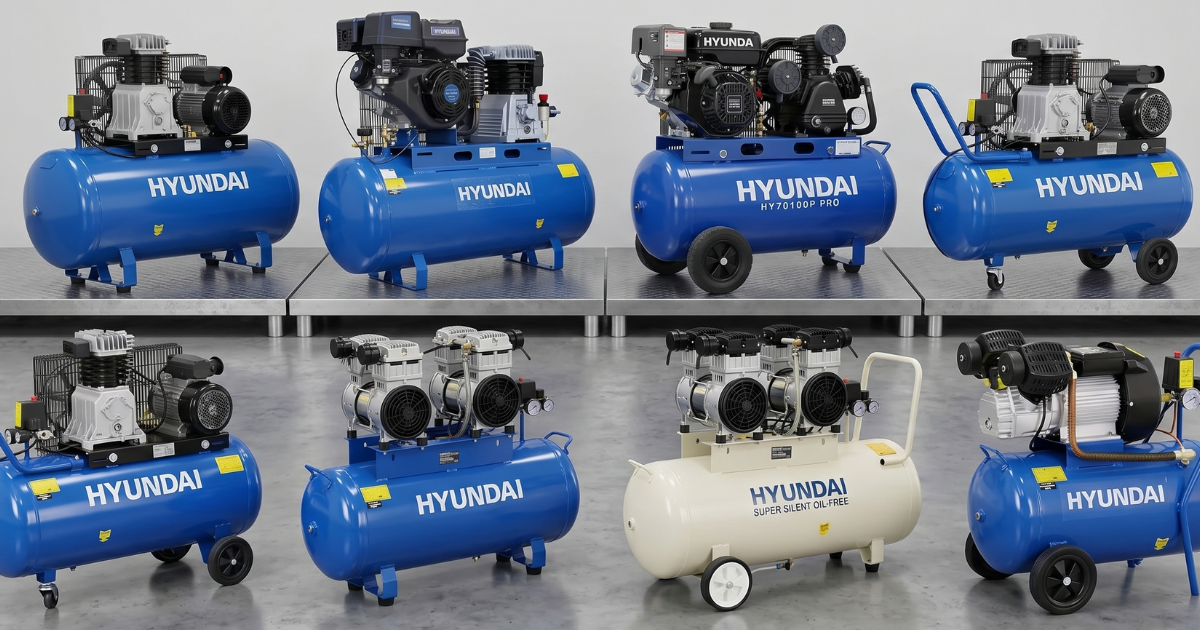
Hyundai Air Compressor Buying Guide 2026
Choose the right Hyundai air compressor with this 2026 UK buying guide. From quiet oil-free models like the HY7524X to powerful V-Twin and belt drive compressors such as the HY3050V and HY3150SX, this guide helps you match Hyundai performance and FAD output to your tools for home, garage, or professional use.
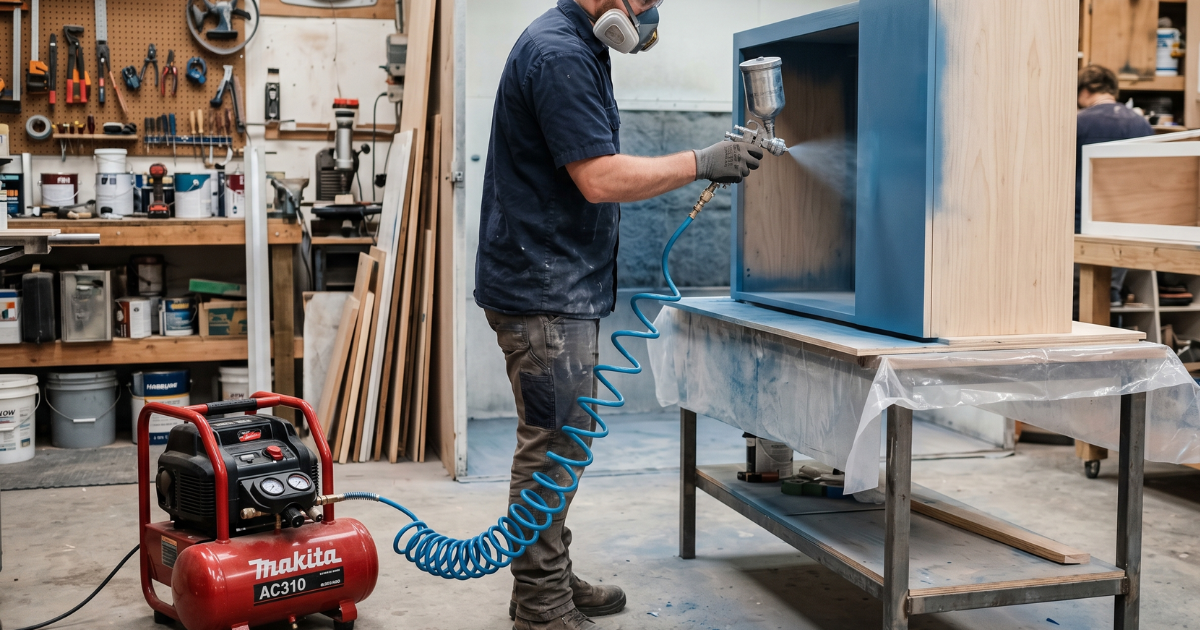
Best Air Compressors for Spray Painting
Looking for the best air compressors for spray painting in the UK in 2026? This guide compares 6 of the best spray painting air compressors, covering everything from quiet airbrush compressors to high-CFM workshop machines for HVLP spray guns and automotive bodywork. We explain the real difference between advertised CFM and usable Free Air Delivery (FAD), helping you choose the right compressor for furniture spraying, fences, cabinets, LVLP touch-up work, and full automotive paint jobs.
Electric Log Splitter Guide UK: Power, Tonnage & Leads
How to choose an electric log splitter: 13A mains power, real splitting force, safe extension leads and what size suits your wood burner.
Petrol Log Splitter Buying Guide: When Petrol Makes Sense
When a petrol log splitter beats electric: remote sites, big rounds and high-volume splitting. Tonnage, cycle times, towing, fuel and hire.

Manual Log Splitters Explained
Kindling crackers, axes, slide-hammers, foot and hand-pump hydraulic splitters: where each works, where it gets hard, and what to buy.
Log Splitter Tonnage Guide UK: What Size Do You Need?
What tonnage log splitter do you need? Match force to log diameter, wood species, grain, knots and moisture, not the badge alone.