
Electric Log Splitter Guide UK: Power, Tonnage & Leads
How to choose an electric log splitter: 13A mains power, real splitting force, safe extension leads and what size suits your wood burner.
Key takeaways
- A mains motor drives a pump, the pump pushes a ram, and the ram forces a log against a steel wedge until it cracks along the grain.
- UK homes supply nominally 230V AC, and a standard BS 1363 plug carries a maximum 13A fuse.
- The "tonne" figure on the box is the maximum force the ram can exert at full hydraulic pressure.
- This is the part most buyers overlook, and it's behind a lot of "my new splitter is weak" complaints.
- Forest Master quotes a 15-second cycle on its 7-tonne FM10; Konner & Sohnen around 10 seconds on its 6-tonne machine.
Published October 2026 · Last checked October 2026 · Approx. 12-minute read
Quick answer
For most UK homes with a wood burner, a 5–7 tonne horizontal electric log splitter (1,500–2,200W) is the right choice. It runs from a normal 13A socket, handles straight-grained logs up to roughly 25cm diameter (larger on 7-tonne models rated for it), and is quiet enough to use in a garden. Plug it in directly where you can; if you must use an extension lead, manufacturers specify 2.5mm² cable, fully unwound, no longer than 10m, on an RCD-protected (30mA) supply. If your logs are mostly knotty hardwood rounds over 30cm, or you process several cubic metres a season, look at a vertical 8-tonne+ electric or a petrol splitter instead.
In this guide
How we put this guide together: this is a research-based guide, not a hands-on test. I worked from manufacturers' published specifications and operating manuals (Forest Master, Scheppach, Konner & Sohnen, The Handy), UK electrical-safety guidance, and owner discussion on UK arborist forums. The voltage-drop figures are my own worked calculations from standard copper cable resistance and are shown so you can check them. Where sources disagree, I say so. Garden-Review earns a commission if you buy through the Amazon links below, at no extra cost to you; it doesn't change what we recommend.
Is an electric log splitter right for you?
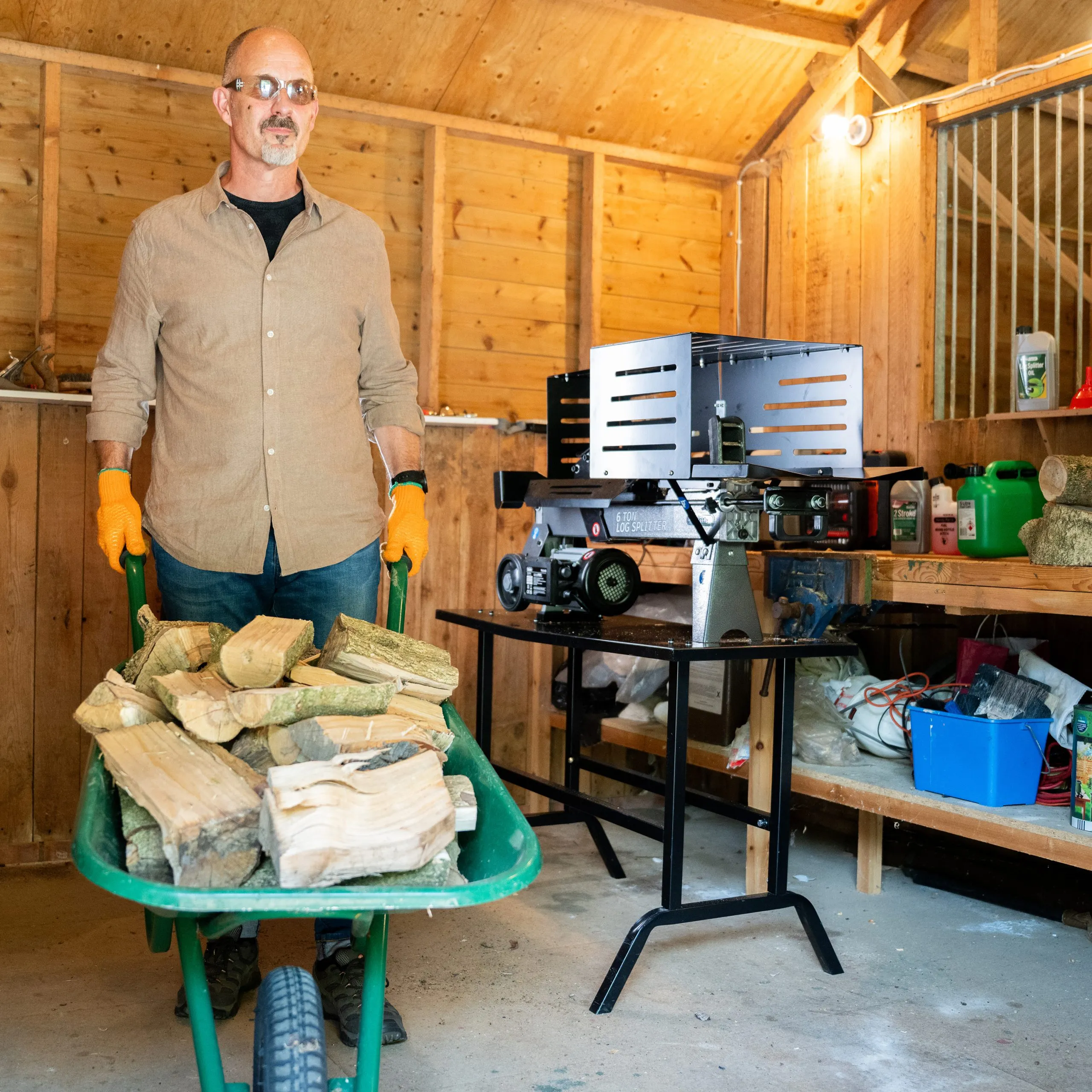
An electric log splitter is a small hydraulic press. A mains motor drives a pump, the pump pushes a ram, and the ram forces a log against a steel wedge until it cracks along the grain. There's no fuel, no pull cord, no exhaust and much less noise than a petrol machine, which is why electric models dominate the domestic end of the market.
The trade-off is power and speed. A UK single-phase socket limits how big the motor can be, so electric splitters are slower and have less in reserve than petrol or tractor-driven machines. They're at their best on stove-length logs with reasonably straight grain - exactly what most wood-burner owners split.
Electric suits you if…
- You split firewood for one or two stoves or an open fire
- You work near the house or a garage socket
- Your logs are mostly under 30cm across
- Noise matters (neighbours, early mornings)
- You want low maintenance and indoor storage
Think again if…
- You need to split in a woodland or field far from power
- Most of your wood is large, knotty hardwood rounds
- You process firewood to sell, or in big volumes
- You only split a few logs a year (a manual splitter may do)
Mains power: what a 13A socket can really run
UK homes supply nominally 230V AC, and a standard BS 1363 plug carries a maximum 13A fuse. Multiply the two and you get the ceiling: roughly 3,000W from one socket. Local fire-safety advice from councils puts it the same way - extension leads and sockets are "usually 13 amps or 3,000 watts" maximum.
That's why domestic electric splitters cluster into two motor sizes:
| Motor | Running current at 230V | Typical rating | Examples |
|---|---|---|---|
| 1,500W | ≈ 6.5A | 4–6 tonnes | Scheppach HL460 (4t), The Handy THLS-4G (4t), Konner & Sohnen KSB 6THE (6t) |
| 2,200W | ≈ 9.6A | 5–7 tonnes | Forest Master FM8/FM10 range, The Handy THLS-6G (6t) |
| 2,300W+ | ≈ 10A+ | 7–8+ tonnes, often vertical | Forest Master FM16 (8t), Scheppach HL710 vertical (7t) |
The running current fits comfortably inside 13A. The catch is start-up. Electric splitters use induction motors, and an induction motor draws several times its running current for a fraction of a second as it starts. That surge is why cheap leads, long leads and older circuits cause trouble - and why Forest Master's own power FAQ lists "check fuse in plug… check RCD for the ring main has not tripped" as the first steps when a splitter won't run.
Mark's tip: follow the start-up sequence in your manual. Forest Master is explicit: "Never move the lever before pressing the motor button," and its FAQ warns that "pressing the lever before the button can also often result in blown fuses." Let the motor spin up unloaded, then bring the ram in.
Don't share the circuit. If your fuse or RCD trips repeatedly, Forest Master suggests trying a different ring main or unplugging everything else on the same one. A splitter in the garage on the same circuit as a tumble dryer or freezer is a common culprit.
Tonnage vs practical splitting force
The "tonne" figure on the box is the maximum force the ram can exert at full hydraulic pressure. Forest Master, for instance, quotes 400 bar for 5 tonnes and 500 bar for 7 tonnes on its FM10 range. It's a useful comparison figure, but it isn't the whole story. Whether a log actually splits depends on:
- Grain and knots. As Konner & Sohnen's manual puts it, "the diameter of the log is not the only factor that determines how easy it is to split. A small log may be difficult to split if it has knots or is a particularly hard wood."
- Species. Straight-grained ash and birch part easily; twisted elm, plane and knotty conifer resist far more. One UK importer's listing warns its 5-tonne model is unsuited to convoluted wood such as poplar or pine.
- Moisture. Manuals disagree here. Forest Master says electric splitters are "best suited to splitting green logs", while Konner & Sohnen says its machine works "most efficiently on dry, seasoned logs". In practice, many species split more cleanly green, and splitting early helps logs season faster, so I'd split soon after felling where you can.
- Wedge design. Some models use a double-edged or 4-way wedge to produce more pieces per stroke, which cuts total time but needs more force per push.
Respect the 5-second rule. Both manuals I reviewed give the same instruction: never hold full pressure on a log for more than about five seconds. If it won't go, release, rotate the log and try a new position, or trim it down. Forcing it overheats the oil and motor and strains the seals. If your splitter seems to have lost force generally, our troubleshooting guide to slow rams and leaks covers the common causes.
What size log can each tonnage handle?
Treat the manufacturer's maximum diameter as the real limit, not the tonnage. Here's what published specs say:
| Model | Force | Motor | Max log length | Max diameter |
|---|---|---|---|---|
| Scheppach HL460 | 4t | 1,500W | 370mm | 250mm |
| The Handy THLS-4G | 4t | 1,500W | 370mm | 250mm |
| Forest Master FM8 | 5t | 2,200W | 370mm | 250mm |
| The Handy THLS-6G | 6t | 2,200W | 520mm | 250mm |
| Konner & Sohnen KSB 6THE | 6t | 1,500W | 520mm | 300mm |
| Forest Master FM10 (7t) | 7t | 2,200W | 430–450mm | 400mm* |
Sources: manufacturer and retailer spec sheets, checked October 2026. *Forest Master's product page lists 400mm; its FM5/8/10 manual lists 500mm. I've used the lower figure.
A sensible rule of thumb from those numbers: 4-tonne machines are for small, straight logs up to about 25cm; 5–6 tonnes gives you headroom on the same sizes plus tougher wood; and 7 tonnes is where larger rounds become realistic, provided the grain cooperates.
Extension leads, voltage drop and RCDs
This is the part most buyers overlook, and it's behind a lot of "my new splitter is weak" complaints. Splitters come with short leads - 1.4m on Forest Master models, 1.6–1.8m on The Handy and Konner machines - so most people need an extension. Get this wrong and you starve the motor of voltage.
What the manufacturers say
"If operating the machine with an extension lead, the extension lead must be at least a heavy duty 2.5mm² cable. For best performance the lead should be no more than 10 metres long."
- Forest Master FM5/FM8/FM10 user manual
Konner & Sohnen's manual gives the same limits (no longer than 10m, no less than 2.5mm²), and Forest Master's FAQ adds that the lead must be "used full unwound". Forest Master also warns: "When a motor is designed for 230/240 volts you are overloading the motor by running it with less than 220 volts."
Why lead size matters: worked voltage-drop figures
Every metre of cable has resistance, and current through it loses voltage. Most household extension leads use 1.25mm² or 1.5mm² cable - fine for a hedge trimmer, marginal for a splitter. Here's my calculation for a 2,200W splitter while running (≈9.6A), counting both the live and neutral conductors:
| Lead length | 1.25mm² cable | 1.5mm² cable | 2.5mm² cable |
|---|---|---|---|
| 10m | ≈ 3.0V | ≈ 2.3V | ≈ 1.4V |
| 25m | ≈ 7.6V | ≈ 5.8V | ≈ 3.5V |
| 50m | ≈ 15.2V | ≈ 11.6V | ≈ 7.1V |
Calculated using standard copper conductor resistances (≈15.9, 12.1 and 7.41 mΩ per metre). Running load only - the momentary dip at motor start-up is several times larger.
On paper, even 15V doesn't sound dramatic. But your supply may already be below 230V, the drop is several times worse during the start-up surge, and it's worst at the moment the ram hits a stubborn knot. A weak supply means the motor works harder, runs hotter and is more likely to trip a fuse or burn out its start capacitor. On UK arborist forum Arbtalk, one owner reported that occasional use on a 50m, 1.5mm² lead ended with "the switch and capacitor blew up"; on a 30m, 2.5mm² lead, his electrician judged it "close to borderline but ok". That's one anecdote, but it lines up with the maths.
Extension lead rules for electric splitters
- Plug straight into the wall if you can. Move the splitter to the power, not the power to the splitter.
- Use 2.5mm² cable, 10m or less, as both manuals specify. Check the cable size on the lead's label or packaging; many "heavy duty" leads are 1.25mm².
- Unwind cable reels fully. Coiled cable can't shed heat. Fire-safety guidance is blunt: "Fully unwind cable reels before use to prevent overheating." Many reels print a much lower coiled rating on the label.
- Never daisy-chain leads or run the splitter through a multi-way adaptor shared with other loads.
- Use outdoor-rated connections and keep plugs and sockets off wet ground.
- Use RCD protection. Both manuals specify a supply with an RCD rated at no more than 30mA (0.03A). Most modern consumer units have one; if yours is older, or you're unsure, use a plug-in RCD adaptor or an RCD-protected lead.
Shop 2.5mm² outdoor extension leads on Amazon Shop 30mA plug-in RCDs on Amazon
Matching the splitter to domestic workloads
Electric splitters are slow. Forest Master quotes a 15-second cycle on its 7-tonne FM10; Konner & Sohnen around 10 seconds on its 6-tonne machine. That covers one push and return, before you load the next log. That's fine for a few barrow-loads at a weekend but frustrating for bulk work. Use this as a guide:
| Your situation | Typical wood | What to buy |
|---|---|---|
| Occasional stove use, buying part-split or small logs | Softwood and small hardwood, under 20cm | 4-tonne, 1,500W horizontal |
| Main winter heating from one stove, buying rounds or a load of cord | Mixed hardwood, 20–30cm | 5–7 tonne, 2,200W horizontal (the sweet spot) |
| Two stoves, own trees, storm clear-up | Larger rounds, some knotty | 7-tonne horizontal with stand, or 8-tonne+ vertical electric |
| Off-grid, woodland, or firewood for sale | Large, unsorted timber | Petrol or tractor-PTO splitter |
Measure your stove first. Your splitter's maximum log length needs to match the logs you cut. If your firebox takes 25cm logs, a 370mm-capacity machine is plenty. If you cut longer logs for an open fire or a large stove, look for 450–520mm capacity.
Plan for seasoning. Wood must be dry to burn cleanly. In England, wood sold in quantities under 2m³ must be certified "Ready to Burn", which means a moisture content of 20% or less. If you're splitting your own, split it early and stack it under cover with airflow so it reaches that level before you burn it.
Horizontal or vertical?
Almost all domestic electric splitters are horizontal: the log lies in a trough and the ram pushes it along into the wedge. They're compact, light enough to move (roughly 32–67kg depending on model and bench), and easy to store. Their weakness is lifting: you have to raise every log onto the bed, which is tiring with heavy rounds. A stand or workbench brings the bed to waist height - Konner & Sohnen recommends a 60–70cm bench.
Vertical electric splitters stand upright, the ram comes down from above, and you roll heavy rounds into place rather than lifting them. They take longer logs (Scheppach's 7-tonne HL710 accepts up to 1,045mm) and suit people splitting larger timber, but they're heavier (97kg for the HL710) and need more storage space.
Safety non-negotiables: buy a machine with two-hand operation. Forest Master describes it like this: "One hand controls the hydraulic control lever while the other hand controls the motor push button switch. The log splitter will freeze upon absence of either hand." Only one person should operate the machine; wear gloves, safety boots and eye protection; split along the grain, never across it; and never split two logs at once. Most manuals also give an operating range of +5°C to 40°C, so don't use or store the splitter in freezing conditions without checking yours.
Electric splitters worth shortlisting
These are research-based picks chosen to cover the main size bands, all from established UK-available brands with published specifications. Prices change often, so check the live listing.
BEST FOR SMALL LOGS & LIGHT USE
Scheppach HL460 - 4 tonne, 1,500W
A compact horizontal splitter for softwood and smaller hardwood up to 250mm diameter and 370mm long. The 1,500W motor draws around 6.5A running, so it's the most forgiving choice for older wiring or a lead run. Choose it if you mostly top up a stove with bought logs rather than processing whole rounds.
- 4t force · 1,500W · max 370mm × 250mm
- Pick it for: occasional use, small storage space
- Skip it if: you split knotty hardwood rounds
BEST LONG-LOG BUDGET OPTION
Lazy-Log Electric Log Splitter - 5 tonne, 1,500W
A 5-tonne horizontal splitter with a safety guard and a 520mm log-length capacity, which is longer than most splitters in this class. That suits open fires and larger stoves. As a 1,500W machine it runs on modest current, but expect slower progress through dense hardwood than with a 2,200W model.
- 5t force · 1,500W · up to 520mm log length
- Pick it for: longer logs on a budget
- Check before buying: max diameter and warranty on the live listing
BEST ALL-ROUNDER FOR STOVE OWNERS
Forest Master FM8D-TC - 5 tonne with workbench & guard
Forest Master is a UK specialist with a detailed manual, a spare-parts supply including replacement motors, and a published power-troubleshooting FAQ. That support matters on a hydraulic tool you'll keep for years. The FM8D-TC is sized for small-to-medium stoves (370mm logs, 250mm diameter), comes pre-filled with oil, and includes the workbench and guard that Forest Master says must be fitted if anyone else uses the machine.
- 5t force · 370mm × 250mm · bench & guard included · pre-filled
- Pick it for: regular stove use, good parts back-up
BEST FOR BIGGER ROUNDS
Forest Master FM10D-7-TC - 7 tonne, 2,200W
The step up for households splitting their own timber. The 7-tonne rating (500 bar) and 2,200W motor give real headroom on larger hardwood, and the DuoCut blade, ram stop and workbench and guard are included. Log length is up to 450mm. It's around 47kg for the splitter alone, more with the bench, and it's the model where a correct 2.5mm² lead matters most. If you want it on its own legs, the FM10T-7 version comes with a stand.
- 7t force · 2,200W · up to 450mm logs · 15-second cycle
- Pick it for: own trees, mixed hardwood, main heating
BEST VERTICAL OPTION
Forest Master FM8VE - 8 tonne vertical with 4-way blade
If lifting heavy rounds onto a horizontal bed is the problem, a vertical splitter lets you roll them into place. The FM8VE adds a 4-way blade for more pieces per stroke. It's bigger and heavier than the horizontal models, so check storage space and confirm the motor rating and log capacity on the live listing before buying.
- 8t force · vertical · 4-way blade
- Pick it for: large, heavy rounds; less lifting
Want ranked picks across electric, petrol and manual? See our Best Log Splitters UK 2026 roundup, or browse every model on our log splitter reviews page.
Useful extras
- Hydraulic oil: both manuals recommend an oil change after about 150 hours. Use the grade your manual specifies; Forest Master recommends its own HYD46+, while Konner & Sohnen specifies ISO VG 22. Shop hydraulic oil
- Gloves, boots and eye protection: Shop safety kit
- Moisture meter: confirms your logs are under 20% before burning. Shop moisture meters
- Ash vacuum: for the other end of the job, see our best ash vacuums for fireplaces.
Electric log splitter buying checklist
- ✓ Log length matches your stove's firebox (measure it)
- ✓ Max diameter covers most of your logs - use the spec, not the tonnage
- ✓ Tonnage: 4t for small softwood; 5–7t for mixed hardwood; 8t+ vertical for big rounds
- ✓ Motor 1,500W for gentle loads or weak supplies; 2,200W for regular hardwood
- ✓ Socket nearby, or a 2.5mm², ≤10m, fully unwound outdoor lead
- ✓ RCD protection (30mA) on the circuit or at the plug
- ✓ Two-hand operation, guard and ram stop
- ✓ Stand or workbench so you're not bending to the floor
- ✓ Warranty and parts: look for UK support and available spares (warranties range from 12 months to 2 years)
- ✓ Weight and storage: horizontal units are roughly 32–67kg; verticals can approach 100kg
About the author
Mark Moore is Garden-Review's Power Tools Specialist, covering mains, cordless and hydraulic tools for UK homes and gardens. His guides focus on the practical details that spec sheets gloss over, such as supply limits, duty cycles and safe set-up, and are built from manufacturer documentation, UK safety guidance and owner feedback. Garden-Review is independent and reader-supported; see our methodology note above.
More in this hub: Log Splitters hub · Log splitter buying guides · Log splitter reviews · Best Log Splitters UK 2026
Sources: Forest Master FM5/FM8/FM10 user manual and power FAQ (forest-master.com); Konner & Sohnen KSB 6THE 52/30 manual; Toolstation listings for The Handy THLS-4G and THLS-6G; Toolstop listing for Scheppach HL710; Lichfield District Council extension-lead fire-safety guidance; Arbtalk owner forum. Specifications checked October 2026.
Frequently Asked Questions: Electric Log Splitter Guide UK: Power, Tonnage & Leads
Can I run an electric log splitter from a normal household socket?
What extension lead should I use with a log splitter?
Is a 5 ton electric log splitter enough?
Why won't my electric log splitter split a log?
Should I split logs green or seasoned?
Electric or petrol log splitter?
Tags
Comments
Join the conversation
Create a free account to leave comments, share photos, and connect with other gardeners.
Related Articles
Log Splitter Tonnage Guide UK: What Size Do You Need?
What tonnage log splitter do you need? Match force to log diameter, wood species, grain, knots and moisture, not the badge alone.
Petrol Log Splitter Buying Guide: When Petrol Makes Sense
When a petrol log splitter beats electric: remote sites, big rounds and high-volume splitting. Tonnage, cycle times, towing, fuel and hire.
Manual Log Splitters Explained
Kindling crackers, axes, slide-hammers, foot and hand-pump hydraulic splitters: where each works, where it gets hard, and what to buy.
Best 7 Ton Horizontal Log Splitters for 2026
Discover the best 7-ton horizontal log splitters for 2026, including top models from Hyundai, Scheppach, Zipper, Titan and Spectrum. Compare key differences in build quality, safety features, and performance to find the ideal electric log splitter for home firewood use, balancing power, reliability, and value for money.
Hyundai HYLS8000V Log Splitter: A UK Gardener's In-Depth Review
The Hyundai HYLS8000V 8-tonne electric log splitter is a serious contender for converting large quantities of timber into usable firewood. In this comprehensive UK review, we delve into its performance, features, safety, and overall value, helping you decide if this robust machine is the ideal choice for your garden or smallholding.
Hyundai Inverter Generator Buying Guide (2026)
Discover the latest Hyundai inverter generator range for 2026 in this comprehensive buying guide, covering everything from ultra-portable camping models to powerful home backup units. Whether you need quiet, fuel-efficient power for caravans, van life, or off-grid living, Hyundai’s inverter generators deliver clean pure sine wave electricity for safe use with sensitive electronics. Explore detailed comparisons, key specifications, and expert mini-reviews to help you choose the perfect generator for your needs.