
Oil vs Oil-Free Air Compressors
Oil vs oil-free air compressors explained for UK buyers in 2026. This guide compares maintenance, noise, lifespan, duty cycle, air quality, and running costs to help you choose the right compressor for DIY, garages, workshops, and professional use. Includes 16 recommended models from Machine Mart and Hyundai, covering silent oil-free compressors, high-output workshop machines, and professional belt-drive systems.
Key takeaways
- Buy oil-free if: you are a home DIYer, hobbyist, or sole-trader who uses a compressor intermittently, nailers, tyre inflation, spray touch-ups, air tools for several hours a week.
- Oil-free compressors use pistons, diaphragms, or scroll mechanisms coated with self-lubricating materials - typically PTFE (polytetrafluoroethylene, commonly known as Teflon) or similar composite compounds.
- The maintenance difference between oil-free and oil-lubricated compressors is one of the most practically significant factors for most UK buyers.
- Duty cycle describes the percentage of time a compressor can run during any given hour.
- The compressed air output from oil-lubricated compressors contains a fine oil mist.
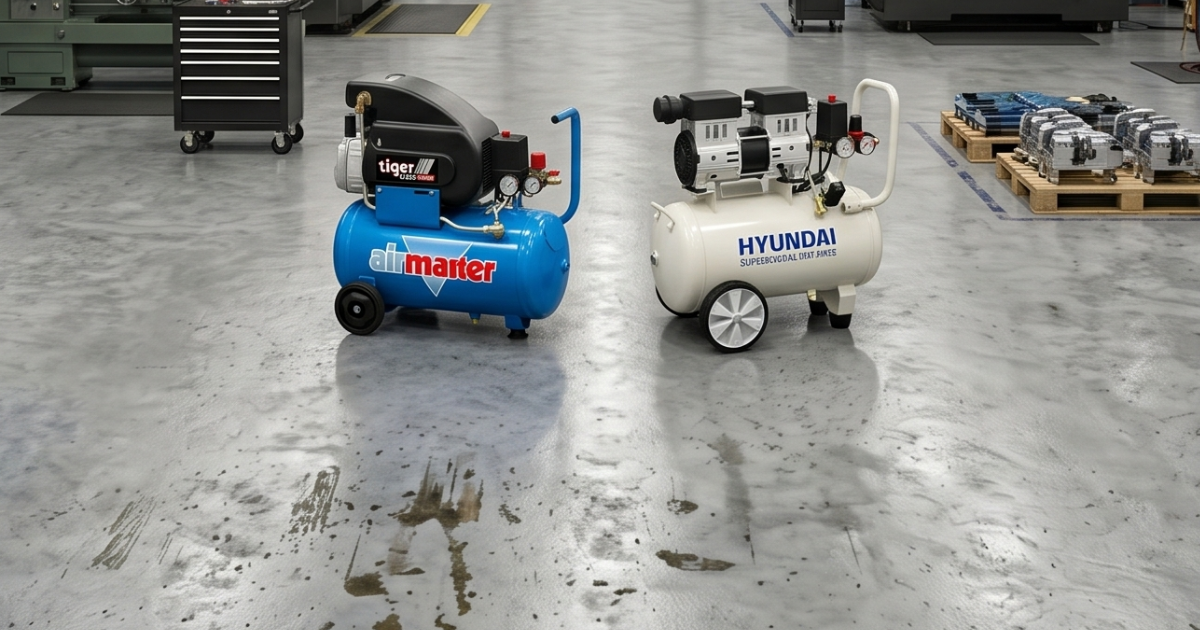
Oil vs Oil-Free Air Compressors - The Complete UK Guide 2026
Everything you need to know to choose between oil-lubricated and oil-free air compressors - how each works, what the real differences are in maintenance, longevity, noise, air quality and running costs, which application suits each type, and which specific machines from Machine Mart and Hyundai represent the best choices in both categories for UK buyers in 2026.
⚡ Quick Answer - Oil vs Oil-Free: Which Should You Buy?
Buy oil-free if: you are a home DIYer, hobbyist, or sole-trader who uses a compressor intermittently, nailers, tyre inflation, spray touch-ups, air tools for several hours a week. All Hyundai compressors and all Clarke/Airmaster direct-drive models are oil-free. Zero maintenance, clean air, no oil disposal, adequate duty cycle for most users. Buy oil-lubricated (belt-drive) if: you run a working garage, joinery workshop, body shop, or professional trade operation where the compressor runs for multiple hours daily and longevity under heavy sustained use is the priority. The Airmaster and Clarke Boxer II belt-drive range from Machine Mart covers this category. Oil-lubricated belt-drive machines last significantly longer under heavy daily use but require regular oil checks, oil changes, and correct used-oil disposal.
In This Guide
- How Each Type Works
- Key Differences - Head to Head
- Maintenance & Running Costs
- Longevity & Duty Cycle
- Air Quality & Contamination
- Noise - The UK Residential Factor
- Best Oil-Free Compressors - Our Picks
- Best Oil-Lubricated Compressors - Our Picks
- Which Type for Which Application?
- Oil Compressor Maintenance Guide
- Frequently Asked Questions
1. How Each Type Works
Oil-Free Compressors
Oil-free compressors use pistons, diaphragms, or scroll mechanisms coated with self-lubricating materials - typically PTFE (polytetrafluoroethylene, commonly known as Teflon) or similar composite compounds. These coatings allow the piston or diaphragm to run against the cylinder wall without oil lubrication. The compression chamber itself contains no oil at any point in the cycle, which means the compressed air output is entirely free from oil vapour or mist.
The motor may still contain oil in its bearings, but this is fully sealed from the air path. All Hyundai compressors in this guide, and all Clarke/Airmaster direct-drive models, are oil-free designs. The slow-running 4-pole motors on the Hyundai silent range (HY5508X, HY7524X, HY27550) run at 1,450 RPM - the low speed is the primary mechanism for both reduced noise and reduced wear on the PTFE-coated pump components.
Oil-Lubricated Compressors
Oil-lubricated compressors use oil in the compression chamber to lubricate the piston rings against the cylinder walls. The oil simultaneously acts as a coolant, carrying heat away from the compression zone and into the sump. This combination of lubrication and active cooling allows the machine to run at higher continuous loads and for longer periods before thermal limits are reached.
Belt-drive oil-lubricated compressors - the type offered by Machine Mart's Airmaster and Clarke Boxer II professional ranges - additionally run their pump at a slow 1,050 RPM via a V-belt rather than direct motor speed. This slow pump speed reduces mechanical wear and heat generation still further, which is the fundamental reason for their extended service life and high duty cycle compared to direct-drive machines.
2. Key Differences - Head to Head
| Factor | Oil-Free | Oil-Lubricated Belt-Drive |
|---|---|---|
| Maintenance | ✓ Virtually zero — drain tank, check air filter | Weekly oil checks · oil changes every 500 hrs or 3 months · belt inspection · filter changes |
| Air Quality | ✓ Completely clean — no oil in air stream | Oil mist in air — coalescing filter required for spray painting or sensitive applications |
| Duty Cycle | ~50% — 30 min on, 30 min off (direct-drive) | ✓ 80–90% — can run most of the working day |
| Service Life | ~2,000–3,000 hrs pump life (typical) | ✓ 10,000–15,000+ hrs pump life with proper maintenance |
| Noise (typical) | Silent: 60–66 dB · Direct-drive: 88–92 dB | ~70–80 dB (belt-drive is quieter than direct-drive) |
| Running Costs | ✓ Lower — no oil, no filters, no oil disposal | Oil, filters, belt wear, regulated disposal of used oil |
| Purchase Price | ✓ Lower to equivalent at most sizes | Higher — complex design costs more |
| Weight & Portability | ✓ Generally lighter — some very portable | Heavier — belt mechanism, larger sump, bigger castings |
| Energy Efficiency | Slightly higher friction (no lubrication in compression zone) | ✓ More efficient — oil reduces friction and power loss |
| Best Suited To | DIY, hobbyist, intermittent trade use, spray painting, nailers, clean-air applications | Daily professional use, heavy sustained loads, working garages, bodyshops, joinery workshops |
| Oil Disposal | ✓ None required | Used engine oil is a hazardous waste — must be disposed of at authorised collection points. Never pour down drains. |
3. Maintenance & Running Costs - The Real Difference
The maintenance difference between oil-free and oil-lubricated compressors is one of the most practically significant factors for most UK buyers. It affects how much time the machine demands of you, how much it costs to run, and how likely you are to keep up with the servicing it needs.
Oil-Free — What Maintenance Is Actually Required
- After every session: Open the tank drain valve and release condensed moisture. Close it again. That's it.
- Periodically: Check and clean the air intake filter — typically every 3–6 months depending on dusty environment use.
- Occasionally: Inspect the power cable and airline connectors for wear.
- Never: Oil levels, oil changes, belt tension, oil filter replacement, or oil disposal.
Total annual maintenance time for a domestic DIY user: approximately 5–10 minutes of tank draining across the year. Annual cost: zero beyond occasional filter cleaning.
Oil-Lubricated — Full Maintenance Schedule
- After every session: Drain tank condensate. The drained liquid contains oil residue — collect it for disposal.
- Weekly: Check oil level via dipstick or sight glass. Top up to correct level with specified compressor oil.
- Every 500 hours or 3 months: Change the oil completely. Dispose of used oil at authorised collection point.
- Quarterly: Check and clean air intake filter.
- Annually: Inspect belt tension and wear — replace if showing cracking or significant wear. Check belt alignment. Inspect pump valves.
Annual maintenance cost estimate (workshop use): ~£75–£120 for oil, filters, and occasional belt replacement. Annual time investment: 4–8 hours including oil changes and inspections.
The maintenance gap matters most for one reason: compressor oil lubrication is not optional. Running an oil-lubricated machine without adequate oil causes catastrophic pump failure — scored cylinder walls, seized pistons, and a machine that cannot be economically repaired. Most pump failures on oil-lubricated compressors in domestic environments are caused by people who bought the machine, didn't read the manual, didn't maintain the oil, and ran it dry. If you are confident you will check and change oil on schedule, the oil-lubricated machine's longevity advantage is real. If you know you won't, buy oil-free and get the same productivity without the risk.
⚠ Used Oil Disposal — UK Legal Requirement
Used compressor oil is classified as hazardous waste under UK environmental regulations. It must never be poured down drains, onto the ground, or into household waste. Take it to your local Household Waste Recycling Centre (most accept used motor oil), an authorised oil bank, or a commercial waste contractor. Condensate drained from an oil-lubricated compressor also contains oil residue and must be treated as oil waste, not water.
4. Longevity & Duty Cycle - Understanding the Numbers
Service life and duty cycle are the two specification points where oil-lubricated belt-drive machines hold their clearest advantage over oil-free alternatives — and they are worth understanding precisely, because the numbers are frequently misrepresented in both directions.
Duty Cycle
Duty cycle describes the percentage of time a compressor can run during any given hour. A 50% duty cycle means 30 minutes running, 30 minutes cooling — the machine must rest as long as it works. A 90% duty cycle means the machine can run almost continuously. Direct-drive oil-free compressors typically operate at 50% duty cycle. Belt-drive oil-lubricated machines operate at 80–90%.
In practical terms for most DIY and domestic use, the 50% duty cycle of an oil-free machine is never relevant — the compressor cycles its motor on and off automatically based on tank pressure, and for intermittent nail gun use, spray touch-ups, or occasional air tool sessions, it never comes close to its duty cycle limit. The duty cycle difference becomes meaningful when the compressor is running almost continuously — a sandblasting session, a full day of framing nailing, or sustained spray painting of large surfaces. At that point, the belt-drive machine's ability to run all day without mandatory rest genuinely differentiates it.
Service Life
Typical pump service life figures often quoted: oil-free ~2,000 hours; oil-lubricated belt-drive ~10,000–15,000 hours. These figures require context. The oil-free figure assumes regular use at moderate loads — a domestic DIY user who runs their compressor 2–3 hours a week would reach 2,000 hours in approximately 15–20 years. The machine will likely be replaced for other reasons long before the pump wears out. The 15,000-hour oil-lubricated figure is achieved under professional daily use with meticulous maintenance — a working garage compressor running 6 hours a day reaches 2,000 hours in less than a year.
| Usage Pattern | Weekly Run Hours | Oil-Free 2,000 hrs pump life | Oil-Lube 12,000 hrs pump life |
|---|---|---|---|
| Weekend DIY | ~2 hrs | ~19 years | 115+ years |
| Active hobbyist | ~6 hrs | ~6 years | ~38 years |
| Sole trader part-time | ~15 hrs | ~2.6 years | ~15 years |
| Working garage daily | ~30 hrs | ~1.3 years | ~7.7 years |
| Professional full-time | ~45 hrs | ~10 months | ~5 years |
The conclusion from the table is clear: for domestic and hobbyist use, oil-free longevity is entirely adequate — you will almost certainly never wear out the pump under normal DIY patterns. Oil-lubricated belt-drive's longevity advantage becomes commercially meaningful only when the machine runs 15+ hours per week — the professional and semi-professional use case.
5. Air Quality & Contamination - Why It Matters
The compressed air output from oil-lubricated compressors contains a fine oil mist. The concentration is small — typically in the parts-per-million range — but it is measurable and consequential for certain applications. Understanding where oil contamination matters and where it doesn't is essential for choosing the right type.
✓ Oil contamination has no effect
- Air tools (impact wrenches, ratchets, grinders)
- Tyre inflation
- Nail guns and staplers
- Blow guns and air dusters for metalwork
- Sand blasting with non-porous materials
For all these applications, oil in the air stream causes no functional or quality problem. An oil-lubricated compressor is fully appropriate.
✗ Oil contamination causes problems
- Spray painting — fish-eye defects, poor adhesion
- Airbrush and hobby painting
- Dental and medical equipment
- Food and beverage processing
- Electronics manufacturing
- Breathing air systems
For spray painting: a coalescing oil separator filter fitted in the airline is mandatory before the spray gun if using an oil-lubricated compressor. Without it, paint finishes will be compromised.
⚠ Also consider moisture
Both oil-free and oil-lubricated compressors produce moisture in the compressed air from atmospheric humidity. A moisture separator (water trap) fitted in the airline is required for spray painting from any compressor type — not just oil-lubricated. Always drain the tank after every session to remove condensed water and prevent internal tank corrosion.
6. Noise - The UK Residential Factor
Noise is frequently the deciding factor for UK buyers in semi-detached or terraced homes, and it doesn't map neatly onto the oil-free vs oil-lubricated distinction. The actual noise spectrum across both categories is:
| Compressor Type | Typical Noise | Residential Suitability | Examples from this guide |
|---|---|---|---|
| Oil-free silent (4-pole slow motor) | 60–62 dB | ✓ Excellent — any reasonable hour | Hyundai HY5508X, HY7524X, HY27550 |
| Oil-free low-noise (twin pump) | 66 dB | ✓ Good — daytime hours | Clarke SHHH50/350 |
| Oil-lubricated belt-drive | ~72–80 dB | △ Acceptable — detached or rural | Airmaster 14/100P, Clarke Boxer II range |
| Oil-free direct-drive (standard) | 88–92 dB | ✗ Neighbours will hear clearly | Clarke Bandit V, Airmaster Tiger 8/260, Raider 15/550, HY3050V |
The counterintuitive finding: oil-lubricated belt-drive machines (~75 dB) are actually quieter than standard direct-drive oil-free machines (~90 dB). The belt-drive mechanism running at ~1,050 RPM generates far less vibration and noise than a direct-drive pump at 2,800+ RPM. For buyers in a detached garage who need both high output and reduced noise, a belt-drive oil-lubricated machine can be a better noise compromise than a high-output direct-drive oil-free machine — provided the maintenance commitment is understood.
7. Best Oil-Free Compressors - Our Picks from Hyundai & Machine Mart
Our full oil-free range spans from compact 8-litre portables to 50-litre workshop machines. Every pick below is zero-maintenance oil-free. We've organised them into three tiers — compact, mid-size, and large — to help you find the right match quickly.
Compact 8L — Portability & 2nd-Fix Nailer Use
Mid-Size 24L — Extended Sessions & Flooring Work
Large 50L — Workshop Power, Spray Painting & First-Fix
8. Best Oil-Lubricated Compressors — Machine Mart's Belt-Drive Range
⚠ Before You Buy an Oil-Lubricated Compressor
All oil-lubricated belt-drive compressors require: (1) regular oil level checks before each session, (2) oil changes every 500 hours or 3 months, (3) correct disposal of used oil at authorised collection points, (4) a coalescing oil separator filter fitted in the airline before any spray gun. Failure to maintain the oil will cause catastrophic pump failure. If you are not prepared to commit to this maintenance schedule, buy an oil-free machine instead.
Oil-lubricated belt-drive compressors are available exclusively from Machine Mart in this guide. Hyundai's entire range is oil-free. Machine Mart sells both Airmaster and Clarke Boxer II belt-drive machines — both are functionally equivalent at each tank size, with the Clarke Boxer II representing a modest step up in build quality at a slightly higher price. All use the same 14 CFM, 3HP single-stage two-cylinder pump configuration.
9. Which Type for Which Application?
Brad nailer, finish nailer, pin nailer
Oil-free ✓ — HY5508X (residential) or Clarke Bandit V (site)
Either type works. Oil-free preferred for residential noise and zero maintenance.
Spray painting (DIY and hobbyist)
Oil-free ✓ — HY27550 or SHHH50/350
Clean air without contamination risk. No coalescing filter needed. Far simpler.
Tyre inflation and blow gun
Either type ✓ — Any compressor works
Oil contamination has zero effect. Use whatever you own.
Impact wrench, air ratchet, DA sander
Either type ✓ — Oil-free adequate for DIY; belt-drive for all-day professional
Oil in air stream doesn't affect air tool performance.
Working garage — daily sustained use
Oil-lubricated belt-drive ✓ — Airmaster 14/100P or Clarke Boxer II 14/100P
Duty cycle and longevity justify the maintenance commitment at this usage level.
Automotive spray painting (professional)
Oil-lubricated + coalescing filter ✓ — Airmaster 14/100P + oil separator
Belt-drive FAD and duty cycle suit full-panel spraying. Coalescing filter is mandatory.
Professional joinery / carpentry workshop
Oil-lubricated ✓ — 100L+ belt-drive suits all-day nailer + tool use
80–90% duty cycle and longevity critical for professional daily workloads.
Food, medical, or clean-room environments
Oil-free only ✓ — No exceptions
Oil contamination is unacceptable in food, pharmaceutical, dental, and medical applications. Oil-free is the only appropriate choice regardless of other factors.
10. Oil Compressor Maintenance Guide — How to Do It Right
If you've decided an oil-lubricated machine is right for your workshop, here's the practical maintenance schedule to maximise pump life and avoid the costly failures that come from neglected oil systems.
📅 Before Every Session
- Check oil level via dipstick or sight glass — must be between min and max marks
- Top up with correct SAE 30 or 20W-50 non-detergent compressor oil if needed — never engine oil or multi-grade
- Listen for unusual noise during startup — rattling or knocking indicates a problem
📅 After Every Session
- Open tank drain valve and release moisture — collect in a container (contains oil residue)
- Allow the machine to cool before covering
- Inspect the oil sight glass or dipstick after running — cloudy oil indicates moisture contamination, change immediately
📅 Every 3 Months or 500 Hours
- Full oil change — drain the old oil completely (never top-up without draining), refill with fresh compressor oil to correct level
- Dispose of used oil at authorised collection point — never pour down drain
- Clean or replace air intake filter — blocked filter stresses the pump
📅 Annually
- Inspect belt tension — press belt firmly between pulleys, deflection should be approximately 10–15mm. Tighten or replace if slack
- Check belt for cracking, glazing, or wear — replace if any deterioration is visible
- Check belt alignment between motor and pump pulleys
- Inspect pump valve reeds if performance has decreased — cleaning or replacing reed valves restores output
ⓘ What Oil to Use in Your Compressor
Use only dedicated non-detergent compressor oil — typically SAE 30 or 20W-50. Do not use standard engine oil (which contains detergents that foam under pressure), automatic transmission fluid, or general lubricating oil. Machine Mart sells Clarke-branded compressor oil suitable for all Airmaster and Clarke belt-drive machines. Consult your specific model's manual for the manufacturer's recommended specification — both Airmaster and Clarke Boxer II manuals are available on the Machine Mart product pages.
11. Frequently Asked Questions
★ Garden-Review Final Verdict
The choice between oil-free and oil-lubricated comes down to one question: how heavily and how continuously will you use it? For the overwhelming majority of UK buyers — weekend DIYers, active hobbyists, and even sole traders who use a compressor for several hours per week - oil-free is the correct answer. Zero maintenance, clean air, adequate longevity for any realistic domestic or semi-professional use pattern, and the silent Hyundai range adds residential-hour usability that no oil-lubricated machine can match.
Oil-lubricated belt-drive earns its place in the working garage, bodyshop, joinery workshop, or professional site where the machine runs 6–8 hours daily. At that usage intensity, the pump longevity difference between oil-free (~2,000 hours) and belt-drive oil-lubricated (~12,000+ hours) becomes commercially significant — a professional operation can expect 5–8 years from a well-maintained belt-drive machine versus under a year from an oil-free direct-drive. The maintenance commitment is real and must be kept. For this buyer, the Airmaster 14/100P or Clarke Boxer II 14/100P represents the appropriate investment.
✓ Choose Oil-Free
- Home DIY, hobby, intermittent trade
- Residential garage — noise matters
- Spray painting — no contamination risk
- No maintenance commitment required
- Clean air mandatory (food, medical, art)
⚛ Choose Oil-Lubricated Belt-Drive
- Working garage or workshop 6+ hrs/day
- Professional daily sustained use
- Maximum pump longevity required
- You commit to oil maintenance schedule
- Quieter than direct-drive at equivalent output
Technical information on oil-free vs oil-lubricated compressor engineering sourced from OTC Industrial Technologies, Griffin Air Systems, Quincy Compressor, J LL Leach, and Winston Engineering (all 2025–2026). Service life figures (~2,000 hours oil-free, ~15,000 hours oil-lubricated) from J LL Leach and industry consensus - actual life varies significantly by usage intensity, load level, and maintenance quality. Duty cycle figures based on manufacturer specifications and class norms for direct-drive oil-free (50%) and belt-drive oil-lubricated (80–90%) machines. All product specifications sourced from Machine Mart UK and Hyundai Power Equipment UK authorised listings. Prices are guide ranges as of May 2026 — verify current pricing before purchase.
Tags
Comments
Join the conversation
Create a free account to leave comments, share photos, and connect with other gardeners.
Related Articles
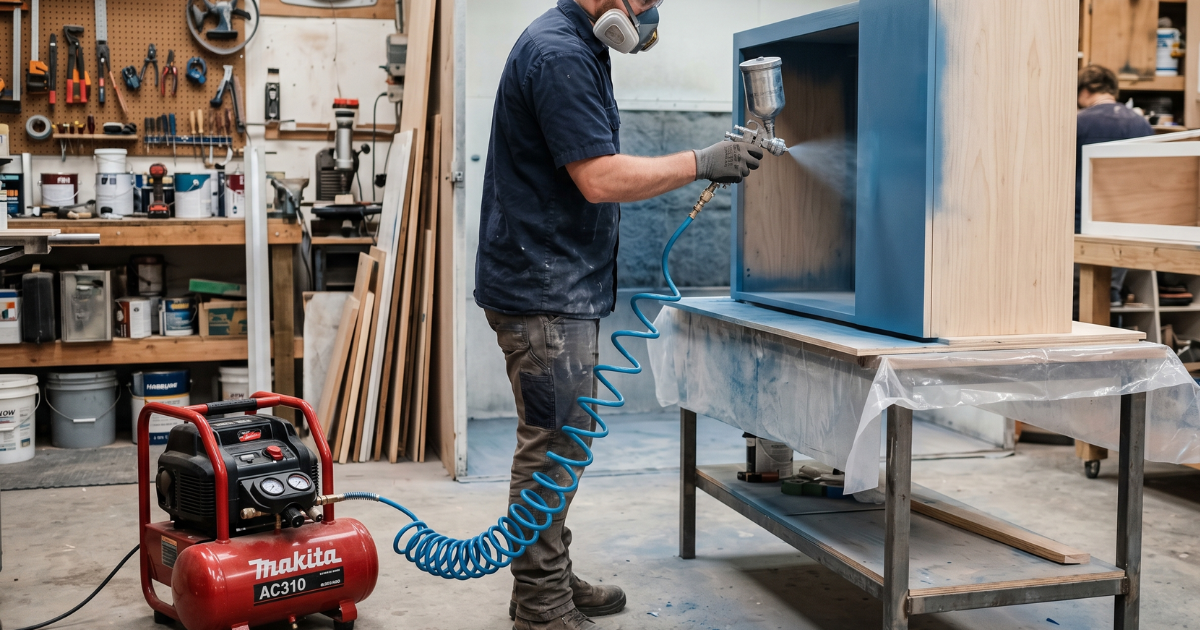
Best Air Compressors for Spray Painting
Looking for the best air compressors for spray painting in the UK in 2026? This guide compares 6 of the best spray painting air compressors, covering everything from quiet airbrush compressors to high-CFM workshop machines for HVLP spray guns and automotive bodywork. We explain the real difference between advertised CFM and usable Free Air Delivery (FAD), helping you choose the right compressor for furniture spraying, fences, cabinets, LVLP touch-up work, and full automotive paint jobs.
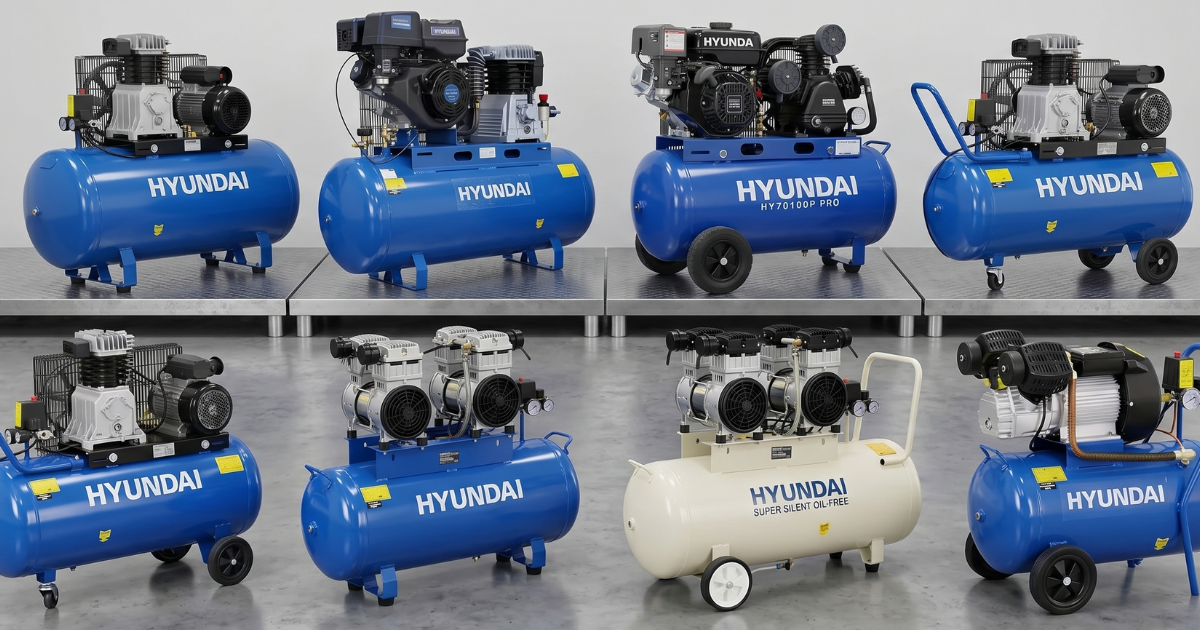
Hyundai Air Compressor Buying Guide 2026
Choose the right Hyundai air compressor with this 2026 UK buying guide. From quiet oil-free models like the HY7524X to powerful V-Twin and belt drive compressors such as the HY3050V and HY3150SX, this guide helps you match Hyundai performance and FAD output to your tools for home, garage, or professional use.
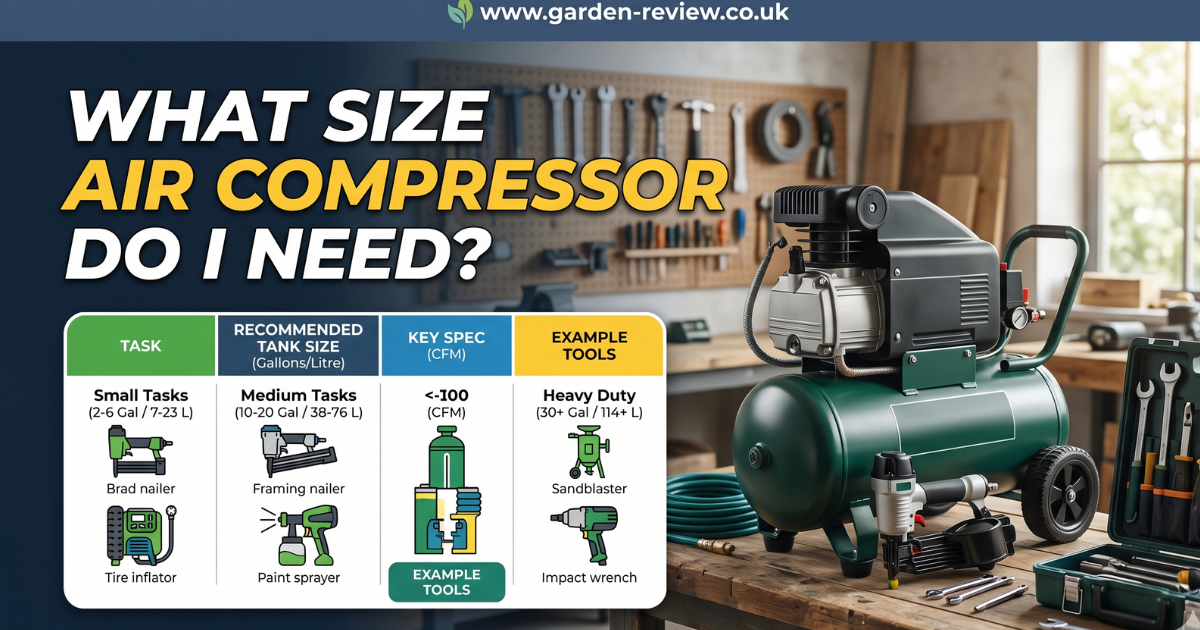
What Size Air Compressor Do I Need? Workshop Guide
CFM, tank size, PSI, duty cycle - explained in plain English, with a step-by-step sizing method and a full tool-by-tool chart for every common application.
Air Compressor Buyer’s Guide for 2026
Air Compressor Buyer’s Guide UK 2026: Learn CFM, PSI, tank sizes and the best compressor for DIY, garages and workshops.
Best Air Compressors for Nail Guns
Looking for the best air compressors for nail guns in the UK in 2026? This guide compares 7 top air compressors for brad nailers, finish nailers, framing nailers, and flooring staplers. We explain which compressors suit DIY joinery, first-fix framing, and workshop use - including tank size, PSI, noise levels, and the best quiet compressors for UK home garages.
Best Air Compressors for DIY UK
Looking for the best air compressors for DIY UK projects in 2026? This guide compares 9 of the best DIY air compressors available, covering everything from compact 8L compressors for nail guns and tyre inflation to powerful 100L workshop models for spray painting and air tools. We explain which compressor is best for home garages, quiet residential use, DIY workshops, and sustained tool use - with honest pros, cons, noise levels, CFM guidance, and real-world UK buying advice.