
Best Air Compressors for Spray Painting
Looking for the best air compressors for spray painting in the UK in 2026? This guide compares 6 of the best spray painting air compressors, covering everything from quiet airbrush compressors to high-CFM workshop machines for HVLP spray guns and automotive bodywork. We explain the real difference between advertised CFM and usable Free Air Delivery (FAD), helping you choose the right compressor for furniture spraying, fences, cabinets, LVLP touch-up work, and full automotive paint jobs.
Key takeaways
- Six compressors ranked specifically for spray painting - from LVLP touch-up work and furniture spraying to full automotive bodywork.
- All CFM figures are Free Air Delivery (FAD) unless marked as displacement.
- This is why the FAD figure matters so much more for spray painting than for any other tool.
- 0.5–2 CFM FAD · 15–25 PSI Used for scale modelling, fine detail painting, cake decoration, and nail art.
- Oil-lubricated compressors (like the Airmaster 14/100P belt-drive) use oil to lubricate the pump cylinders.
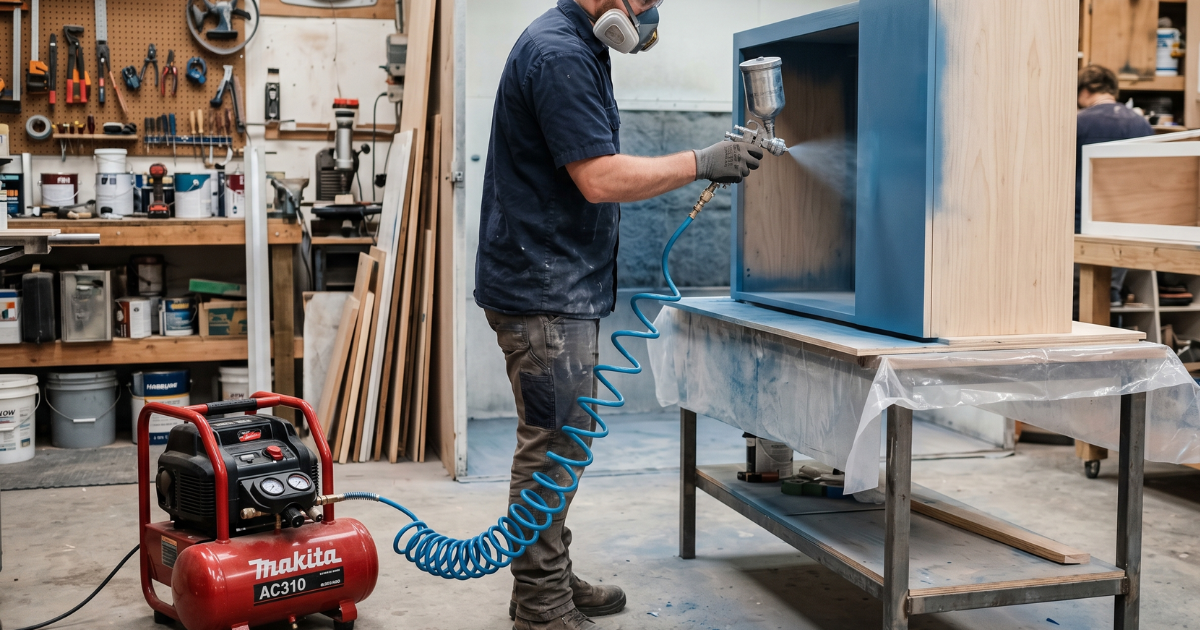
Best Air Compressors for Spray Painting UK 2026
Six compressors ranked specifically for spray painting - from LVLP touch-up work and furniture spraying to full automotive bodywork. Every pick is matched to real spray gun CFM requirements using Free Air Delivery (FAD) figures, not the inflated displacement numbers used in most marketing.
⚠ Read This First — Displacement CFM vs Free Air Delivery (FAD)
Almost every air compressor sold in the UK quotes a displacement CFM figure - the theoretical maximum if the pump were 100% efficient. This number is not what your spray gun receives. The figure that matters is Free Air Delivery (FAD) - the actual volume of air delivered at your working pressure. FAD is typically 50–65% of the displacement figure, and for spray painting it is the only specification worth comparing.
Real-world example: The Clarke SHHH50/350 advertises 16.9 CFM. The manufacturer's own technical manual (page 18) states FAD of 155 L/min at 7 bar - that is 5.5 CFM, not 16.9. This guide uses confirmed FAD figures throughout so you can make like-for-like comparisons.
⚡ Quick Answer — Best Compressor for Spray Painting UK 2026
Airbrush & hobby work: Hyundai HY7524X (3.5 CFM FAD, silent, ~£180–£220).
LVLP gun, touch-ups, furniture: Hyundai HY27550 (6 CFM FAD, silent 60 dB, ~£295–£370) — our Top Pick for home spray painting.
HVLP full-size gun, fences, sheds, panels: Hyundai HY3050V (7 CFM FAD, ~£270–£330) or Clarke Raider 15/550 (~£250–£300).
Quiet workshop with HVLP demands: Clarke SHHH50/350 (5.5 CFM FAD, 66 dB, ~£350–£420).
Sustained automotive bodywork & full resprays: Airmaster 14/100P belt-drive (estimated 8–9 CFM FAD, ~£400–£480) - the only machine in this guide capable of running a professional full-size HVLP gun continuously.
All 6 Picks — Spray Painting Comparison
All CFM figures are Free Air Delivery (FAD) unless marked as displacement. FAD is what your spray gun actually receives.
| # | Model | FAD (actual) | Tank | Noise | Oil-Free | Spray Use Case | Price |
|---|---|---|---|---|---|---|---|
| 1 | Hyundai HY7524X | ~3.5 CFM FAD | 24L | 62 dB | ✓ | Airbrush, LVLP touch-up, hobby | ~£180–£220 |
| 2 | Hyundai HY27550 ★ Top Pick | 6 CFM FAD | 50L | 60 dB | ✓ | LVLP gun, furniture, fence, shed | ~£295–£370 |
| 3 | Hyundai HY3050V | 7 CFM FAD | 50L | ~90 dB | ✓ | HVLP touch-up, panels, garden spraying | ~£270–£330 |
| 4 | Clarke Raider 15/550 | ~7 CFM FAD (est.) | 50L | ~90 dB | ✓ | HVLP touch-up, panels, garden spraying | ~£250–£300 |
| 5 | Clarke SHHH50/350 | 5.5 CFM FAD | 50L | 66 dB | ✓ | LVLP gun, quiet workshop, furniture | ~£350–£420 |
| 6 | Airmaster 14/100P | ~8–9 CFM FAD (est.) | 100L | ~75 dB | ✗ Oil-lubricated | Full HVLP, automotive, sustained spraying | ~£400–£480 |
In This Guide
- What CFM Do You Actually Need for Spray Painting?
- HVLP vs LVLP vs Airbrush - Gun Types Explained
- Oil Contamination & Why It Ruins Paint
- 1. Hyundai HY7524X - Airbrush & Hobby
- 2. Hyundai HY27550 - Top Pick Home Spraying
- 3. Hyundai HY3050V - HVLP & Workshop
- 4. Clarke Raider 15/550 - Budget Workshop Pick
- 5. Clarke SHHH50/350 — Quiet Workshop
- 6. Airmaster 14/100P — Automotive & Professional
- Essential Spray Painting Accessories
- Which Compressor for Which Painting Task?
- Frequently Asked Questions
1. What CFM Do You Actually Need for Spray Painting?
Spray painting is the most demanding application for any air compressor because it requires sustained air delivery — not just a burst as with a nailer or tyre inflation, but consistent volume at consistent pressure for the entire duration of a pass. This is why the FAD figure matters so much more for spray painting than for any other tool.
The key rule for compressor selection: your compressor's FAD at working pressure should exceed your spray gun's CFM requirement by at least 25–30%. Running a compressor at 100% of its capacity for sustained spraying degrades motor life, causes uneven pressure delivery as the tank cycles, and produces inconsistent paint atomisation — visible as patches, orange peel, or runs in the finished coat.
| Spray Task | Min FAD Needed | Typical PSI at Gun | Suitable picks from this guide |
|---|---|---|---|
| Airbrush (hobby, detail) | 0.5–2 CFM FAD | 15–25 PSI | HY7524X, HY27550 |
| Touch-up gun (0.8–1.0 mm) | 3–5 CFM FAD | 20–30 PSI | HY27550, SHHH50/350 |
| LVLP full gun - furniture, fences, sheds | 4–6 CFM FAD | 20–30 PSI | HY27550, SHHH50/350, HY3050V |
| HVLP small gravity gun (1.3 mm) - panels, cars | 6–8 CFM FAD | 25–40 PSI | HY3050V, Raider 15/550, Airmaster 14/100P |
| HVLP full-size gun (1.4 mm) - automotive | 8–12 CFM FAD | 28–45 PSI | Airmaster 14/100P (only fully suitable pick) |
| Professional automotive - whole car respray | 12–15 CFM FAD | 30–50 PSI | Beyond the scope of this guide — professional compressors required |
ⓘ An Honest Note on UK Domestic Compressor Limitations
No 13A-plug domestic compressor in this guide - nor any available at Machine Mart or Hyundai - delivers 12+ CFM FAD. Full whole-car resprays with professional-grade HVLP guns genuinely require 12–15 CFM FAD continuously, which demands a 3-phase or dedicated high-current supply machine. Every compressor in this guide can handle spray painting tasks from airbrushing up to single-panel automotive work, and several handle intermittent full-panel work. None will sustain a professional 13 CFM HVLP gun continuously through a full car respray on a 13A plug.
2. HVLP vs LVLP vs Airbrush - Gun Types & What They Need
Airbrush
0.5–2 CFM FAD · 15–25 PSI
Used for scale modelling, fine detail painting, cake decoration, and nail art. Extremely low CFM requirement — virtually any compressor over 8L handles an airbrush comfortably. Requires very low, stable pressure. A regulator is essential to reduce compressor output pressure to airbrush operating range.
LVLP — Low Volume Low Pressure
3–6 CFM FAD · 20–30 PSI
Designed for smaller compressors. Lower CFM requirement than HVLP at the trade-off of slightly less transfer efficiency and requiring more passes for complete coverage. Ideal for furniture, garden equipment, fences, touch-up bodywork, and general DIY spraying from a 50L domestic compressor.
HVLP — High Volume Low Pressure
6–14 CFM FAD · 25–45 PSI
The professional standard for automotive and fine finishing work. Higher paint transfer efficiency (up to 65%) than conventional guns — less overspray and material waste. The full-size HVLP (1.3–1.4 mm air cap) requires 8–14 CFM FAD continuously. A demanding gun that exposes the real FAD limitations of domestic compressors.
The most practically important conclusion from understanding gun types: matching your gun to your compressor is as important as the compressor itself. A 4 CFM FAD compressor like the HY27550 paired with a good LVLP gun produces consistently better spray painting results than the same compressor struggling with a full-size HVLP gun that needs 10 CFM. Buy the gun that matches your compressor's FAD, not the other way round.
3. Oil Contamination - Why It Ruins Spray Paint Finishes
Oil-lubricated compressors (like the Airmaster 14/100P belt-drive) use oil to lubricate the pump cylinders. A small amount of this oil inevitably enters the compressed air stream as a fine mist. In the air supply to a spray gun, oil contamination causes fish-eye defects, small circular craters in the painted surface where oil has repelled the paint. Even trace amounts invisible to the eye cause adhesion problems and finish defects that require sanding back and respraying.
✓ Oil-Free compressors (spray painting preferred)
HY7524X, HY27550, HY3050V, Clarke Raider 15/550, Clarke SHHH50/350. No oil in the air stream - clean, dry air direct from the compressor. Safe for all spray painting applications with a moisture trap fitted.
⚠ Oil-lubricated compressors (needs oil separator)
Airmaster 14/100P. Can be used for spray painting only with a high-quality coalescing oil separator/filter fitted in the airline before the spray gun. Do not attempt automotive spray work from an oil-lubricated compressor without one.
Moisture is a separate concern that applies to all compressors. Compressed air contains atmospheric moisture that condenses in the tank and hose as liquid water. Water droplets reaching the spray gun cause blushing (milky, cloudy finish in topcoats), paint adhesion failure, and streaking in base coats. A water/moisture separator trap fitted in the airline is not optional for spray painting - it is a requirement for all compressors regardless of oil-free status.
Essential Spray Painting Accessories
The compressor alone is not a complete spray painting setup. Every machine in this guide requires additional accessories before it can produce a quality paint finish.
💧 Moisture / Water Separator
Required for all compressors. Inline filter that removes condensed water droplets from the airline before they reach the gun. Without one, moisture causes blushing, fisheye, and paint adhesion failure. Fit as close to the spray gun as practical. Budget ~£10–£25.
⚡ Pressure Regulator
Required for all spray work. Reduces compressor outlet pressure (up to 116 psi) to the lower operating pressure of your spray gun (typically 20–45 PSI). Most compressors include one — check it is present before spraying. A separate high-quality regulator fitted at the gun gives finer control.
🧰 Coalescing Oil Separator
Required for oil-lubricated compressors (Airmaster 14/100P). Removes fine oil mist from compressed air. A basic water separator will not remove oil mist — a dedicated coalescing filter is needed. Budget ~£20–£40. Fit upstream of the water separator.
📪 Quality Airline Hose
A 10m airline hose allows you to position the compressor away from the painting area — reducing noise at the gun and keeping compressor vibration from disturbing the work surface. A coiled recoil hose is more convenient for close-range work. Ensure the bore size matches your compressor's fittings.
🌠 LVLP Spray Gun
For most domestic compressors below 8 CFM FAD, an LVLP gun matched to your compressor's actual FAD will produce far better results than a mismatched HVLP gun. Brands worth considering include DeVilbiss, Iwata, Sata (at higher budgets) or Draper and SGS for entry-level work. Match the air cap specification to your CFM.
🧻 PPE — Respirator & Eye Protection
Paint vapour from spray guns is hazardous to inhale. A P3-rated or higher spray painting respirator (not a dust mask) is essential. Full face visor or safety glasses protect eyes from atomised paint mist. Disposable spray suit prevents skin and clothing contamination. These are not optional safety measures.
Which Compressor for Which Spray Painting Task?
Airbrush / Scale modelling / Nail art
Hyundai HY7524X — quiet, over-specified, ideal
Car scratch repair / LVLP touch-up in residential garage
Hyundai HY27550 — 6 CFM FAD, 60 dB, silent
Garden furniture, bikes, cabinets — residential
Hyundai HY27550 — best quiet option with enough FAD
Fences, sheds, large structures — detached garage
Hyundai HY3050V — 7 CFM FAD, highest output + kit included
Automotive panels — detached garage, budget priority
Clarke Raider 15/550 — same FAD as HY3050V, lower price, no kit
Quiet workshop spraying — semi-commercial setting
Clarke SHHH50/350 — 66 dB, 5.5 CFM FAD, all-day operation
Full automotive bodywork — HVLP 1.3+ mm gun
Airmaster 14/100P — only machine in this guide for sustained HVLP
Complete whole-car professional respray
Beyond this guide — requires 12–15 CFM FAD and professional supply
Frequently Asked Questions
★ Garden-Review Final Verdict — Spray Painting
For most UK DIYers spray painting furniture, garden equipment, fences, cabinets, and touch-up automotive work from a residential garage, the Hyundai HY27550 is the standout recommendation. It delivers 6 CFM FAD at 60 dB — genuinely quiet, clean oil-free air, and enough output for a well-matched LVLP gun to produce excellent results on all the tasks that matter most to home spray painters. Match it with a quality LVLP gun rather than a large HVLP and the results will consistently exceed expectations.
For a detached garage with no noise constraints where the priority is maximum FAD per pound, the Hyundai HY3050V is the better choice — 7 CFM FAD, lower price, and the 5-piece kit included. For the home car restorer who genuinely needs to run a full-size HVLP gun through multiple body panels, only the Airmaster 14/100P delivers the sustained 8–9 CFM FAD and 80–90% duty cycle the task requires — with a coalescing filter fitted.
★ Top Pick — Home spray painting
Hyundai HY27550
6 CFM FAD · 60 dB · £295–£370
Detached garage / best FAD value
Hyundai HY3050V
7 CFM FAD · 90 dB · £270–£330
Automotive bodywork — serious use
Airmaster 14/100P
8–9 CFM FAD · 75 dB · £400–£480
FAD figures for the Hyundai HY27550 (150 L/min / 6 CFM) and HY3050V (200 L/min / 7 CFM) sourced from multiple authorised Hyundai UK stockists including The Power Site, Bata Ltd, Nicky Grist, and UK Planet Tools. SHHH50/350 FAD (155 L/min / 5.5 CFM at 7 bar) sourced from Clarke's own manufacturer technical manual (document 2242050, page 18), confirmed via Detailing World forum cross-reference. HY7524X FAD estimated at ~3.5 CFM based on 5.2 CFM displacement and standard diaphragm pump conversion ratio. Airmaster 14/100P FAD estimated at 8–9 CFM based on belt-drive class efficiency ratios — Machine Mart does not publish a confirmed FAD figure; verify before purchase. All prices are guide ranges as of May 2026 - verify current pricing before purchase.
Tags
Comments
Join the conversation
Create a free account to leave comments, share photos, and connect with other gardeners.
Related Articles
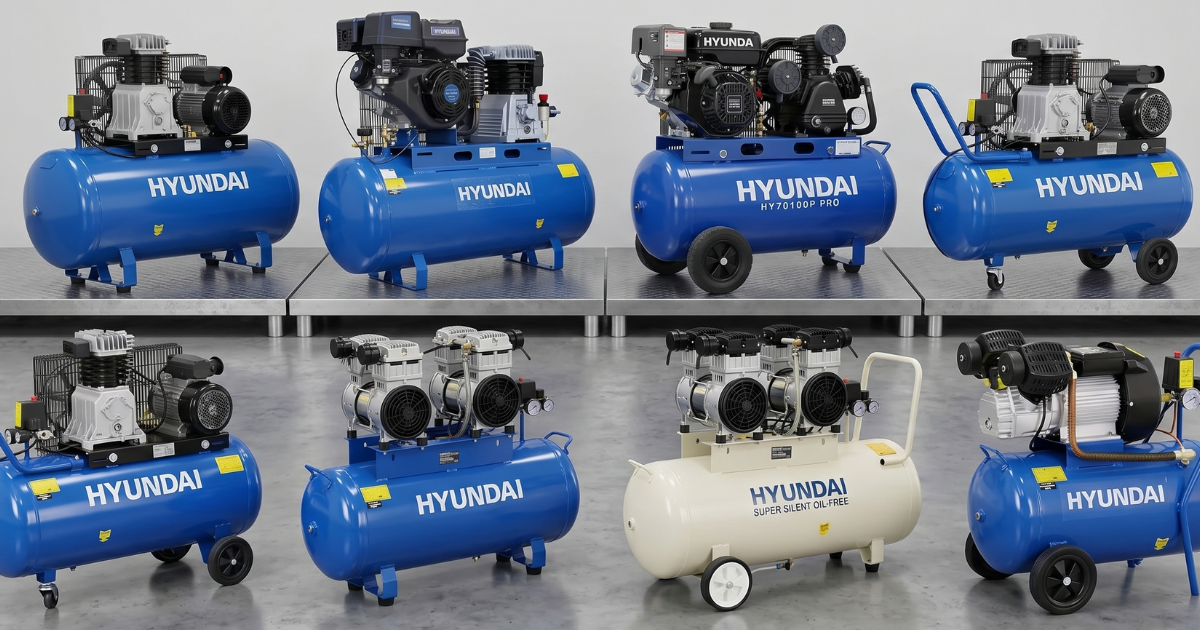
Hyundai Air Compressor Buying Guide 2026
Choose the right Hyundai air compressor with this 2026 UK buying guide. From quiet oil-free models like the HY7524X to powerful V-Twin and belt drive compressors such as the HY3050V and HY3150SX, this guide helps you match Hyundai performance and FAD output to your tools for home, garage, or professional use.
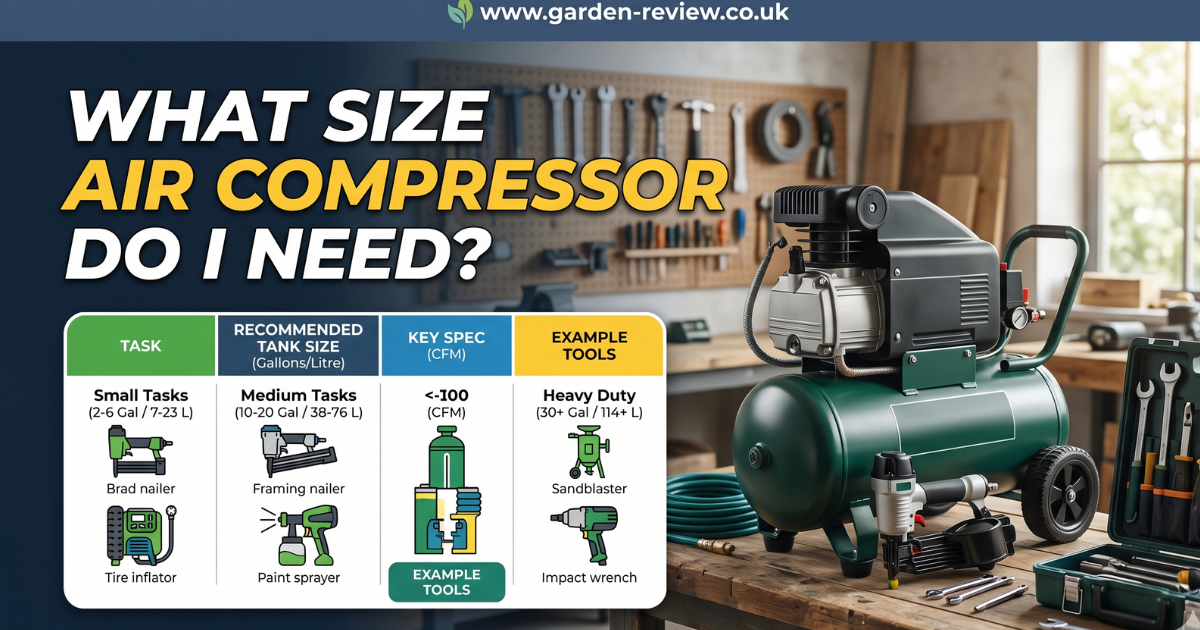
What Size Air Compressor Do I Need? Workshop Guide
CFM, tank size, PSI, duty cycle - explained in plain English, with a step-by-step sizing method and a full tool-by-tool chart for every common application.
Air Compressor Buyer’s Guide for 2026
Air Compressor Buyer’s Guide UK 2026: Learn CFM, PSI, tank sizes and the best compressor for DIY, garages and workshops.
Best Air Compressors for Nail Guns
Looking for the best air compressors for nail guns in the UK in 2026? This guide compares 7 top air compressors for brad nailers, finish nailers, framing nailers, and flooring staplers. We explain which compressors suit DIY joinery, first-fix framing, and workshop use - including tank size, PSI, noise levels, and the best quiet compressors for UK home garages.
Best Air Compressors for DIY UK
Looking for the best air compressors for DIY UK projects in 2026? This guide compares 9 of the best DIY air compressors available, covering everything from compact 8L compressors for nail guns and tyre inflation to powerful 100L workshop models for spray painting and air tools. We explain which compressor is best for home garages, quiet residential use, DIY workshops, and sustained tool use - with honest pros, cons, noise levels, CFM guidance, and real-world UK buying advice.
Airmaster Air Compressor Buying Guide 2026
Everything you need to know before buying an Airmaster compressor - from the compact Tiger range for home workshops to the heavy-duty belt-driven industrial models.