
Petrol Log Splitter Buying Guide: When Petrol Makes Sense
When a petrol log splitter beats electric: remote sites, big rounds and high-volume splitting. Tonnage, cycle times, towing, fuel and hire.
Key takeaways
- Electric log splitters are limited by the UK 13A socket: roughly 3kW at most, which caps the motor, the pump and therefore the speed and force.
- Ranges drawn from manufacturer and retailer specs checked October 2026, including Forest Master's electric and petrol ranges, The Handy, Scheppach and Oxdale hire machines.
- On petrol machines, extra tonnage mainly buys you bigger diameters, tougher species and knots .
- There are three designs: Most serious petrol splitters use a two-stage pump.
- Petrol splitters are heavy: about 85kg for Forest Master's petrol Fast Fire, 101kg for the Oxdale SE400 and close to 300kg for the FM22VPT.
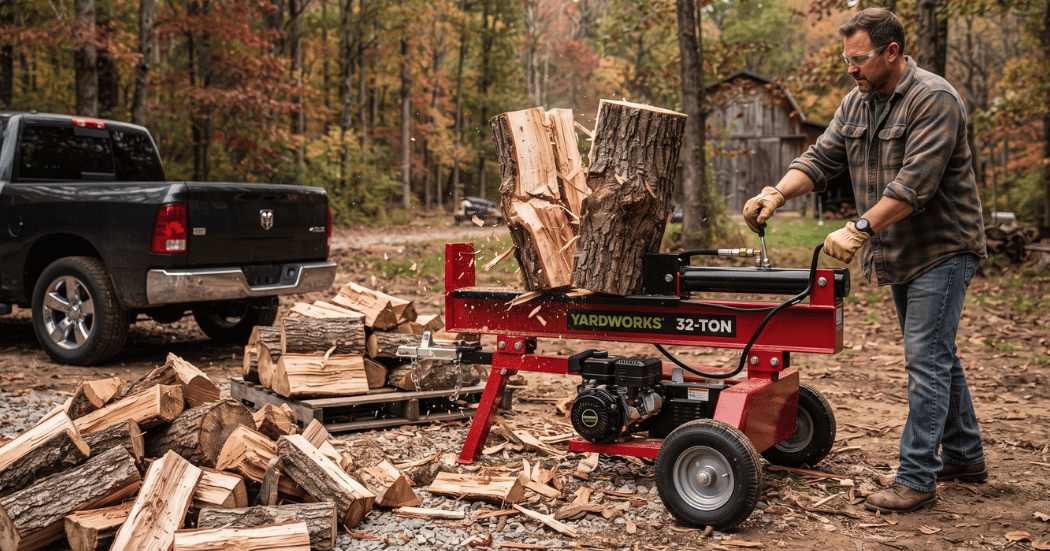
Published October 2026 · Last checked October 2026 · Approx. 15-minute read
Quick answer
A petrol log splitter makes sense when there's no mains power where the wood is, when you're regularly splitting large or knotty rounds over 30–40cm, or when you're processing several cubic metres a season. Most hydraulic petrol models deliver 10–25 tonnes with a two-speed pump and split logs up to 50cm–1.1m long, far beyond a 13A electric machine. If you split a few barrow-loads a year near the house, an electric splitter (or a day's hire) is cheaper, quieter and easier to live with.
In this guide
- When petrol makes sense (and when it doesn't)
- Petrol vs electric at a glance
- Tonnage and larger rounds
- Cycle time, two-stage pumps and kinetic splitters
- Remote working: moving and towing
- Horizontal, vertical or both?
- Fuel, E10 and engine care
- Noise, exhaust and safety
- Buy or hire?
- Petrol splitters worth shortlisting
- FAQs
How we put this guide together: this is a research-based guide, not a hands-on test. I worked from manufacturers' published specifications and manuals (Forest Master, Rock Machinery, SIP, Lumag, HZC Power), UK hire-company listings, GOV.UK fuel guidance and UK arborist forum discussion. Throughput figures are my own illustrative arithmetic and are labelled as such. Where sources disagree, I say so. Garden-Review earns a commission if you buy through the Amazon links below, at no extra cost to you; it doesn't change what we recommend.
Petrol Log Splitter Buying Guide: When Petrol Makes Sense for Remote Sites, Big Rounds & Volume
Electric log splitters are limited by the UK 13A socket: roughly 3kW at most, which caps the motor, the pump and therefore the speed and force. A petrol engine removes that ceiling and the cable. That opens up three jobs that electric machines struggle with.
1. Remote working
Woodland, field edge, allotment or a storm-felled tree at the bottom of a long garden. No socket, no extension-lead voltage drop, and you take the splitter to the timber rather than hauling rounds to the house.
2. Larger rounds
Trunk sections, knotty hardwood and long logs. Petrol hydraulic machines commonly run 10–25 tonnes and accept logs from about 45cm up to 1.1m long. Domestic electric models top out around 7–8 tonnes and 45–52cm.
3. Sustained high volume
Heating a farmhouse, supplying several stoves, or running a smallholding. Two-speed pumps and kinetic flywheels cut cycle times, and that adds up over a long day.
Petrol is probably the wrong choice if you split near a socket, your logs are mostly under 30cm, you only need a few loads a year, or noise is a problem for neighbours. In that case read our guide to choosing an electric log splitter instead.
Petrol vs electric at a glance
| Factor | Domestic electric | Petrol |
|---|---|---|
| Typical force | 4–8 tonnes | 8–25+ tonnes |
| Max log length | 30–52cm | 45cm–1.1m |
| Cycle time | 8–22 seconds | 3 seconds (kinetic) to ≈ 10–15 seconds (two-stage hydraulic) |
| Power source | 13A socket, ideally within 10m | Anywhere |
| Weight | 32–67kg | 85–335kg |
| Noise and fumes | Quiet, no exhaust | Loud (hire listings quote up to 104dB), carbon monoxide |
| Maintenance | Hydraulic oil only | Hydraulic oil plus engine oil, fuel, plug and air filter |
| Price (new) | £280–£700 | £1,000–£3,000+ |
Ranges drawn from manufacturer and retailer specs checked October 2026, including Forest Master's electric and petrol ranges, The Handy, Scheppach and Oxdale hire machines.
Tonnage and larger rounds
Tonnage is the maximum force at full hydraulic pressure. On petrol machines, extra tonnage mainly buys you bigger diameters, tougher species and knots. Rough guidance by tonnage band:
- 8–10 tonnes: stove-length hardwood up to about 40cm. Forest Master's 8-ton Fast Fire is rated for 50–400mm diameter at 520mm long.
- 15–20 tonnes: larger, knottier rounds and longer logs for open fires or for cross-cutting later.
- 22–25 tonnes: big trunk sections and long timber. Forest Master's FM22VPT handles logs up to 1.1m.
- 30–40 tonnes: farm and estate volumes of large, knotty rounds, usually with a log lifter, such as HZC Power's 40-ton HS40335.
Two cautions. First, bigger tonnage doesn't automatically mean a faster or better machine. On UK forum Arbtalk, one experienced user warned that a "6.5hp engine on a 17 or 22 tonne machine is definitely going to be painfully slow in both directions", because the same pump has to fill a bigger ram. Check the engine size and the cycle time, not just the tonnage. Second, wedge shape matters. The same forum user noted that a short wedge copes better with knots, while a long wedge is quicker on clean timber.
Cycle time, two-stage pumps and kinetic splitters
Cycle time is how long the ram takes to go out and back. For volume work it matters as much as tonnage. There are three designs:
Two-stage (two-speed) hydraulic
Most serious petrol splitters use a two-stage pump. The ram moves fast at low pressure until it meets resistance, then switches to slower, full-pressure splitting. Forest Master's FM22VPT, for example, runs at "14-ton fast splitting speed and 22-ton slower power mode for tougher, dense logs", with a quoted 14-second full cycle on a 1.1m log. Oxdale's 10-tonne SE400, a common UK hire machine, uses a "Dual Speed Hydraulic Pump" with a full cycle "under ten seconds".
Kinetic (flywheel)
Kinetic splitters don't use a hydraulic ram. The engine spins a heavy flywheel, which stores energy and releases it in one fast stroke. Forest Master's Fast Fire models claim a 3-second cycle using a 19.5kg flywheel on the 8-ton model. The trade-off is that they're designed around one fast strike rather than slow, sustained force. Forest Master's own manual says that if a log doesn't split fully, "DO NOT keep the power on and the lever engaged."
What cycle time means in practice
As an illustration of my own (not a test result), assume you spend about 10 seconds loading and clearing each log. A 15-second cycle then gives roughly 140 strokes an hour. A 3-second kinetic cycle gives roughly 275. Your own handling speed is often the real bottleneck, which is why log lifts, work tables and good positioning matter on high-volume days.
Remote working: moving and towing
Petrol splitters are heavy: about 85kg for Forest Master's petrol Fast Fire, 101kg for the Oxdale SE400 and close to 300kg for the FM22VPT. How you'll move it is a key buying decision:
- Wheeled stands (for example, rear wheels and locking castors) suit yards, garages and hard paths.
- Large pneumatic wheels and a handle let one person push a 10-tonne machine across grass.
- Tow hitches and trailer kits let you pull larger machines behind a quad, ride-on or compact tractor across your own land.
"Towable" usually doesn't mean road-legal. Many splitter hitches and pneumatic wheels are sold for off-road use on your own land only, and none of the towable models in this guide is listed as road-legal. Towing on a public road in the UK brings trailer requirements, including lights, number plate and reflectors under the Road Vehicles Lighting Regulations 1989, plus suitable road-rated tyres, wheel bearings and coupling. Unless the manufacturer explicitly states a splitter is road-legal, transport it on a trailer that is.
Horizontal, vertical or both?
Vertical operation is the big advantage on larger petrol machines. You roll a heavy round onto the base plate instead of lifting it, which saves your back on trunk sections. The FM22VPT splits vertically and adds a built-in log lifter. Horizontal operation is quicker for repetitive stove-length logs fed from a pile at waist height. Some models offer both. Rock Machinery's 15-ton Venom C-Series, for example, switches between the two, so you can move between big rounds and production splitting. If you want vertical on a budget, Lumag's 8-ton HB8N is vertical-only.
Fuel, E10 and engine care
Since 2021, E10 petrol (up to 10% ethanol) has been the standard grade at UK pumps. GOV.UK's guidance lists "petrol-powered garden equipment or machinery, such as lawnmowers and chainsaws" among equipment that "may not be compatible" and advises owners to check the manual or ask the manufacturer. It adds: "If in doubt, continue to use E5 (97+ octane) petrol," which is sold as the 'super' grade at most filling stations.
Splitters sit unused for months, which makes storage the bigger issue. Forest Master warns that E10's "higher ethanol content makes it more susceptible to water contamination and fuel separation during storage" and suggests not storing E10 for more than 30 days. My practical advice:
- Check the engine handbook for the approved fuel grade. Forest Master's Fast Fire manual says to fill with fuel and oil "as specified in the engine manufacturers handbook".
- Buy fuel in small amounts, and consider E5 super unleaded or a fuel stabiliser if the machine will stand for a while.
- Before winter storage, drain the tank and carburettor or run it dry. Our carburettor cleaning guide shows why stale fuel causes most non-starts.
- Petrol splitters are usually supplied without engine oil. Fill it before the first start.
- Change hydraulic oil at the interval in the manual. Forest Master recommends every 150 hours on its electric splitters.
Shop fuel stabiliser on Amazon Shop 4-stroke engine oil Shop fuel cans
Noise, exhaust and safety
- Carbon monoxide: never run a petrol splitter in a garage, barn or shed with the doors shut. Forest Master's manual is explicit: "DO NOT operate the log splitter in an enclosed area. The exhaust fumes contain carbon monoxide an odourless and deadly gas."
- Noise: UK hire listings quote noise levels up to 104dB for a 10-tonne petrol splitter. Wear ear defenders, and think about neighbours and timing.
- Two-hand controls: on Forest Master's petrol Fast Fire, one hand holds the throttle control and the other the operating handle. On Arbtalk, an experienced user put it bluntly: "if it is only one hand operation there's no way it can be CE approved so they shouldn't be selling it." Avoid single-handed machines.
- One operator only, and keep helpers and children clear of the wedge. Wear gloves, safety boots and eye protection.
- Stop the engine before moving the machine, and don't adjust the governor or over-speed the engine.
- Using it for work? If you split firewood for sale or as part of a business, the Provision and Use of Work Equipment Regulations (PUWER) and noise-at-work rules apply. Keep training and maintenance records.
If your machine loses force or speed, our guide to slow rams, leaks and splitters that won't split covers the hydraulic side.
Buy or hire?
For a one-off storm clear-up, hiring often wins. Prices from two UK hire listings checked October 2026, both for an Oxdale SE400 10-tonne petrol splitter:
| Hirer | First day | Week | Notes |
|---|---|---|---|
| TFM Farm & Country | £67.50 | £168.75 | £33.75 each extra day; £168.75 refundable deposit |
| Mammoth Hire | £225.18 (24h) | £281.47 | Inc. VAT; damage waiver and delivery extra |
Prices vary widely by region and supplier. Check locally.
Rule of thumb: if you'd hire for more than about a week in total each year, or you need the machine at short notice during winter, buying starts to make sense. A new petrol splitter costs roughly £1,000–£3,000, so compare that with several seasons of hire, plus delivery, and the cost of your time collecting and returning it.
Petrol log splitters worth shortlisting
These research-based picks cover the main use cases. Prices change often, so check the live listing.
At a glance:
| Model | Force | Engine | Max log length | Layout | Best for |
|---|---|---|---|---|---|
| Forest Master FM8FF-HTW | 8t kinetic | Honda GX35 | 520mm | Horizontal | Speed (3s cycle) |
| Forest Master FM22VPT | 22t two-stage | 263cc | 1.1m | Vertical | Long logs, trunk rounds |
| Rock 15ton Venom C-Series | 15t | B&S Vanguard 6.5hp | 520mm | Horizontal + vertical | All-rounder |
| Rock 12 Ton Venom | 12t | Honda GX 6.5hp | 500mm | Horizontal | Portable, van-sized |
| SIP 8 Petrol Ton Log Splitter | 8t | 196cc 6.5hp | 520mm | Horizontal | Budget petrol |
| Lumag HB8N | 8t | Loncin 196cc | 550mm | Vertical | Less lifting on a budget |
| HZC Power HS40335 | 40t | B&S 13.5hp | 530mm | Horizontal, log lifter | Heavy-duty volume |
Specs from manufacturer and retailer listings, checked October 2026.
BEST FOR SPEED & HIGH-VOLUME STOVE LOGS
Forest Master FM8FF-HTW Fast Fire — 8 ton kinetic, Honda engine
The quickest machine here on paper. Its flywheel gives a claimed 3-second cycle, and it's powered by a Honda GX35 four-stroke, which Forest Master markets as Honda-certified. It splits logs 50–400mm across and up to 520mm long, and at about 85–100kg (sources vary) it moves on a wheeled stand with locking castors. One owner on Forest Master's site reports "at least 3 times more production done in the same time" than with his hydraulic splitter. It's best on stove-length logs rather than huge trunk rounds. The warranty in the manual is a 1-year limited parts warranty, shorter than some rivals. List price was £999.95 on Forest Master's site when checked.
- 8t kinetic · Honda GX35 · 3s cycle · 400mm × 520mm
- Pick it for: volume splitting of stove logs, yard or smallholding use
- Skip it if: you split big trunk sections or need a tow hitch
BEST FOR BIG ROUNDS & LONG LOGS
Forest Master FM22VPT — 22 ton vertical, two-stage
This is the serious end of domestic and smallholding splitting. It has a 263cc Euro 5 petrol engine and a two-stage pump (14 tonnes fast, 22 tonnes power), and splits logs up to 1.1m long with a quoted 14-second full cycle. It also has a built-in log lifter, a two-way ram stop and manual or auto return. It splits vertically and folds horizontal for moving on the optional trailer package, which is described for use around your property, not as road-legal. At about 300kg it's not something you push around a garden. Forest Master priced it from £1,839.95 when checked. It's a newer model with only two reviews on Forest Master's site so far: one positive ("It certainly packs a punch") and one reporting assembly problems with the trailer kit. Check the assembly support before you buy.
- 22t two-stage · 263cc · logs up to 1.1m · 14s cycle · ≈300kg
- Pick it for: farms, woodland owners, trunk sections
BEST HORIZONTAL + VERTICAL ALL-ROUNDER
Rock Machinery 15ton Venom C-Series — 15 ton, Briggs & Stratton Vanguard
Rock Machinery is a UK log-splitter specialist, and its 15-ton Compact Series is built for people who want one machine for both jobs: vertical for heavy rounds you'd rather roll than lift, and horizontal for production splitting. It uses a 6.5hp Briggs & Stratton Vanguard engine, the commercial-grade series one Arbtalk owner of a larger Rock model described as "reliable and very good on fuel". It takes logs up to 52cm, has two-hand controls and auto return, and weighs around 137kg. Rock says the design "combines the practical design of larger models with a machine that's easy to store and manoeuvre." It was listed at £1,375 when checked. The same owner advised keeping "your eye on the hydraulic oil reservoir filler screw, and the hoses", so check fittings after delivery.
- 15t · B&S Vanguard 6.5hp · up to 520mm · horizontal and vertical · ≈137kg
- Pick it for: mixed big rounds and stove logs, smallholdings
BEST PORTABLE HONDA-POWERED HYDRAULIC
Rock Machinery 12 Ton Venom — 12 ton, Honda GX 6.5hp
A compact horizontal splitter for buyers who want Honda engine reliability without moving to a big trailed machine. It has a quoted 10-second cycle, takes logs up to 500mm, and has two-hand controls with an auto-return valve. At about 125kg on large pneumatic tyres it can be wheeled to the wood pile, and retailer The Green Reaper says it "can fit on a small trailer or in a van". Rock states it "conforms fully with EU health and safety regulations". It was listed at £1,225 when checked. The bed is fairly low, so plan to work from a log table or stand if you're splitting for hours.
- 12t · Honda GX 6.5hp · 10s cycle · up to 500mm · ≈125kg
- Pick it for: remote stove-log splitting, van or trailer transport
BEST BUDGET PETROL SPLITTER
SIP 01987 8 Ton Petrol Log Splitter — 196cc, horizontal
SIP is an established UK workshop-equipment brand, and this is one of the most affordable ways into petrol splitting. It has a 196cc 6.5hp Euro V four-stroke and 8 tonnes of force, and handles logs 70–300mm across and 120–520mm long, which covers most stove wood. A large wheel helps on rough ground, and it weighs around 115kg. SIP describes it as "suitable for short periods of continuous use within the agricultural and landscaping sector", so it's better for regular weekend splitting than all-day production. It has a 2-year domestic warranty. The engine brand isn't named, so check parts availability before you buy.
- 8t · 196cc 6.5hp · 300mm × 520mm · ≈115kg · 2-year warranty
- Pick it for: occasional remote splitting on a tighter budget
BEST VALUE VERTICAL
Lumag HB8N — 8 ton vertical, Loncin 196cc
A vertical petrol splitter at a horizontal-machine price. You stand the round on the base rather than lifting it onto a bed. It uses a 6hp Loncin G200F four-stroke and takes logs 250–550mm long and 80–350mm across, with a stop clamp to shorten the stroke for quicker cycles on short logs. It has two-hand operation and weighs around 121kg. Lumag says it's "much stronger than similar looking models". It was listed at £995 when checked. The warranty is listed inconsistently (5 years in the description, 12 months in the site banner), so confirm it in writing before buying.
- 8t · Loncin 196cc · 350mm × 550mm · vertical · ≈121kg
- Pick it for: heavier rounds without the back strain, on a budget
BEST HEAVY-DUTY / HIGH-VOLUME
HZC Power HS40335 — 40 ton, Briggs & Stratton 13.5hp
If you're heating a farmhouse or processing timber in bulk, this is the heavyweight here. It has 40 tonnes of force from a 13.5hp Briggs & Stratton engine, a log lifter so you don't have to hoist big rounds, two-hand operation, an oil filter and a tow coupling. It takes logs up to 53cm and weighs around 335kg, so you'll need a quad or compact tractor to move it. The hitch is for your own land: nothing in the listings says it's road-legal. HZC's spec sheet for a closely related 40T model quotes a two-stage pump and a 15-second cycle. It was priced around €3,090 on Amazon Germany in March 2026, so expect a premium price in the UK too.
- 40t · B&S 13.5hp · up to 530mm · log lifter · tow coupling · ≈335kg
- Pick it for: farms, estates, very high volumes of large rounds
Not sure petrol is worth it? Compare it with electric in our electric log splitter guide, see ranked picks in Best Log Splitters UK 2026, or browse our log splitter reviews.
Useful extras
- Ear defenders and safety glasses: Shop on Amazon
- Riggers' gloves and safety boots: Shop on Amazon
- Hydraulic oil (use the grade in your manual): Shop on Amazon
- Log tongs or a pickaroon, to save your back with heavy rounds: Shop on Amazon
- Firewood moisture meter (burn at 20% or under): Shop on Amazon
Petrol log splitter buying checklist
- ✓ Do you really need petrol? No socket at the wood pile, big rounds, or high volume
- ✓ Tonnage matched to your largest regular rounds: 8–10t stove logs, 15–20t knotty or large, 22t+ trunk sections
- ✓ Engine size relative to tonnage: an underpowered engine on a big ram is slow
- ✓ Cycle time and pump type: two-stage hydraulic or kinetic flywheel
- ✓ Max log length for your stove, open fire or onward cross-cutting
- ✓ Vertical option or log lift if you handle heavy rounds
- ✓ How it moves: wheels, hitch, trailer. Is it road-legal? (Usually not.)
- ✓ Two-hand controls and a ram stop
- ✓ Fuel compatibility (E10 or E5) and a winter storage plan
- ✓ Warranty and parts: engine brand, dealer support, and how long the cover lasts (from 1 year to 2+ years in this guide, so check each listing)
About the author
Mark Moore is Garden-Review's Power Tools Specialist, covering petrol, mains and cordless equipment for UK homes, gardens and smallholdings. His buying guides focus on the decisions that matter after purchase, such as running costs, transport, fuel and safety, and are built from manufacturer documentation, UK regulations and owner feedback. Garden-Review is independent and reader-supported; see our methodology note above.
More in this hub: Log Splitters hub · Log splitter buying guides · Log splitter reviews · Choosing an electric splitter · Best Log Splitters UK 2026
Sources: Forest Master FM22VPT and Fast Fire product pages, Fast Fire manual and comparison chart (forest-master.com); Forest Master E10 fuel blog; GOV.UK "E10 petrol explained"; TFM Farm & Country and Mammoth Hire petrol splitter hire listings; Rock Machinery and The Green Reaper listings for the Rock 12 and 15 ton Venom; World of Power listing for SIP 01987; Lumag GB listing for the HB8N; HZC Power HS40335 listing (beste-testsieger.de) and HZC HS40285 spec sheet; Arbtalk forum threads on Forest Master splitters and towing. Checked October 2026.
Frequently Asked Questions: Petrol Log Splitter Buying Guide
Is a petrol log splitter better than electric?
What size petrol log splitter do I need?
Can I tow a petrol log splitter on the road?
Can I use E10 petrol in a log splitter?
What is a kinetic log splitter?
Should I buy or hire a petrol log splitter?
Tags
Comments
Join the conversation
Create a free account to leave comments, share photos, and connect with other gardeners.
Related Articles
Electric Log Splitter Guide UK: Power, Tonnage & Leads
How to choose an electric log splitter: 13A mains power, real splitting force, safe extension leads and what size suits your wood burner.
Manual Log Splitters Explained
Kindling crackers, axes, slide-hammers, foot and hand-pump hydraulic splitters: where each works, where it gets hard, and what to buy.
Log Splitter Tonnage Guide UK: What Size Do You Need?
What tonnage log splitter do you need? Match force to log diameter, wood species, grain, knots and moisture, not the badge alone.
Best 7 Ton Horizontal Log Splitters for 2026
Discover the best 7-ton horizontal log splitters for 2026, including top models from Hyundai, Scheppach, Zipper, Titan and Spectrum. Compare key differences in build quality, safety features, and performance to find the ideal electric log splitter for home firewood use, balancing power, reliability, and value for money.
Hyundai HYLS8000V Log Splitter: A UK Gardener's In-Depth Review
The Hyundai HYLS8000V 8-tonne electric log splitter is a serious contender for converting large quantities of timber into usable firewood. In this comprehensive UK review, we delve into its performance, features, safety, and overall value, helping you decide if this robust machine is the ideal choice for your garden or smallholding.
Hyundai Inverter Generator Buying Guide (2026)
Discover the latest Hyundai inverter generator range for 2026 in this comprehensive buying guide, covering everything from ultra-portable camping models to powerful home backup units. Whether you need quiet, fuel-efficient power for caravans, van life, or off-grid living, Hyundai’s inverter generators deliver clean pure sine wave electricity for safe use with sensitive electronics. Explore detailed comparisons, key specifications, and expert mini-reviews to help you choose the perfect generator for your needs.