
What Size Air Compressor Do I Need? Workshop Guide
CFM, tank size, PSI, duty cycle - explained in plain English, with a step-by-step sizing method and a full tool-by-tool chart for every common application.
Key takeaways
- Before looking at specific models, you need to understand three figures that appear on every compressor spec sheet.
- The table below lists typical CFM requirements for the most common pneumatic tools used in the UK.
- This method works for home DIY, trade use, and light industrial applications.
- Tank size is the most misunderstood aspect of compressor selection.
- Use these as a quick starting point, then apply the step-by-step method above to confirm your exact requirements.
Quick Answer
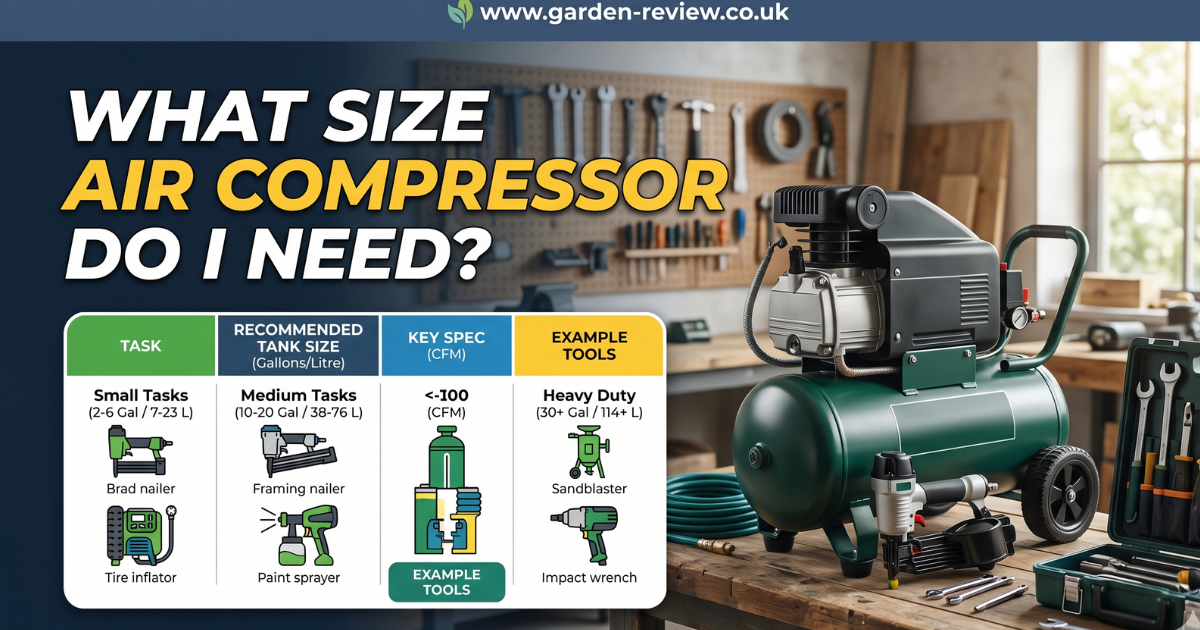
The right size air compressor depends on three things: the CFM (airflow) your tools require, the tank size for sustained use, and your available power supply. Most UK home workshop users need a 24–50 litre compressor delivering 7–10 CFM. Tradespeople and garages typically need 50–150 litres at 14 CFM or more. This guide shows you exactly how to work it out.
In This Guide
- The Three Key Specs Explained (CFM, PSI, Tank)
- CFM Requirements — Tool-by-Tool Chart
- How to Size Your Compressor: Step-by-Step
- Choosing the Right Tank Size
- Recommended Sizes by Use Case
- Direct Drive vs Belt Drive vs Rotary Screw
- UK Power Supply — What You Need to Know
- Common Sizing Mistakes to Avoid
- Frequently Asked Questions
- Quick Reference Summary
1. The Three Key Specs Explained
Before looking at specific models, you need to understand three figures that appear on every compressor spec sheet. Get comfortable with these and the rest of the buying process becomes straightforward.
CFM — Cubic Feet Per Minute (Airflow)
CFM measures the volume of air a compressor delivers every minute. It is the single most important number when choosing a compressor. Every pneumatic tool has a CFM requirement — if your compressor cannot meet it, the tool will underperform, stall, or work in frustrating short bursts.
On UK compressor specs you may also see FAD (Free Air Delivery) measured in litres per minute. To convert: 1 CFM = 28.3 l/min. You may also encounter SCFM (Standard CFM), corrected for temperature and altitude — for most UK buyers at sea level the difference is negligible.
Always choose a compressor whose CFM rating exceeds your most demanding tool's requirement — ideally by 25–30% to account for hose pressure drop, minor leaks, and tool wear over time.
Tip
Always choose a compressor that can deliver 25–30% more CFM than your most demanding tool requires. This safety buffer covers pressure drop through hoses, minor air leaks, tool wear and future expansion of your tool collection.
PSI / Bar — Pressure
PSI (pounds per square inch) and bar both measure air pressure — the force behind the air, not its volume. Most air tools require 4–7 bar (58–100 PSI) to operate correctly. UK compressors typically have a maximum working pressure of 8–10 bar, which covers virtually all common applications.
One important point: the minimum pressure your tool needs matters more than the compressor's maximum. Piston compressors start pumping at roughly 2 bar below their cut-out pressure, so factor this in — along with any pressure drop across long hose runs, dryers and inline filters.
Don't Confuse PSI with CFM
A compressor can have a high maximum pressure (PSI/bar) but low airflow (CFM). Pressure is the force; CFM is the volume. Both must be adequate — but CFM is almost always the limiting factor in practice.
Tank Size — The Air Receiver
The tank (properly called the air receiver) stores compressed air so the motor doesn't have to run continuously. A larger tank means longer working periods before the motor cycles on again — vital for sustained tasks like spray painting and sanding.
Critically: tank size does not increase CFM. A 200-litre tank on a low-output compressor still delivers the same airflow as a 24-litre tank with the same pump — it simply holds more air in reserve. For intermittent tools such as nail guns and impact wrenches, tank size is less important. For continuous-use tools, a large tank is essential.
Duty Cycle
Duty cycle expresses the percentage of time a compressor can run before needing to cool down. A 50% duty cycle means the machine should rest for every minute it runs. Direct-drive piston compressors are typically rated at 50–75% — fine for DIY and most trade use. Rotary screw compressors can operate at 100% duty cycle, making them ideal for continuous production environments.
2. CFM Requirements — Tool-by-Tool Chart
The table below lists typical CFM requirements for the most common pneumatic tools used in the UK. Always check your specific tool's manual — figures can vary between brands and models. Remember to add your 25–30% safety buffer on top.
| Air Tool | CFM Required | Bar Required | Demand | Typical Use |
|---|---|---|---|---|
| Tyre inflator (car) | 1–3 CFM | 4–8 bar | Low | Home / garage |
| Tyre inflator (van/lorry) | 3–5 CFM | 6–8 bar | Low | Commercial / fleet |
| Brad nailer / tacker | 0.3–1.5 CFM | 5–7 bar | Low | Joinery, DIY |
| Finish nailer | 1–2.5 CFM | 5–7 bar | Low | Trim, skirting boards |
| Framing nailer | 2.4–4 CFM | 6–8 bar | Low | Roofing, framing |
| Blow gun / air duster | 3–5 CFM | 4–8 bar | Low | Workshop cleaning |
| Air stapler | 1–2 CFM | 5–7 bar | Low | Upholstery, fencing |
| Air drill | 3–5 CFM | 6–8 bar | Medium | General workshop |
| ½″ impact wrench | 4–6 CFM | 6–8 bar | Medium | Garage, tyre fitting |
| ¾″ impact wrench | 7–9 CFM | 6–8 bar | Medium | Heavy garage use |
| Orbital sander | 6–9 CFM | 6–8 bar | Medium | Bodywork, woodworking |
| Angle grinder | 5–8 CFM | 6–8 bar | Medium | Metal fabrication |
| Die grinder | 7–10 CFM | 6–8 bar | Medium | Engineering, bodywork |
| Spray gun (HVLP / DIY) | 7–10 CFM | 3–5 bar | Medium | Fences, sheds, furniture |
| Spray gun (automotive) | 10–14 CFM | 3–5 bar | High | Bodyshop, vehicle prep |
| Air chisel / hammer | 4–8 CFM | 6–8 bar | Medium | Demolition, stone |
| Sandblasting cabinet (small) | 15–20 CFM | 6–8 bar | High | Restoration, cleaning |
| Sandblasting (outdoor / large) | 25–50+ CFM | 6–8 bar | High | Industrial, construction |
All figures are typical ranges. Always check your specific tool's manufacturer specifications. Add 25–30% when selecting your compressor.
3. How to Size Your Compressor: Step-by-Step
Follow these six steps to calculate exactly what you need. This method works for home DIY, trade use, and light industrial applications.
List all your air tools
Write down every pneumatic tool you own or plan to buy. Find the CFM (or l/min FAD) requirement for each in its manual or on the manufacturer's website. Note also the bar/PSI requirement.
Identify your most demanding tool
Find the tool with the highest CFM requirement. If you will only ever use one tool at a time, this single figure is your baseline — you do not need to add the CFM of all your tools together.
Add CFM if you'll run multiple tools simultaneously
Only relevant if two or more tools will run at the same time — for example, two mechanics working from one compressor. Add their individual CFM requirements together.
Apply a 25–30% safety buffer
Multiply your total CFM by 1.25. This covers pressure drop through hoses and fittings, minor air leaks, tool wear, and future expansion.
Calculate your minimum tank size
Multiply your most demanding tool's CFM by 6 to get a minimum tank size in litres. In practice, always go larger if your workspace allows.
Choose the compressor type to match your duty cycle
Intermittent use (nail guns, impact wrenches) → direct-drive piston. Regular sustained use (spray painting, sanding) → belt-driven piston. Continuous 24/7 production → rotary screw.
Worked Example
You want to spray a car (12 CFM at 4 bar) and occasionally use a blow gun (4 CFM) — one at a time. Most demanding tool: 12 CFM. Add 25% buffer: 12 × 1.25 = 15 CFM required. Minimum tank: 12 × 6 = 72 litres — in practice, go for 100 litres or more. You need a belt-driven compressor rated at 14+ CFM with a 100-litre receiver.
4. Choosing the Right Tank Size
Tank size is the most misunderstood aspect of compressor selection. The key rule: the tank stores air — it does not produce it. A larger tank gives you a bigger reserve, allowing the motor to rest more between cycles. It does not make the compressor more powerful or increase its CFM rating.
When Tank Size Matters Most
Tank size is critical for tools that consume air continuously — spray guns, sanders, grinders, air chisels. With a small tank, the motor cycles constantly, generating heat and wear, and you may experience pressure drops mid-operation. For these applications, always go as large as your space and budget allow.
For intermittent tools — nail guns, impact wrenches, air ratchets — the tank recovers quickly between uses. A 6-litre or 24-litre tank is often perfectly adequate.
| Tank Size | Best For | Typical User |
|---|---|---|
| 6–9 litres | Tyre inflation, brad nailers, light finishing nailers | Home DIY |
| 24–25 litres | Framing nailers, blow guns, impact wrenches, short spray bursts | DIY / light trade |
| 50 litres | Regular spraying, sustained workshop use, multiple intermittent tools | Semi-pro / trade |
| 100 litres | Sustained vehicle spraying, regular sanding, busy DIY workshops | Serious DIY / small garage |
| 150–200 litres | Professional garages, bodyshops, joinery workshops — daily commercial use | Professional |
| 200+ litres | Industrial settings, multiple simultaneous users, continuous production | Industrial |
Rule of Thumb
Minimum tank size (litres) = Peak tool CFM × 6. A spray gun needing 10 CFM requires at least a 60-litre tank. A tank can never be too large — only too small.
5. Recommended Sizes by Use Case
Use these as a quick starting point, then apply the step-by-step method above to confirm your exact requirements.
Home DIY
6–24 litres · 5–7 CFM
Tyre inflation, brad nailers, blow guns, light touch-up spraying. A compact 24-litre direct-drive compressor is ideal.
General Workshop
50 litres · 9–11 CFM
Impact wrenches, air ratchets, nail guns, regular spraying. A 50-litre model handles the majority of tasks.
Home Garage
50–100 litres · 9–14 CFM
Impact wrenches, tyre changes, spray painting. Go belt-driven if you spray regularly — quieter, longer lasting.
Builder / Tradesperson
50 litres portable · 9–14 CFM
Framing nailers, flooring staplers, blow guns on site. Portability is key — a wheeled 50-litre belt-drive is the professional's choice.
DIY Spray Painting
50–100 litres · 9–12 CFM
Fences, sheds, garden furniture. A 50-litre 9 CFM model handles light spraying; for whole vehicles step up to 100 litres.
Bodyshop / Pro Spraying
100–150 litres · 14+ CFM belt-drive
Full vehicle prep, primers and topcoats. A 150-litre belt-driven model is the industry standard for professional finishing.
Joinery Workshop
100–150 litres · 14 CFM belt-drive
Brad and framing nailers, occasional spraying, sanders. A 150-litre belt-driven model offers headroom for all-day professional use.
Sandblasting
150–200+ litres · 15–25+ CFM
One of the most demanding applications. Small cabinets need 15–20 CFM continuously; large outdoor blasting needs 25 CFM or more.
6. Direct Drive vs Belt Drive vs Rotary Screw
The compressor type is just as important as the numbers. Here is a plain-English comparison of the three main types available to UK buyers.
| Feature | Direct Drive Piston | Belt Drive Piston | Rotary Screw |
|---|---|---|---|
| Typical tank sizes | 6–100 litres | 50–200+ litres | Small or tankless |
| Typical CFM range | 3–15 CFM | 7–20 CFM | 15–200+ CFM |
| Duty cycle | 50–75% | 75–100% | 100% |
| Noise level | Louder | Quieter | Quieter |
| Portability | ✓ Excellent | Good (wheeled) | ✗ Fixed install |
| Maintenance | Low | Low (belt checks) | Higher |
| Upfront cost | Lowest | Mid-range | High |
| 13A socket | ✓ Usually yes | ✓ Yes (230V models) | ✗ Typically 3-phase |
| Best for | Home DIY, light trade | Garages, workshops, trade | Industrial production |
Direct-drive piston compressors are the right choice for the majority of UK home and light trade users. They are compact, affordable and run from a standard 13-amp socket. The motor spins the pump directly, making them slightly noisier and warmer under sustained use — but for most DIY and trade tasks this is perfectly acceptable.
Belt-driven piston compressors use a V-belt to drive the pump at a lower RPM — typically 900–1,100 RPM versus 1,450 RPM for a direct-drive. This reduces heat, noise and wear, significantly extending pump life. If you use a compressor regularly for professional work, the extra upfront cost pays for itself many times over.
Rotary screw compressors are the tool of heavy industry. They can run 24/7, deliver very consistent airflow and are highly energy efficient. They require professional installation and maintenance, and are overkill for all but the busiest commercial operations.
7. UK Power Supply — What You Need to Know
Your available power supply shapes your choices significantly in the UK.
- 230V single-phase (standard 13A socket): Most home and light trade compressors run on 230V from a standard plug. All direct-drive and belt-driven piston compressors up to 3HP (2.2 kW) can be run this way — covering the vast majority of DIY and trade applications.
- 110V (site supply): For construction sites where centre-tapped 110V transformers are standard, ensure you buy a compressor rated for 110V. Several portable models are available in both 110V and 230V variants.
- 415V three-phase: Larger rotary screw compressors and industrial piston units require three-phase power — standard in factories and large workshops but rarely available in domestic properties without significant electrical work.
Check Your Socket Voltage
UK mains voltage can range from around 216V to 253V. Some older circuits deliver as low as 218V, which can reduce the performance of larger 3HP compressors. Check your supply voltage with a multimeter before purchasing a bigger machine. On long extension leads, always use a heavy-duty cable rated for the current draw — a thin 13A extension causes voltage drop and may affect starting performance.
8. Common Sizing Mistakes to Avoid
- Choosing by price alone. A cheap compressor that is undersized will cost more over time — through overheating, premature wear, and jobs that take far longer than they should.
- Confusing tank size with power. A 200-litre tank on a 5 CFM compressor still only delivers 5 CFM. For continuous tools, pump output (CFM) is what matters — not reservoir size.
- Ignoring pressure drop. Long hose runs, bends, connectors, filters and dryers all reduce the pressure reaching your tool. Always account for this, especially in larger workshops where hose runs exceed 10 metres.
- Not adding a safety buffer. A compressor running constantly at its maximum CFM rating will overheat and wear quickly. Always choose one that operates comfortably below its peak — the 25–30% buffer rule ensures this.
- Ignoring duty cycle. Using a 50% duty-cycle direct-drive compressor for sustained spray painting or sanding will dramatically shorten its life. Match the duty cycle to your actual usage pattern.
- Buying only for today. Think about tools you might add in the next year or two. Upsizing slightly now avoids a costly replacement sooner than expected.
- Forgetting simultaneous use. If two people will use the compressor at the same time, add the CFM requirements of both their tools. One compressor running two tools must satisfy the combined demand.
9. Frequently Asked Questions
These are the questions we are asked most often about choosing the right air compressor size in the UK.
10. Quick Reference Summary
Use this panel as a quick sanity check before you buy.
⚡ At-a-Glance Sizing Guide — UK Buyers
The Golden Rules
- Size by CFM first — it is the most important number on the spec sheet.
- Add 25–30% to your peak CFM requirement as a safety buffer.
- Tank size = CFM × 6 for a minimum in litres. Bigger is always better.
- Choose belt-drive for any sustained professional or daily use.
- Buy once, buy right — slightly upsizing now avoids a costly replacement in two years.
All CFM figures in this guide are typical guidelines. Always check your specific tool's manufacturer specifications before purchasing. This guide does not constitute professional advice for industrial or safety-critical compressed air systems.
Tags
Comments
Join the conversation
Create a free account to leave comments, share photos, and connect with other gardeners.
Related Articles
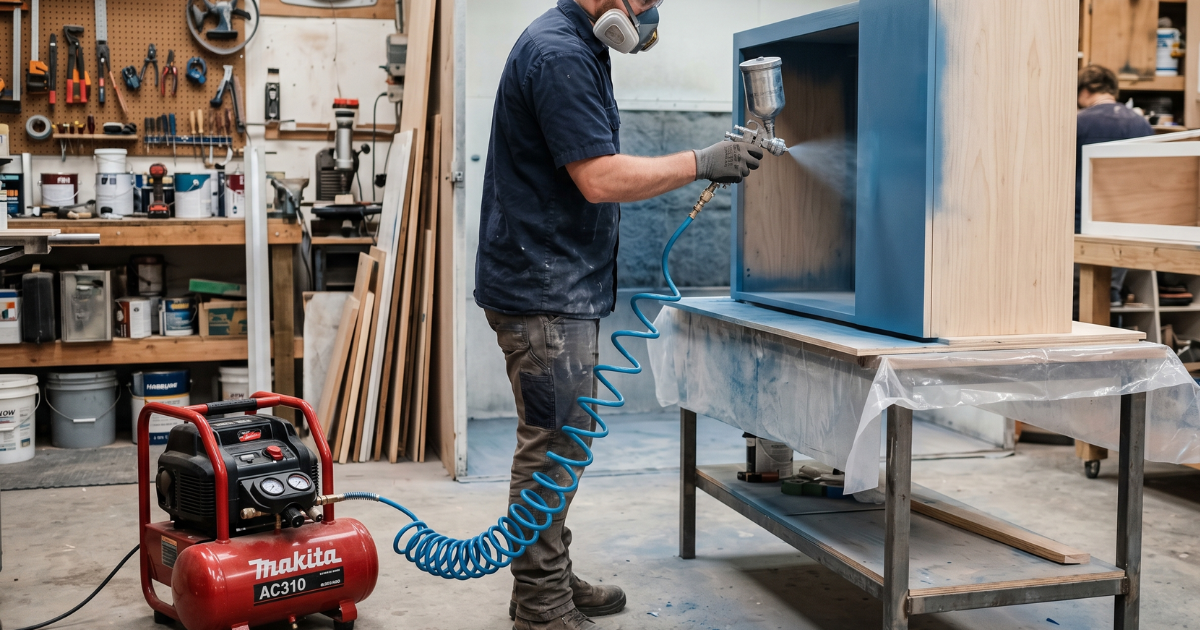
Best Air Compressors for Spray Painting
Looking for the best air compressors for spray painting in the UK in 2026? This guide compares 6 of the best spray painting air compressors, covering everything from quiet airbrush compressors to high-CFM workshop machines for HVLP spray guns and automotive bodywork. We explain the real difference between advertised CFM and usable Free Air Delivery (FAD), helping you choose the right compressor for furniture spraying, fences, cabinets, LVLP touch-up work, and full automotive paint jobs.
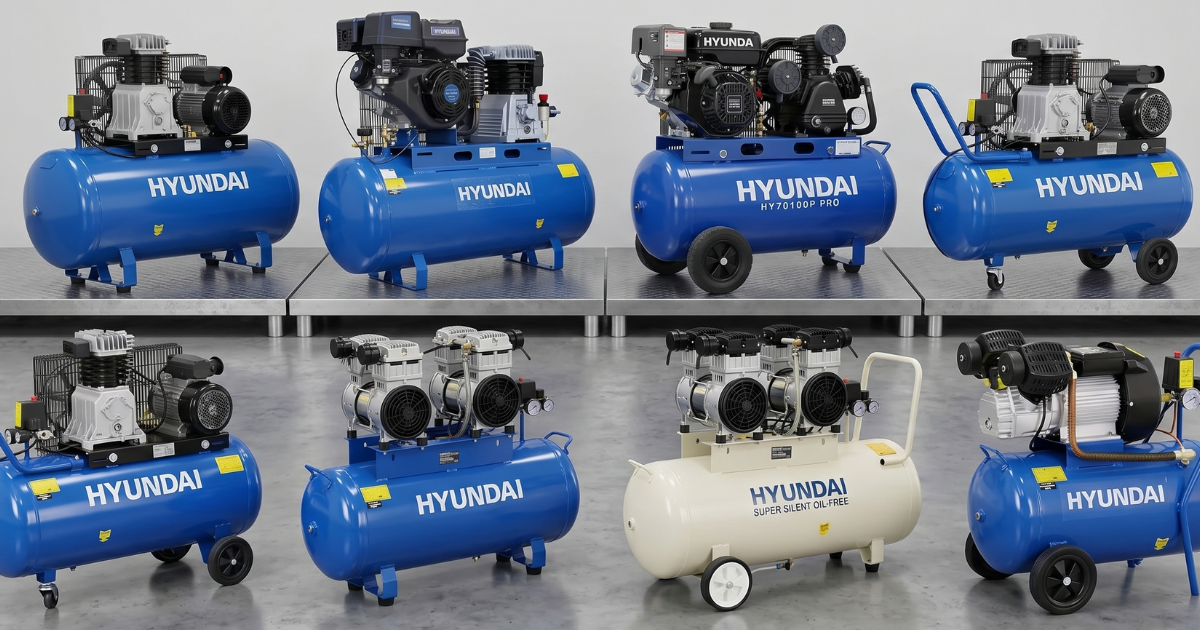
Hyundai Air Compressor Buying Guide 2026
Choose the right Hyundai air compressor with this 2026 UK buying guide. From quiet oil-free models like the HY7524X to powerful V-Twin and belt drive compressors such as the HY3050V and HY3150SX, this guide helps you match Hyundai performance and FAD output to your tools for home, garage, or professional use.
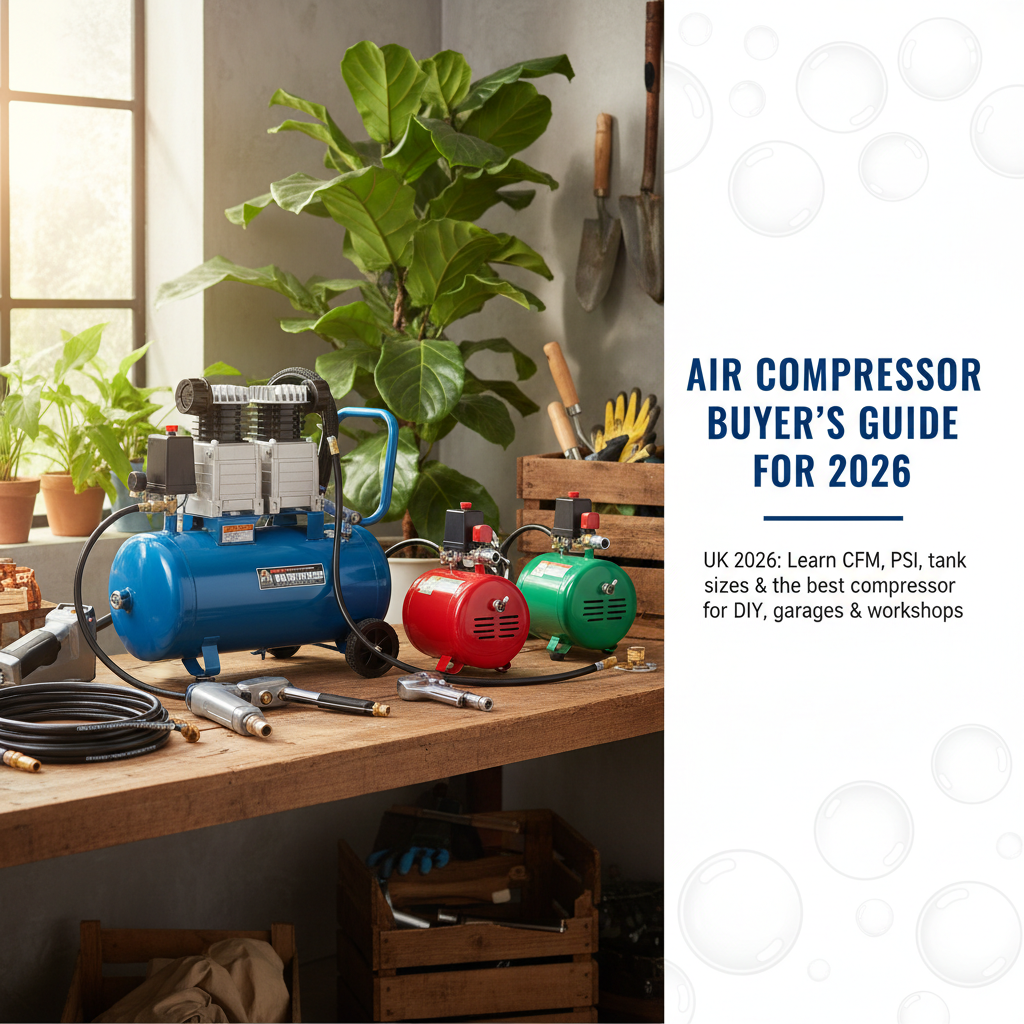
Air Compressor Buyer’s Guide for 2026
Air Compressor Buyer’s Guide UK 2026: Learn CFM, PSI, tank sizes and the best compressor for DIY, garages and workshops.
Best Air Compressors for Nail Guns
Looking for the best air compressors for nail guns in the UK in 2026? This guide compares 7 top air compressors for brad nailers, finish nailers, framing nailers, and flooring staplers. We explain which compressors suit DIY joinery, first-fix framing, and workshop use - including tank size, PSI, noise levels, and the best quiet compressors for UK home garages.
Best Air Compressors for DIY UK
Looking for the best air compressors for DIY UK projects in 2026? This guide compares 9 of the best DIY air compressors available, covering everything from compact 8L compressors for nail guns and tyre inflation to powerful 100L workshop models for spray painting and air tools. We explain which compressor is best for home garages, quiet residential use, DIY workshops, and sustained tool use - with honest pros, cons, noise levels, CFM guidance, and real-world UK buying advice.
Airmaster Air Compressor Buying Guide 2026
Everything you need to know before buying an Airmaster compressor - from the compact Tiger range for home workshops to the heavy-duty belt-driven industrial models.