
Log Splitter Tonnage Guide UK: What Size Do You Need?
What tonnage log splitter do you need? Match force to log diameter, wood species, grain, knots and moisture, not the badge alone.
Key takeaways
- A splitter's tonnage is the maximum force the ram can push with .
- More diameter generally needs more force, but less than most buyers think.
- Champion Power Equipment's buying guide tells buyers to work out tonnage from "the hardest wood" they expect to split, not the average.
- Where the grain runs straight, very little force is needed once the wedge starts a crack.
- Owners report that stringy species such as hornbeam, plane and eucalyptus get much harder once dry.
By Mark Moore — Power Tools Specialist, Garden-Review
Published October 2026 · Last checked October 2026 · Approx. 12-minute read
Quick answer
Don't choose a log splitter on the tonnage badge alone. As a starting point: 4–5 tonnes for straight-grained softwood and small hardwood up to about 25cm; 6–8 tonnes for mixed stove-length hardwood up to about 30–40cm; 10–15 tonnes for knotty or awkward rounds; and 20 tonnes and up for big trunk sections. Then adjust for species (elm, plane, hornbeam and fruit wood are much harder than ash or birch), grain and knots, and moisture. Above all, check the maker's maximum log diameter and length: that's the real limit.
In this guide
How we put this guide together: this is a research-based guide, not a hands-on test. I compiled maximum-log-size specs from more than a dozen UK electric, petrol and manual splitters, worked through the hydraulic maths behind tonnage ratings myself (shown so you can check it), and drew on manufacturer guidance (Forest Master, Champion) and UK and US owner forums for species and knot behaviour. Where sources disagree, notably on green versus seasoned wood, I say so. Garden-Review earns a commission if you buy through the Amazon links below, at no extra cost to you; it doesn't change what we recommend.
What the tonnage badge really means
A splitter's tonnage is the maximum force the ram can push with. It's set by two things: the hydraulic pressure the pump and relief valve allow, and the area of the ram piston. Force = pressure × piston area. That simple formula explains a lot.
Take Forest Master's published figures. Its electric range quotes 5 tonnes at 400 bar, 7 tonnes at 500 bar and 8 tonnes at 550 bar. Working backwards, all three imply a ram roughly 40–43mm across (my calculation). In other words, on these machines the step from 5 to 7 tonnes comes mainly from higher hydraulic pressure, not a bigger cylinder.
The same maths is a useful check on any spec sheet:
| Machine (published spec) | Pressure | Ram bore | Calculated force | Badge |
|---|---|---|---|---|
| Oxdale SE400 petrol (hire spec) | 330 bar | 60mm | ≈ 9.5 tonnes | 10 tonnes |
| Hyundai 25T petrol (NZ listing) | 4,037 psi (≈ 278 bar) | 100mm | ≈ 22.3 tonnes | 25 tonnes |
My calculation: force = pressure × π × (bore ÷ 2)², converted to tonnes-force. Published pressures may be rounded.
The takeaway: badges are rounded, sometimes generously, and two machines with the same badge can perform differently. The badge also says nothing about speed, wedge shape or log capacity, which often matter more in daily use.
Tonnage and log diameter
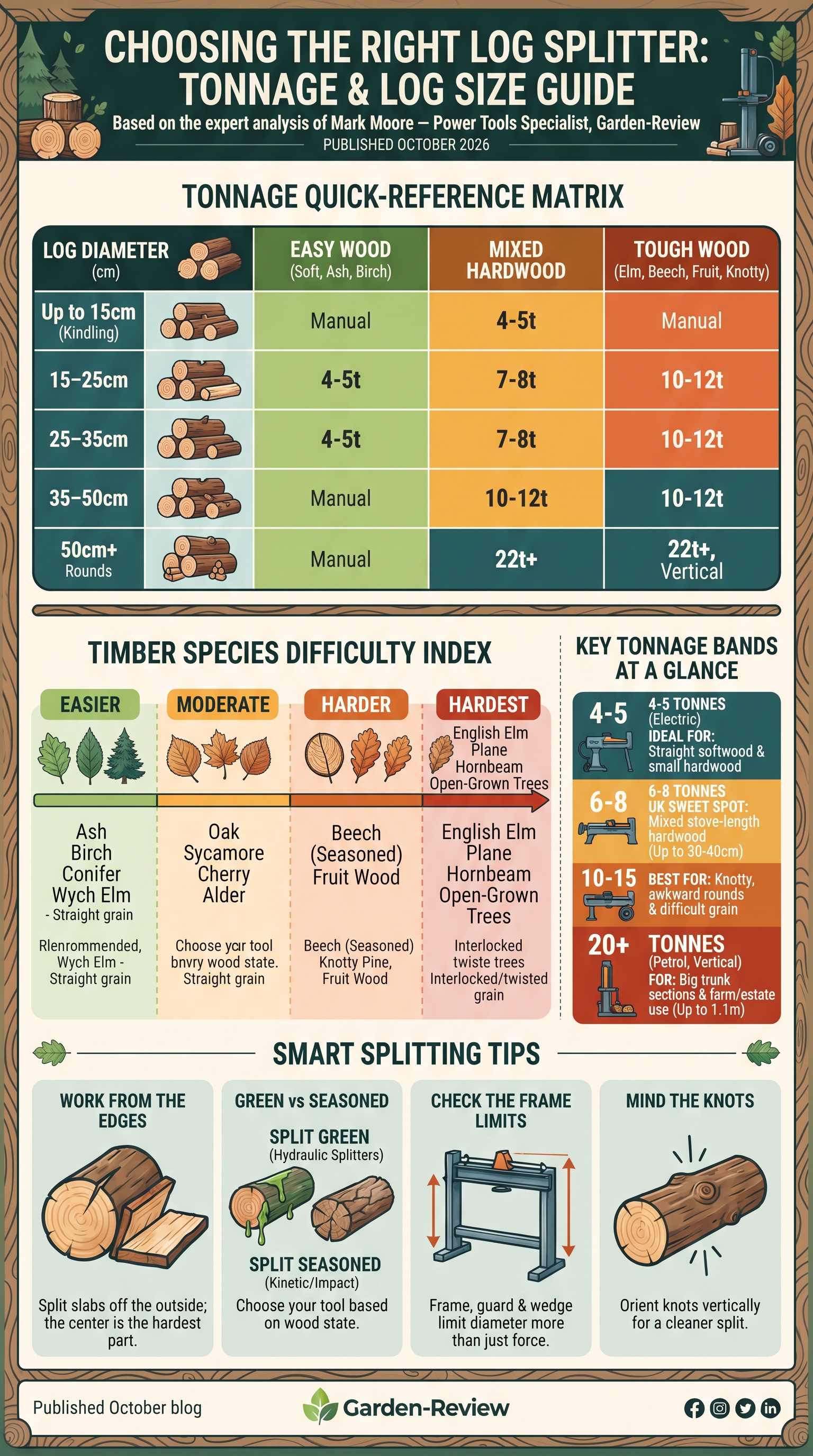
More diameter generally needs more force, but less than most buyers think. Forest Master goes as far as calling the idea that you need a more powerful splitter for larger diameters "a fallacy". Its point is that "the hardest part of the log is in the centre" and that "you should be aiming for just off-centre of the log". Splitting slabs off the edge of a big round takes much less force than driving straight through the heart.
In practice, a splitter's maximum log diameter is limited as much by its frame, guard and wedge as by its force. Here's what manufacturers actually rate their machines for:
| Force | Example machines | Rated max diameter | Rated max length |
|---|---|---|---|
| 1.2t (foot pump) | Sealey LS450H | 250mm | 450mm |
| 4–5t electric | Scheppach HL460, The Handy THLS-4G, Forest Master FM5/FM8 | 250mm | 300–370mm |
| 6t electric | The Handy THLS-6G, Konner & Sohnen KSB 6THE | 250–300mm | 520mm |
| 7–8t electric | Forest Master FM10 (7t), FM16 (8t) | 400mm* | 430–450mm |
| 8t petrol | SIP 01987 (horizontal), Lumag HB8N (vertical), Forest Master Fast Fire (kinetic) | 300–400mm | 520–550mm |
| 10t manual | Forest Master DUO10T | 300mm vertical (larger horizontal) | 510mm |
| 20t+ petrol | Forest Master FM22VPT | Large rounds | Up to 1.1m |
Specs from manufacturer and retailer listings, checked October 2026. *Forest Master quotes 400mm on its product pages and up to 500mm in the FM10 manual; maximum diameters apply with the safety guard fitted.
Two patterns stand out. First, the 250mm ceiling on most 4–6 tonne electric machines comes from the frame, not just the force. Second, the jump to 7–8 tonnes is where rated diameter rises to around 400mm. Look at the diameter rating, not just the badge.
Timber species
Species can matter more than diameter. Champion Power Equipment's buying guide tells buyers to work out tonnage from "the hardest wood" they expect to split, not the average. From manufacturer guidance and owner reports, here's how common UK firewood species tend to behave:
| Splitting difficulty | Species | Notes |
|---|---|---|
| Easier | Ash, birch, straight-grained conifer, wych elm | Straight grain parts cleanly. One Arbtalk user found wych elm splits because of its straighter grain. |
| Moderate | Oak, sycamore, cherry, alder | Forest Master recommends its 7-ton for green sycamore up to 30cm. |
| Harder | Beech (especially seasoned), knotty pine and larch, fruit wood | Forest Master calls seasoned beech "generally quite hard" and suggests "upwards of 7-ton". It says its 8-ton FM16 is for wood "that is particularly fibrous or tough, such as fruit tree wood". |
| Hardest | English elm, plane, hornbeam, big old open-grown trees | English elm is the classic problem: one Arbtalk user said its heartwood and sapwood "seem to have spiraling grain that goes in opposite directions". Owners also name hornbeam and plane, especially once dried. |
A practical guide compiled from manufacturer advice and owner reports, not lab cleavage tests. Individual logs vary a lot.
Tree history matters too. One experienced US owner observed that "the trunks of most big, old yard trees are very difficult to split", while trees grown in dense stands tend to have cleaner, straighter grain. Garden and hedgerow trees grown in the open are usually knottier and twistier than forestry timber.
Grain and knots
A log splits along its grain. Where the grain runs straight, very little force is needed once the wedge starts a crack. Interlocked, spiral or wavy grain, and especially knots, make the fibres hold together across the split, and force requirements jump. Practical tips from manufacturers and owners:
- Orient the knot. Forest Master's manual recommends placing logs "that have a visible knot, so that the knot is vertical", so the wedge splits through it in line rather than across it.
- Work from the edges. On stubborn rounds, take slabs off the outside first. Elm specialists on Arbtalk advise splitting off the sapwood first and working "in to the Center".
- Use the cracks. Husqvarna advises you to "split along the grain, aiming for cracks" already present in the end of the log.
- Choose the right wedge. Forest Master notes that a more acute blade can "get lost inside" big logs, and that its 8-ton FM16 uses a more obtuse blade for tough, fibrous wood. Twin-blade designs split from both ends, so a knot at one end doesn't stop the split.
- Don't hold the pressure. Most manuals say never hold full pressure for more than about five seconds. Release, rotate the log and try again.
If a knotty log won't go, more tonnage isn't always the answer. Repositioning the log, or cutting it shorter, often works better. If your splitter seems weaker than it should be on every log, see our troubleshooting guide for slow rams and leaks.
Moisture: green or seasoned?
This is where the experts disagree, and the answer depends on the species and the type of splitter:
The case for green
Forest Master advises "splitting freshly chopped wood whilst it's still green" on its electric splitters, and says its 7-ton FM10 will split "just about every wood... so long as the wood is still green". Owners report that stringy species such as hornbeam, plane and eucalyptus get much harder once dry. Splitting early also speeds seasoning.
The case for seasoned
Champion says "green wood is difficult to split and takes more tonnage", and that drying makes wood "more brittle and easier to split". Kinetic and slide-hammer splitters work best on seasoned wood: Forest Master says its Smart Splitter needs seasoned logs. Cold weather also makes fibres more brittle.
My take: on hydraulic splitters, split green where you can, especially stringy or interlocked species. On impact tools (axes, mauls, slide-hammers and kinetic splitters), seasoned or frozen wood usually breaks more cleanly. Either way, logs must reach 20% moisture or less before burning; in England, wood sold in small quantities must be certified "Ready to Burn" to that standard.
Safety note on seasoned wood: Forest Master warns that seasoned wood "absorbs the pressure until it pops with an almost explosion-like effect" and that "this is when an injury is most likely to occur". Keep hands clear, wear eye protection, and use the guard.
Shop firewood moisture meters Shop safety goggles
Log length and wedge design
Longer logs take more force, because the wedge has to drive the split further before it runs through. They also need a longer ram stroke. That's why small machines limit length as well as diameter: 300–370mm on 4–5 tonne electrics, 450–550mm on 6–8 tonne machines, and up to 1.1m on large vertical petrol splitters.
Measure your stove first. Most stoves take logs of 25–40cm, so a 370mm-capacity machine is often enough. Choosing a longer capacity than you need costs money and floor space, and won't add useful force.
Wedge design changes how far tonnage goes. A 4-way wedge produces four pieces per stroke but needs more force per push. Twin-blade designs split from both ends. A tall, obtuse wedge copes better with fibrous wood. Compare wedges alongside tonnage.
Choosing your tonnage: the matrix
Start with your typical log diameter, then move one band up for each "harder" factor that applies to most of your wood: tough species, knotty or twisted grain, or the wrong moisture state for your splitter type.
| Typical diameter | Easy wood (straight, softwood/ash/birch) | Mixed hardwood | Tough (elm, beech, fruit, knotty) |
|---|---|---|---|
| Up to 15cm (kindling) | Manual (kindling cracker, foot splitter) | Manual or 4t | 4–5t |
| 15–25cm | 4–5t | 5–6t | 7–8t |
| 25–35cm | 6–7t | 7–8t | 10–12t |
| 35–50cm | 8–10t | 10–15t | 15–22t |
| 50cm+ rounds | 12–15t, or split from the edge | 15–22t | 22t+, vertical with log lift |
Garden-Review guidance, built from manufacturer maximum-diameter ratings and the species and grain factors above. It's a starting point, not a guarantee. Always check the machine's own rated maximum diameter and length.
Then use the power source to narrow your choice. 4–8 tonnes is the domestic electric splitter range from a 13A socket. Above that, you're usually into petrol splitters. For kindling and occasional small logs, see manual splitters explained.
Example splitters by tonnage band
Research-based examples covering each band, all covered in more detail in our other buying guides. Prices change often, so check the live listing.
4 TONNES · SMALL, EASY LOGS
Scheppach HL460 — 4t electric, 1,500W
Rated for logs up to 250mm diameter and 370mm long. It's the right size for softwood, ash and birch stove logs from bought loads, and the 1,500W motor is easy on household wiring.
7 TONNES · MIXED HARDWOOD (THE SWEET SPOT)
Forest Master FM10D-7-TC — 7t electric, DuoCut blade
500 bar, 2,200W and logs up to 450mm long. Forest Master says this tonnage "will split just about every wood you can put in it no problem, so long as the wood is still green", and the DuoCut blade helps with knots. It's the band most UK stove owners should start from.
8 TONNES KINETIC · SEASONED WOOD, SPEED
Forest Master FM8FF-HTW Fast Fire — 8t kinetic, Honda petrol
A flywheel splitter with a claimed 3-second cycle, rated for logs 50–400mm across and up to 520mm long. Forest Master recommends its Fast Fire range for seasoned logs such as beech.
10 TONNES MANUAL · BIG ROUNDS, NO POWER
Forest Master DUO10T — 10t foot/hand hydraulic
Twin blades split from both ends, which helps with knots. It takes logs up to 510mm long and 300mm across vertically, more horizontally. Forest Master cites a 90-year-old customer splitting 60cm logs on it by working from the edge. It's slow, but proof that technique beats tonnage.
22 TONNES · TRUNK SECTIONS
Forest Master FM22VPT — 22t vertical petrol, two-stage
It runs at 14 tonnes in fast mode and 22 tonnes in power mode, takes logs up to 1.1m, and has a built-in log lifter so you can roll big rounds into place. It's for farms and woodland owners dealing with large, mixed timber.
For ranked picks across every type, see Best Log Splitters UK 2026 or browse our log splitter reviews.
Tonnage buying checklist
- ☐ Measure your typical and largest log diameters and your stove's log length
- ☐ List your species and plan for the hardest one you split regularly
- ☐ Assess grain and knots: garden and hedgerow trees are usually knottier
- ☐ Green or seasoned? Hydraulic suits green; impact tools suit seasoned
- ☐ Check the rated max diameter and length, not just the badge
- ☐ Compare the wedge: twin-blade, 4-way, obtuse or acute
- ☐ Sanity-check the spec: pressure × ram area should roughly match the badge
- ☐ Match the power source: manual up to kindling and small logs, electric 4–8t, petrol 8t+
Frequently asked questions
What tonnage log splitter do I need?
For straight-grained logs up to about 25cm, 4–5 tonnes is usually enough. For mixed hardwood up to 30–40cm, choose 6–8 tonnes. Knotty or tough species such as elm and beech, and rounds over 35cm, call for 10–15 tonnes or more. Always check the machine's rated maximum diameter.
Is a 5 ton log splitter enough?
For softwood and straight-grained hardwood up to about 25cm, yes. Forest Master describes 5 tonnes as entry-level and best for softwood, with hardwood requiring "more planning". If you split beech, elm, fruit wood or knotty logs regularly, 7–8 tonnes is a safer choice.
What size log can a 7 ton splitter split?
Typical 7-tonne electric splitters are rated for logs up to around 400mm diameter and 430–450mm long. That assumes reasonably straight grain; knotty or tough species may need splitting from the edge.
Which firewood is hardest to split?
Among common UK species, English elm, plane, hornbeam, fruit wood and large old open-grown trees are usually the hardest, because of interlocked or twisted grain and knots. Ash, birch and straight-grained softwood are the easiest.
Is green or seasoned wood easier to split?
It depends. Forest Master recommends splitting green wood on its hydraulic splitters, and stringy species get harder when dry. Champion and impact-tool makers find seasoned, brittle wood easier. As a rule: hydraulic splitters, split green; axes, slide-hammers and kinetic splitters, seasoned or frozen.
Does a bigger log need more tonnage?
Somewhat, but less than many people assume. The centre of a log is hardest to split, so working slabs off the edge reduces the force needed. A splitter's frame and wedge also limit diameter, so check the rated maximum log size.
About the author
Mark Moore is Garden-Review's Power Tools Specialist, covering hydraulic, mains, cordless and petrol equipment for UK homes and gardens. His guides explain the engineering behind the spec sheet, such as pressure, force and duty cycles, so buyers can choose on facts rather than badges. They're built from manufacturer documentation, his own worked calculations and owner feedback. Garden-Review is independent and reader-supported; see our methodology note above.
More in this hub: Log Splitters hub · Log splitter buying guides · Choosing an electric splitter · Petrol log splitter guide · Manual splitters explained
Sources: Forest Master "Electric Log Splitter – What Tonnage Do I Need?" and replies, FM5/8/10 manual and comparison chart; Champion Power Equipment log splitter buying guide; Husqvarna firewood guide; manufacturer and retailer spec listings (Scheppach, The Handy, Konner & Sohnen, Sealey, SIP, Lumag, Forest Master); Mammoth Hire (Oxdale SE400 specs); Trade Tested NZ (Hyundai 25T specs); Arbtalk "Splitting Elm" thread; Hearth.com "What wood is the worst to split" thread. Checked October 2026.
Tags
Comments
Join the conversation
Create a free account to leave comments, share photos, and connect with other gardeners.
Related Articles
Electric Log Splitter Guide UK: Power, Tonnage & Leads
How to choose an electric log splitter: 13A mains power, real splitting force, safe extension leads and what size suits your wood burner.
Petrol Log Splitter Buying Guide: When Petrol Makes Sense
When a petrol log splitter beats electric: remote sites, big rounds and high-volume splitting. Tonnage, cycle times, towing, fuel and hire.
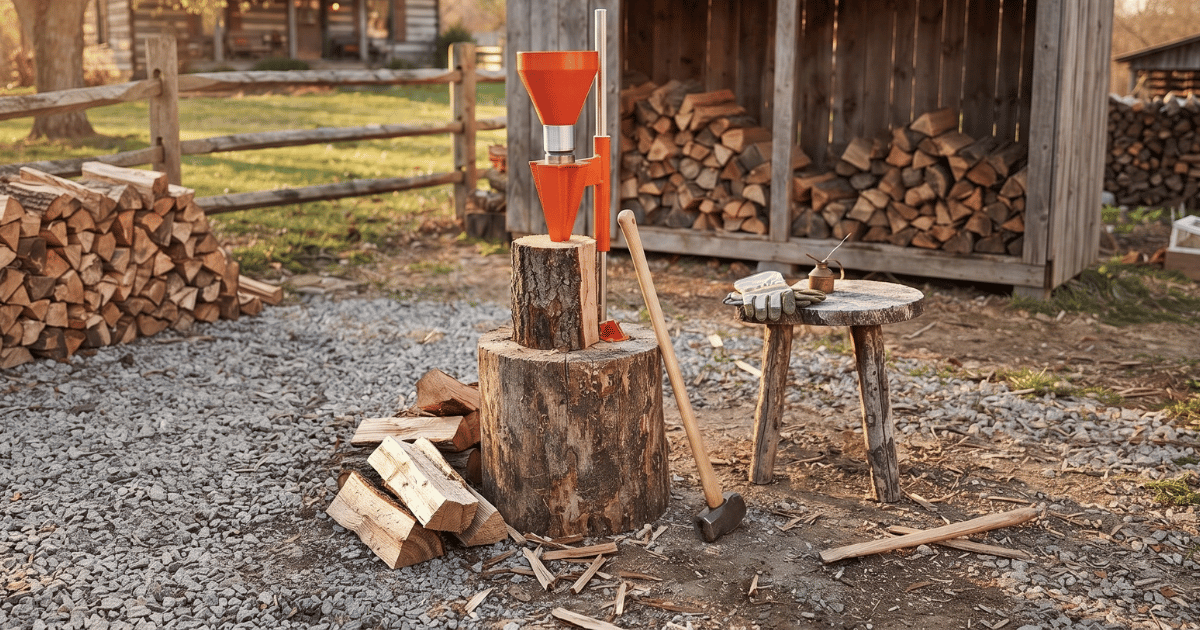
Manual Log Splitters Explained
Kindling crackers, axes, slide-hammers, foot and hand-pump hydraulic splitters: where each works, where it gets hard, and what to buy.
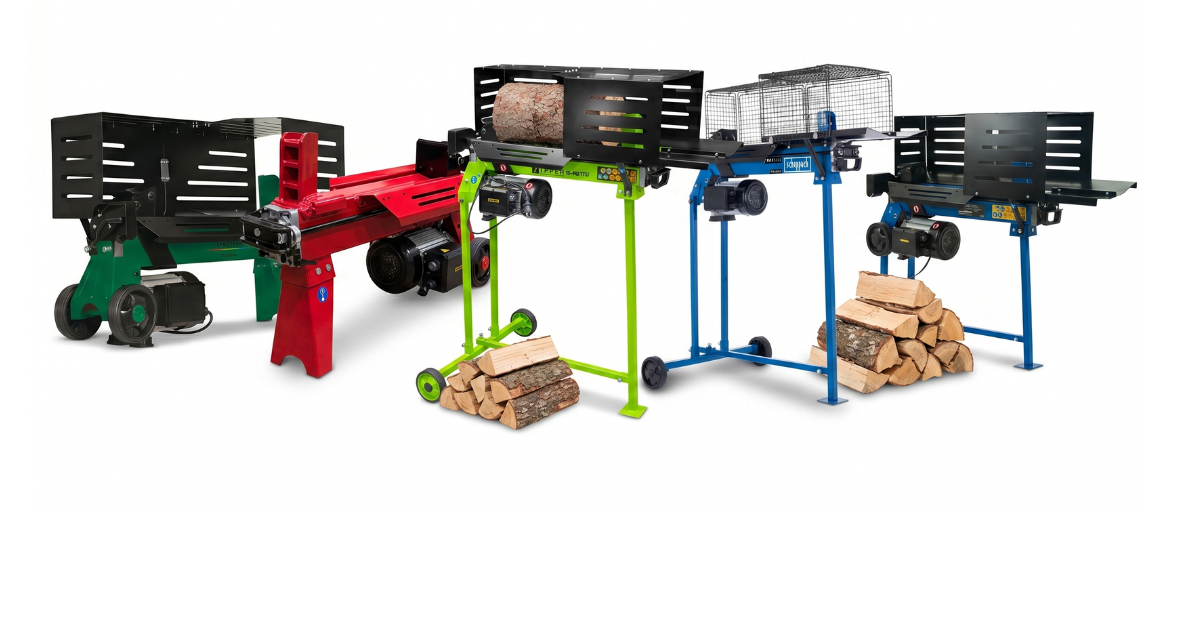
Best 7 Ton Horizontal Log Splitters for 2026
Discover the best 7-ton horizontal log splitters for 2026, including top models from Hyundai, Scheppach, Zipper, Titan and Spectrum. Compare key differences in build quality, safety features, and performance to find the ideal electric log splitter for home firewood use, balancing power, reliability, and value for money.
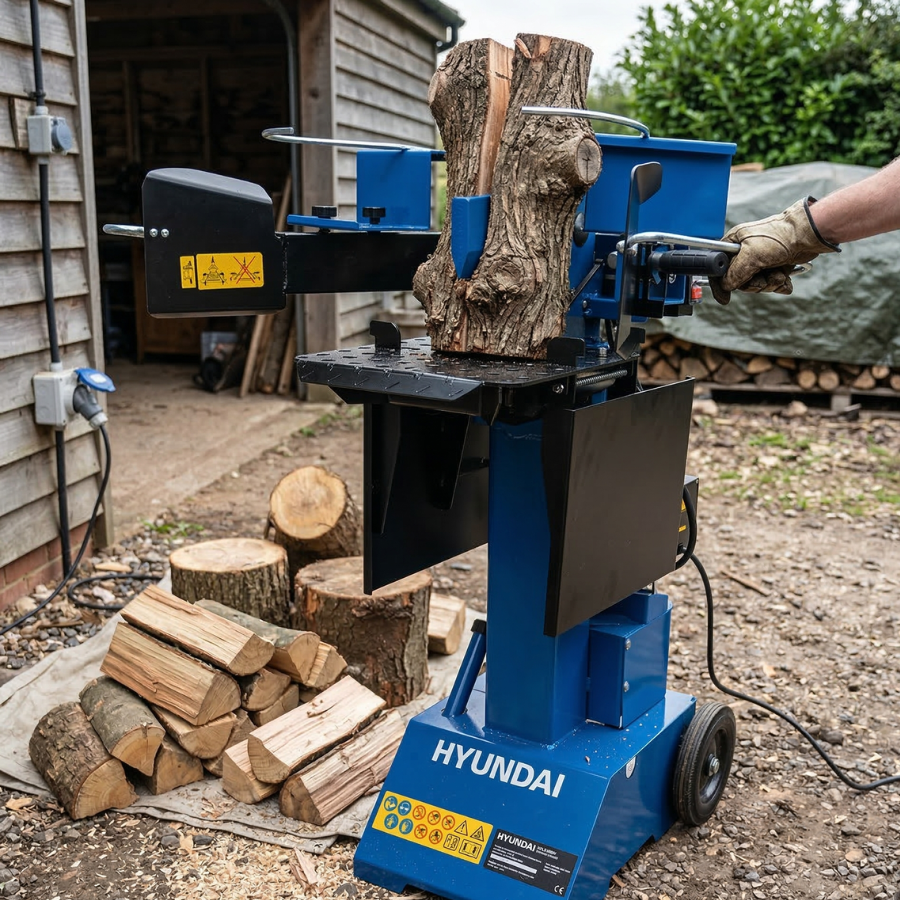
Hyundai HYLS8000V Log Splitter: A UK Gardener's In-Depth Review
The Hyundai HYLS8000V 8-tonne electric log splitter is a serious contender for converting large quantities of timber into usable firewood. In this comprehensive UK review, we delve into its performance, features, safety, and overall value, helping you decide if this robust machine is the ideal choice for your garden or smallholding.
Hyundai Inverter Generator Buying Guide (2026)
Discover the latest Hyundai inverter generator range for 2026 in this comprehensive buying guide, covering everything from ultra-portable camping models to powerful home backup units. Whether you need quiet, fuel-efficient power for caravans, van life, or off-grid living, Hyundai’s inverter generators deliver clean pure sine wave electricity for safe use with sensitive electronics. Explore detailed comparisons, key specifications, and expert mini-reviews to help you choose the perfect generator for your needs.