
Portable Power Station vs Generator: Battery or Petrol?
A portable power station stores electricity; a petrol generator makes it by burning fuel. Here’s how to choose between them for home backup, camping and garden projects.
Key takeaways
- A power station’s output rating tells you how much equipment it can supply at once.
- Mains charging costs depend on your electricity tariff and the energy drawn from the socket.
- A power station avoids engine noise, exhaust and routine engine servicing.
- Never run a petrol generator indoors, in a garage or in a shed.
- A battery unit is worth considering for phones, laptops, lighting and other manageable loads, particularly when you need power indoors.

The power station vs generator decision starts with what you need to run, where you will use it and how long you need electricity. A portable power station stores energy in a rechargeable battery. A petrol generator produces electricity while its engine is running. Both can supply power away from a socket, but their practical strengths are quite different.
For charging phones, running a laptop or keeping modest essentials powered during a short outage, a battery unit is often the simpler choice. For sustained work away from mains electricity, petrol can be more practical—provided you have a safe outdoor operating position, fuel and tolerance for engine noise.
Power station vs generator: the key differences
| Consideration | Portable power station | Petrol generator |
|---|---|---|
| Energy source | Stores electricity supplied by mains charging or other supported charging sources. | Burns petrol to generate electricity. |
| Runtime | Limited by battery capacity, connected load and conversion losses. | Limited by fuel supply, tank capacity and operating requirements. |
| Replenishing energy | Needs charging time and a suitable electricity source. | Can be refuelled after shutdown and cooling, following the manual. |
| Noise | No engine, although cooling fans can be audible. | Engine and exhaust noise must be considered. |
| Indoor operation | No combustion exhaust; follow ventilation and placement instructions. | Outdoor operation only because of carbon monoxide risk. |
| Maintenance | Battery care, appropriate storage and keeping ventilation clear. | Engine servicing and fuel management as specified by the manufacturer. |
| Long periods off-grid | Depends on access to recharging and sufficient charging input. | Depends on available petrol and safe operating conditions. |
| Typical buying priority | Check both output in watts and stored energy in watt-hours. | Check continuous output, starting capability and fuel consumption. |
Understand watts, watt-hours and starting loads
Watts describe power; watt-hours describe stored energy. A power station’s output rating tells you how much equipment it can supply at once. Its battery capacity helps indicate how long it can supply that equipment. A higher output rating does not automatically mean a longer runtime.
That distinction is visible in the examples below. According to their listings, the Jackery Explorer 1000 v2 has 1,500W AC output and 1,070Wh capacity, while the Anker SOLIX C1000 Gen 2 offers 2,000W output and 1,024Wh capacity. The Anker has the higher quoted output, but the Jackery has slightly more nominal stored energy.
For a rough battery-runtime calculation, divide capacity in watt-hours by the connected load in watts. Treat the result as an idealised estimate, not a guarantee: inverter losses, the unit’s own consumption and changing appliance demand affect actual runtime. Not all nominal battery energy will reach your appliance.
Motors and compressors can also draw extra power when starting. Check the appliance’s starting requirement against the power source’s documented capability. A peak or surge figure is not continuous output, and several sockets do not mean each socket can deliver the unit’s full rating simultaneously.
Running costs: compare the whole job
Charging a portable power station
Mains charging costs depend on your electricity tariff and the energy drawn from the socket. Charging losses mean this is not simply the battery’s advertised capacity. To compare costs properly, use measured charging consumption where available and your actual tariff, rather than assuming every recharge costs the same.
A time-of-use tariff may make scheduled charging worthwhile if you already have access to cheaper periods. However, a power station does not create free electricity, and buying one solely to shift household consumption needs a separate calculation that includes purchase cost and battery wear.
Compatible solar charging can reduce reliance on sockets, but panels introduce an additional purchase and transport consideration. Input limits, connectors, shading and weather all matter. A manufacturer’s fastest solar-charging claim should not be treated as a dependable year-round UK charging time.
Fuelling a petrol generator
Petrol running costs depend on fuel price and consumption at the load you actually use. Compare manufacturer fuel-consumption or runtime information at a stated load: a tank-runtime headline without that context is not enough. Engine oil, servicing and any consumable parts also belong in the ownership budget.
There is no honest universal answer that battery power is always cheaper, or petrol always better value. For occasional modest loads, the convenience of charging at home may be decisive. For lengthy work without recharging access, the ability to bring additional fuel may matter more than charging cost.
Practicality: noise, weight and replenishing power
A power station avoids engine noise, exhaust and routine engine servicing. That makes it appealing for a home office, camping or an evening outdoors. It is not necessarily silent: cooling fans can run during charging or demanding use. The XIERXIN listing specifically warns of fan buzzing at high speed.
Portable does not necessarily mean comfortable to carry any distance. Check the stated weight and handle arrangement, then consider stairs, storage and the walk from car to pitch. Petrol-generator transport also involves fuel handling; a solar-equipped battery setup may mean carrying panels and extra cables.
Charging speed matters most when you have only a short window near mains power. The Jackery’s quoted one-hour charge and Anker’s quoted 49-minute recharge require their app-enabled fast-charging settings. Those claims are not promises that every charging source will deliver the same result.
Petrol offers a different advantage: you can bring more stored fuel rather than wait for a battery to charge. However, refuelling requires stopping the engine and allowing it to cool as instructed. Maintenance schedules still apply during extended use; a generator is not an indefinitely running, unattended supply.
Safety and household backup
Never run a petrol generator indoors, in a garage or in a shed. An open door does not make an enclosed location safe. Carbon monoxide can be fatal. Operate outdoors, well away from doors, windows and vents, following the manufacturer’s siting instructions.
Outdoor operation also requires suitable protection from weather without trapping exhaust or restricting cooling. Plan cable routing so leads are appropriately rated, protected from damage and not a trip hazard. Keep petrol in suitable containers and follow fuel-storage guidance.
A battery power station has no combustion exhaust, but still needs clear ventilation, appropriate temperatures and protection from moisture. Do not cover cooling vents or assume that a camping-oriented product is waterproof. Follow the charging and storage instructions rather than leaving the unit wherever space happens to be available.
For either option, distinguish plugging individual appliances into the unit from supplying household circuits. Never connect a generator or power station to a household socket to backfeed the wiring. A connection to fixed wiring needs a suitable professionally designed arrangement and a qualified electrician.
Likewise, do not assume every power station provides uninterrupted backup. The Anker listing quotes an under-10ms UPS switchover, but compatibility with sensitive or medical equipment must be confirmed with the equipment supplier. A general backup claim is not a medical-suitability guarantee.
Which option suits your household?
Choose a power station for convenient, modest backup
A battery unit is worth considering for phones, laptops, lighting and other manageable loads, particularly when you need power indoors. It also suits trips where you can recharge between uses. List your essential devices first, then check their combined demand and the energy required over your intended backup period.
The main limitation is finite stored energy. Heating and cooking appliances can use substantial power, so an appliance being within the output limit does not make it economical to run for long. Prioritising essentials is often more useful than buying solely by the biggest wattage headline.
Choose petrol for sustained work away from charging
A petrol generator can make more sense for extended outdoor DIY or repeated use where mains recharging is unavailable. The trade-off is finding a safe operating location and accepting noise, fuel storage and servicing. Check individual tools carefully, especially their starting requirements.
For help narrowing that choice, see our Champion Generator Buying Guide and Hyundai Inverter Generator Buying Guide (2026). If you are comparing compact petrol options specifically, our P1 P1000i 1000W Petrol Inverter Suitcase Generator Review provides a further model to investigate.
The buying rule: choose sufficient output for the equipment, then enough stored energy—or a workable fuel plan—for the duration. Neither technology is automatically a whole-home backup solution.
Products worth considering
These three supplied examples are battery power stations, not petrol generators. Their listing specifications illustrate different priorities; they are not hands-on test recommendations.
Jackery Explorer 1000 v2
The Jackery Explorer 1000 v2 costs around £379 at the time of writing. According to the listing, its strengths include a 1,070Wh LiFePO4 battery, 1,500W AC output, two pure sine wave AC sockets and 100W USB-C charging. The app-enabled one-hour recharge is useful for short charging windows. Limitations include only two AC sockets, a listed weight of 23.8lb and a continuous output ceiling below the Anker’s.
XIERXIN 1000W/666Wh Power Station
The XIERXIN 1000W/666Wh Power Station costs around £179.99 at the time of writing. Its appeal is the lowest supplied price, four 230V AC outlets and listed pure sine wave output. However, its 666Wh capacity is the smallest here, and the listing explicitly prohibits loads above 1,000W. It also warns of cooling-fan noise and specifies 24V vehicle charging, so do not assume compatibility with a standard 12V car socket.
Anker SOLIX C1000 Gen 2
The Anker SOLIX C1000 Gen 2 costs around £462 at the time of writing. Its listed 2,000W output, 1,024Wh capacity and app-enabled 49-minute recharge suit buyers prioritising higher output and quick replenishment. Anker also quotes under-10ms UPS switchover and solar input up to 600W, with a 60V maximum. The drawbacks are the highest supplied price and finite battery capacity: higher output does not guarantee longer runtime. Solar panels are not listed in the supplied box contents.
Frequently Asked Questions: Portable Power Station vs Generator: Battery or Petrol?
Can a portable power station run a fridge during a power cut?
Is a power station cheaper to run than a petrol generator?
Can I use either option indoors?
Will solar panels keep a power station running indefinitely?
Tags
Comments
Join the conversation
Create a free account to leave comments, share photos, and connect with other gardeners.
Related Articles
Champion Generator Buying Guide
Which Champion generator is right for you? Camping, caravan, home backup or trade - a plain-English guide to every model in the range
P1 P1000i 1000W Petrol Inverter Suitcase Generator Review
The P1 P1000i is a lightweight and affordable inverter generator designed for low-power applications. It’s ideal for charging electronics and running small appliances while camping, but its limited output means it won’t handle high-demand devices.
Hyundai DHY18COM-1 Review: 17kW / 20.4kVA* Compact Diesel Generator, S 1500rpm, Single Phase
A compact, professionally specified 17kW diesel generator with a 4-cylinder water-cooled engine, DSE6120 MKIII control panel, AVR alternator, ATS compatibility, and red diesel approval - engineered for prime power and serious standby use.
Hyundai Inverter Generator Buying Guide (2026)
Discover the latest Hyundai inverter generator range for 2026 in this comprehensive buying guide, covering everything from ultra-portable camping models to powerful home backup units. Whether you need quiet, fuel-efficient power for caravans, van life, or off-grid living, Hyundai’s inverter generators deliver clean pure sine wave electricity for safe use with sensitive electronics. Explore detailed comparisons, key specifications, and expert mini-reviews to help you choose the perfect generator for your needs.
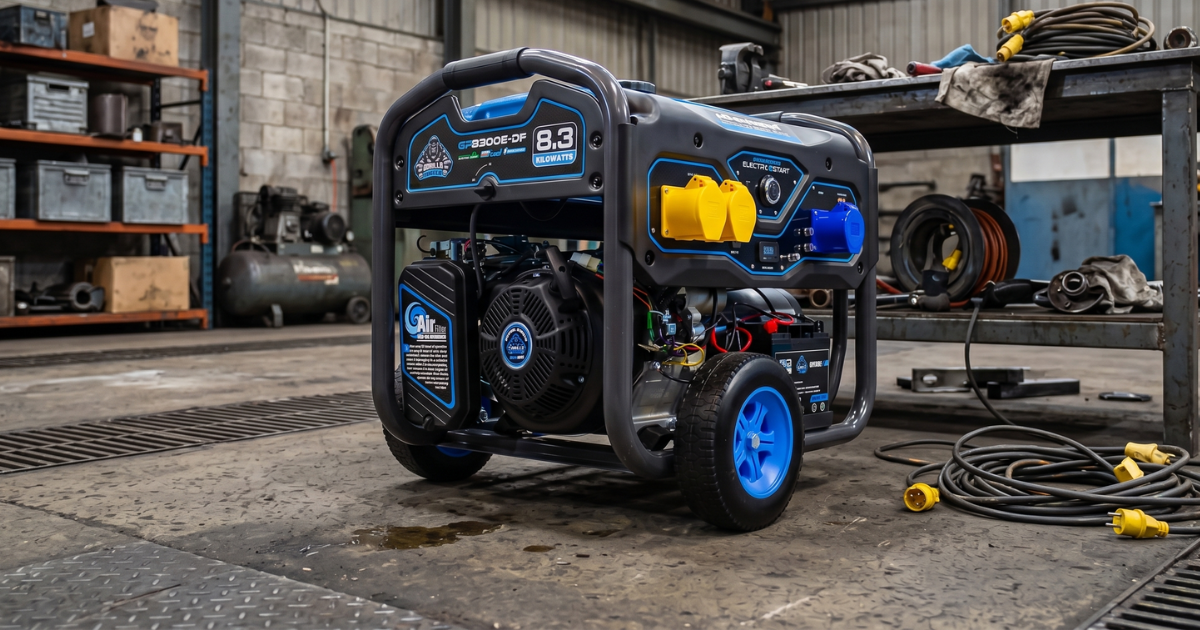
Gorilla Power GP8300E-DF Review (2026) - 8.3kW Dual-Fuel Generator
Gorilla Power GP8300E-DF delivers 8kW true sine wave, dual fuel, and remote start for serious whole-home or site backup power in the £900–£1,100 bracket.

4smile 300L Garden Composter Review: Is It Any Good?
Tired of piling up garden and kitchen waste? The 4smile 300L composter promises an easy, eco-friendly solution. We put it to the test to see if this budget-friendly bin can turn your scraps into black gold.