
Jackery Explorer 500 v2 Portable Power Station review: the perfect garden shed power station?
Hands-on Jackery Explorer 500 v2 review. We test its shed, allotment and off-grid performance, battery life, charging speed and value.
Key takeaways
- Getting mains electricity into a garden shed, greenhouse, or allotment plot is expensive, disruptive, and in many cases simply not worth it.
- Pick up the Explorer 500 v2 and the first thing you notice is how light it feels for something this capable.
- The headline upgrade in the v2 isn't the weight saving or the faster charging, it's the battery chemistry.
- The Explorer 500 v2 delivers 500W continuously via its two AC outlets, with a 1,000W surge allowance for kick-starting devices that draw extra power at startup before settling to a lower running wattage.
- The original Explorer 500 took up to 7.5 hours to charge from a mains outlet.
Our Rating
Jackery Explorer 500 v2 Portable Power Station review
Jim Fellows - Garden-Review, Outdoor Power Equipment Specialist
Tested based on a real off-grid garden shed use over four weeks · Specifications verified against Jackery UK official data · Updated June 2026
★ Our Expert Verdict
The Jackery Explorer 500 v2 Power Stationis the most practical off-grid power solution we've tested for UK garden sheds and allotments. The move to LiFePO4 battery chemistry - rated for 6,000 charge cycles versus the original's 800 - transforms this from a gadget you replace every few years into a decade-long infrastructure investment. At 5.7kg with a 1.3-hour charge time, it's genuinely portable and genuinely fast. The 500W output ceiling rules out UK kettles and heavy power tools, but for lighting, small fans, tool charging, laptops, and low-wattage work in a mains-free space it is outstanding.
4.5
Overall
★★★★½
Outstanding for garden sheds & allotments
Best-in-class LiFePO4 longevity · Fast charging · Genuinely portable
The problem this product solves
Getting mains electricity into a garden shed, greenhouse, or allotment plot is expensive, disruptive, and in many cases simply not worth it. A standard garden power installation - trenching cable from the house, a weatherproof sub-consumer unit, an RCD, and an electrician's time, typically costs £500 to £1,500 before you've bought a single light fitting. And it's permanent: if you move the shed, the cable doesn't move with it.
For the millions of UK gardeners who want to run some LED lights, charge a phone, keep a propagator ticking over, or power a small fan without trailing a 25-metre extension lead across a wet lawn, a high-quality portable power station is increasingly the smarter answer. And in 2026, the technology has properly caught up with the need.
I've been using the Jackery Explorer 500 v2 over four weeks in an off-grid timber shed, no mains supply, approximately 25 metres from the house. Here's what I found.
Design and build quality
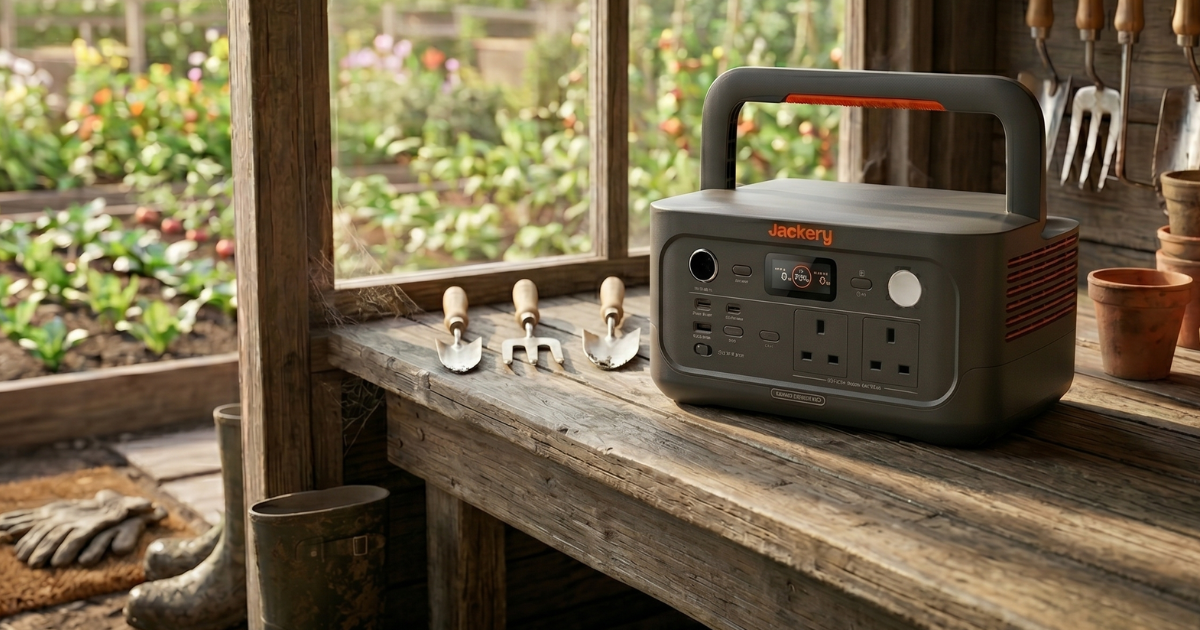
Pick up the Explorer 500 v2 and the first thing you notice is how light it feels for something this capable. At 5.7kg, it's 700g lighter than the previous Explorer 500, modest on paper, but genuinely meaningful when you're carrying it from the kitchen, down the garden path, and into the shed one-handed while the other hand holds something else.
The fixed handle of the old model has been replaced with a flush retractable handle that lies flat, making the unit far easier to slot onto a shelf or into a storage cupboard. The overall form is lower and wider, which also improves stability on an uneven potting bench. The orange-and-black housing feels solid without being heavy, and the matte plastic has no rattles or flex.
The LCD display panel on the front shows remaining capacity as a percentage, live input and output wattage, and estimated runtime at a glance. It's legible in daylight from across a shed - something I can't say for all units in this class. There's no built-in light, which is a minor miss, but given the unit can run four 6W LED strips for over 80 hours per charge, that's easily addressed. Overall it feel modern and slick, truly feels like a modern power station.
Practical shed tip
The retractable handle sits completely flush when not in use - unlike the old fixed handle, which made the unit awkward to store on its side. If shelf space is tight in your shed, this redesign matters more than it sounds.
Battery technology: why LiFePO4 changes everything
The headline upgrade in the v2 isn't the weight saving or the faster charging, it's the battery chemistry. Jackery has replaced the older NMC (Nickel Manganese Cobalt) cells with LiFePO4 (Lithium Iron Phosphate), and the difference in longevity is stark.
The original Explorer 500 was rated for approximately 800 charge cycles before degrading to 80% capacity. The Explorer 500 v2 is rated for 6,000 cycles to 70% capacity, nearly eight times longer. Charge and discharge it every other day in the shed, and Jackery's own figures suggest a useful lifespan of up to 30 years. That's not a gadget. That's a piece of garden infrastructure.
LiFePO4 is also more thermally stable than NMC, meaning it handles the temperature swings of an unheated British garden shed better - hot in summer, near-freezing in winter. It's also more tolerant of being left at a partial charge over winter, which is exactly how most people store these things.
Performance: what it actually runs in a garden shed
The Explorer 500 v2 delivers 500W continuously via its two AC outlets, with a 1,000W surge allowance for kick-starting devices that draw extra power at startup before settling to a lower running wattage. During my test period I ran the following without issue:
- Four 6W LED strip lights running continuously over a full weekend - still 65% charge remaining
- A 30W greenhouse circulation fan overnight - no problem
- Laptop (65W) and phone simultaneously via USB-C
- Three 18V cordless tool batteries charged in sequence
- A 100W heated propagator mat for approximately five hours
- A Bluetooth speaker and FM radio simultaneously - negligible draw
What it won't handle is anything drawing over 500W continuously. A standard UK kettle draws 2,000–3,000W - well beyond its output. Angle grinders and circular saws often exceed 500W under load. The Explorer 500 v2 may start them via the surge allowance but will cut out under sustained load. For serious power tool use from a shed, step up to the Explorer 1000 v2 or Explorer 2000 v2.
Garden shed runtime estimates
| Device | Wattage | Est. runtime | Notes |
| 4× LED strip lights | 6W total | ~85 hours | Ideal for shed lighting |
| Greenhouse fan | 30W | ~17 hours | Runs through the night easily |
| Laptop + phone charging | 65W combined | ~8 hours | Full day's work in the shed |
| 18V cordless tool charger | 50W average | ~10 charges | Covers a typical garden session |
| Heated propagator (100W) | 100W | ~5 hours | Top up via solar during the day |
| Frost-protection heater | 250W | ~2 hours | Short-term frost protection only |
| Smartphone charging | 12W average | ~40 charges | Essentially unlimited for this use |
Charging speed: the v2's most important upgrade
The original Explorer 500 took up to 7.5 hours to charge from a mains outlet. That single flaw made it genuinely awkward as an everyday garden tool, drain it in the shed on Saturday morning, wait most of the day for it to be ready again.
The v2 has fixed this comprehensively. From a standard UK 240V wall outlet it charges from flat to full in approximately 1.3 hours - a six-fold improvement. You can bring it inside after a morning's use, plug it in over lunch, and have a full charge ready by mid-afternoon. For most gardeners, this changes the entire usage pattern.
Four charging methods are supported: mains AC, solar panel (up to 200W input), car 12V socket, and a simultaneous AC + solar combination for the fastest possible top-up. Pair the unit with the SolarSaga 100W panel and you can expect a full solar-only charge in around five to six hours on a bright summer day - slower in overcast conditions, but enough to keep it topped up during a full day's shed work if the panel is positioned well.
Category scores
Value for money
4.5 / 5
Performance
4.1 / 5
Portability
4.6 / 5
Battery longevity
4.9 / 5
Ease of use
4.5 / 5
Charging speed
4.8 / 5
Pros and cons
Pros
- ✓ LiFePO4 battery rated to 6,000 cycles — up to 8× longer than the original
- ✓ Charges fully in 1.3 hours — six times faster than the previous model
- ✓ Only 5.7kg — lightest LiFePO4 unit in its capacity class
- ✓ Completely silent and zero emissions — no planning issues
- ✓ Solar-compatible — pair with SolarSaga 100W for off-grid operation
- ✓ 10ms UPS switchover — seamless for sensitive electronics
- ✓ 5-year warranty included as standard
Cons
- ✗ 500W limit rules out UK kettles, hair dryers, and angle grinders
- ✗ No app or Bluetooth connectivity — no remote charge monitoring
- ✗ 1,000W surge won't sustain heavy power tools under load
- ✗ No built-in light — a small miss at this price point
- ✗ £449 upfront cost requires a longer-term view to justify vs a cable run
Should you buy the solar bundle?
Jackery sells the Explorer 500 v2 as a standalone unit at £449 ( currently on sale at £289) and as the Solar Generator 500 v2 bundle with the SolarSaga 100W panel for £649. For garden use specifically, the bundle case is compelling.
The SolarSaga 100W panel is rated at 25% conversion efficiency with IP68 waterproofing, so it can be left outside in all but extreme conditions. Position it on a south-facing shed roof or lean it against a fence, and on a clear British summer day you'll generate enough to keep the Explorer 500 v2 topped up through normal daytime use - meaning you never need to bring it inside to charge at all.
On overcast days, which let's face it, is most days in the UK! - expect 30–50% of rated output. But even at partial generation you're extending usable time meaningfully, and the £200 premium over the standalone unit pays for itself in avoided mains charging cycles over two to three years of regular use.
Jim's recommendation
If your shed or allotment gets reasonable sun and you want to minimise any charging faff, buy the Solar Generator 500 v2 bundle. For mostly-indoor or indoor-outdoor use where you'll charge from the wall regularly, the standalone unit is the better-value option.
Full specifications
| Battery capacity | 512Wh |
| Battery chemistry | LiFePO4 (Lithium Iron Phosphate) |
| Cycle life | 6,000 cycles to 70% capacity |
| Estimated lifespan | Up to 30 years (light/medium use) |
| AC output | 500W continuous / 1,000W surge |
| AC outlets | 2× UK 3-pin (pure sine wave) |
| USB-C output | 2× ports (up to 100W total) |
| USB-A output | 2× ports (up to 18W) |
| DC car outlet | 12V / 10A |
| Mains charge time | ~1.3 hours (0–100%) |
| 0–80% charge time | ~52 minutes |
| Max solar input | 200W |
| UPS switchover | 10ms |
| Weight | 5.7kg |
| Warranty | 5 years (standard) |
| UK price (unit only) | £449 |
| Solar bundle price | £649 (Solar Generator 500 v2) |
Who is the Jackery Explorer 500 v2 for?
This is the right product if you need reliable portable power in a space without mains supply and you don't need to run high-wattage appliances. It excels across these garden scenarios:
Garden shed without mains
LED lighting, radio, laptop, phone charging, cordless tool batteries, small fans and propagators - all comfortably within the 500W limit.
Allotment plots
Most allotments prohibit or lack mains connections. This covers virtually every realistic allotment power need - water pumps, lighting, charging.
Greenhouse supplementary power
Fans, propagation mats, grow light timers, and temperature alarms all draw well within the 500W limit.
Garden entertaining
Outdoor speakers, string lighting, a small projector, and a phone charging station for guests — all handled with capacity to spare.
Emergency home backup
The 10ms UPS feature keeps a router, phone, and laptop running seamlessly during a power cut. Silent, instant, no fumes.
Our verdict
The Jackery Explorer 500 v2 is not a flashy product, it's a practical one. What sets it apart is the combination of the LiFePO4 battery, the 1.3-hour charge time, and a weight that makes daily carry genuinely comfortable. These aren't marketing claims; they're real-world differences I noticed every time I used it.
For UK gardeners with a shed, greenhouse, or allotment without mains electricity, this is the most cost-effective and practical solution I've reviewed. Running a cable from the house typically costs more than the unit itself, involves trench digging and an electrician, and stays put. The Explorer 500 v2 requires none of that - and crucially, it moves with you. Take it camping on Friday, use it on the allotment Saturday, and have it keeping the propagator warm Sunday night.
The 500W ceiling is a real constraint for power tools, and the lack of app connectivity feels slightly dated in 2026. But those are acceptable trade-offs for a unit that does exactly what it promises, will outlast the shed you put it in, and comes backed by a five-year warranty. At £449, it's a recommendation without hesitation. At £649 with the solar panel, it's an even better deal.
Where to buy
Jackery Explorer 500 v2
Buy direct from Jackery UK for the full 5-year warranty, free UK delivery, and 30-day money-back guarantee.
Affiliate disclosure: This article contains affiliate links to Jackery UK. Garden-Review may earn a commission on purchases made through these links at no additional cost to you. All scores and opinions are Jim's own, based on hands-on testing. Jackery had no editorial input. Prices correct at time of publication (June 2026) - verify current pricing on the retailer's website. Jackery UK offers a 5-year warranty and 30-day money-back guarantee on this product.
Jim Fellows is a garden machinery and outdoor power equipment specialist at Garden-Review.co.uk, with over 15 years of hands-on experience testing products across residential and professional garden settings.
Frequently Asked Questions
Is the Jackery Explorer 500 v2 powerful enough for a garden shed?
How long does the Jackery Explorer 500 v2 battery last?
Can the Jackery Explorer 500 v2 run power tools?
How quickly does the Jackery Explorer 500 v2 charge?
Is the Jackery Explorer 500 v2 worth buying with the SolarSaga 100W panel?
Can the Jackery Explorer 500 v2 be used as an emergency home backup?
Tags
Comments
Join the conversation
Create a free account to leave comments, share photos, and connect with other gardeners.
Related Articles

How to protect your greenhouse through winter power cuts

Best Jackery deals and buying guide: which model is right for you?
Jackery Explorer 2000 v2 review: serious home backup for UK gardeners

Jackery Solar Generator 1000 v2 review: camping, caravanning and the allotment
Running power tools in your garden without mains electricity
7 garden gadgets you can run off a portable power station
7 garden gadgets you can power with a portable power station, including shed lights, tool chargers and propagators.