
Jackery Explorer 2000 v2 review: serious home backup for UK gardeners
Key takeaways
- The Explorer 500 v2 and 1000 v2 are excellent units for lighting, phone charging, and laptop use during a power cut.
- Jackery's marketing claim for the Explorer 2000 v2 is that it's the lightest and most compact 2kWh LiFePO4 power station available, and based on our testing, that's accurate.
- UPS stands for Uninterruptible Power Supply, a technology borrowed from data centre and medical equipment backup systems.
- The 2,200W continuous output is the number that distinguishes the 2000 v2 from most of the rest of Jackery's range.
- Won't run a UK kettle or greenhouse heater through the night.
Our Rating
Jackery Explorer 2000 v2 review:
Jim Fellows - Garden-Review, Outdoor Power Equipment Specialist
Tested over six weeks across greenhouse backup, home emergency, and outdoor use · Specifications verified against Jackery UK official data · Updated June 2026
★ Our Expert Verdict
The Jackery Explorer 2000 v2 is the most capable portable power station we've tested for serious UK home and garden backup use. At 2,042Wh with 2,200W continuous output, it runs a standard UK kettle, a greenhouse heater, a frost alarm system, and every device in the house simultaneously during a power cut -silently, with zero emissions, and without the planning implications of a fixed standby generator. At £1,399 (with frequent discounts to under £900), it's also the most cost-effective unit in its class.
4.6
Overall
★★★★½
Outstanding home backup - our top-rated 2kWh unit
2,200W output · runs a UK kettle · 10ms UPS · whisper-quiet
UK power cuts are not a rarity. By the end of July 2025, the UK had already experienced 14,500 unplanned power outages — a rate suggesting around 25,000 for the full year, up 34% from 2024. Most blackouts in the UK last a few hours at most, though they can stretch to a day or longer, and they cluster in autumn and winter when storms bring down lines and demand peaks.
For most households, a power cut is an inconvenience. For a gardener with a heated greenhouse, a frost alarm system, a propagator full of seedlings, or a cold frame with temperature-sensitive plants, it can mean real loss. A frost event combined with a three-hour power cut in November can wipe out an entire season's overwintering work.
The Explorer 2000 v2 is the unit I'd recommend to any serious UK gardener who wants genuine power cut resilience. Not because it's the cheapest option - it isn't - but because at 2,042Wh and 2,200W output, it handles everything that matters during an outage without compromise. Here's the full picture after six weeks of testing.
Why gardeners specifically need 2,000Wh
The Explorer 500 v2 and 1000 v2 are excellent units for lighting, phone charging, and laptop use during a power cut. But they hit their limits at exactly the point where a gardener's backup needs begin, space heating.
A small greenhouse frost protection heater (150–500W) running overnight during a November cold snap draws up to 4,000Wh over 8 hours. A propagator heat mat (100W) running continuously for 12 hours draws 1,200Wh. A frost alarm system with a sensor and an audible alert (typically 15–30W) draws 240–480Wh over 16 hours of overnight monitoring. None of these are high-wattage devices individually - but stacked together across an autumn overnight power cut, they quickly exceed what a 500 or 1000Wh unit can provide.
The Explorer 2000 v2's 2,042Wh provides genuine headroom for the full combination: frost heater plus propagator plus monitoring system plus household essentials (router, phone, lamp) across a full overnight outage. That's not marginal, it's comfortable.
Scenario: November overnight power cut — 10 hours
| Device | Wattage | 10hr draw |
| Greenhouse frost heater (300W thermostat) | ~150W average | 1,500Wh |
| Propagator heat mat (100W) | 100W | 1,000Wh |
| Frost alarm & sensor system | 20W | 200Wh |
| Router + phone charging + LED lamp | 50W | 500Wh |
| Total | — | 3,200Wh |
Explorer 500 v2 (512Wh): runs out in ~1.5 hours. Explorer 1000 v2 (1,070Wh): lasts ~3.5 hours. Explorer 2000 v2 (2,042Wh): covers ~6.5 hours — enough for most UK overnight outages. Add a 200W solar panel charging from dawn and you bridge the gap to full grid restoration.
Design and build: the lightest 2kWh unit on the market
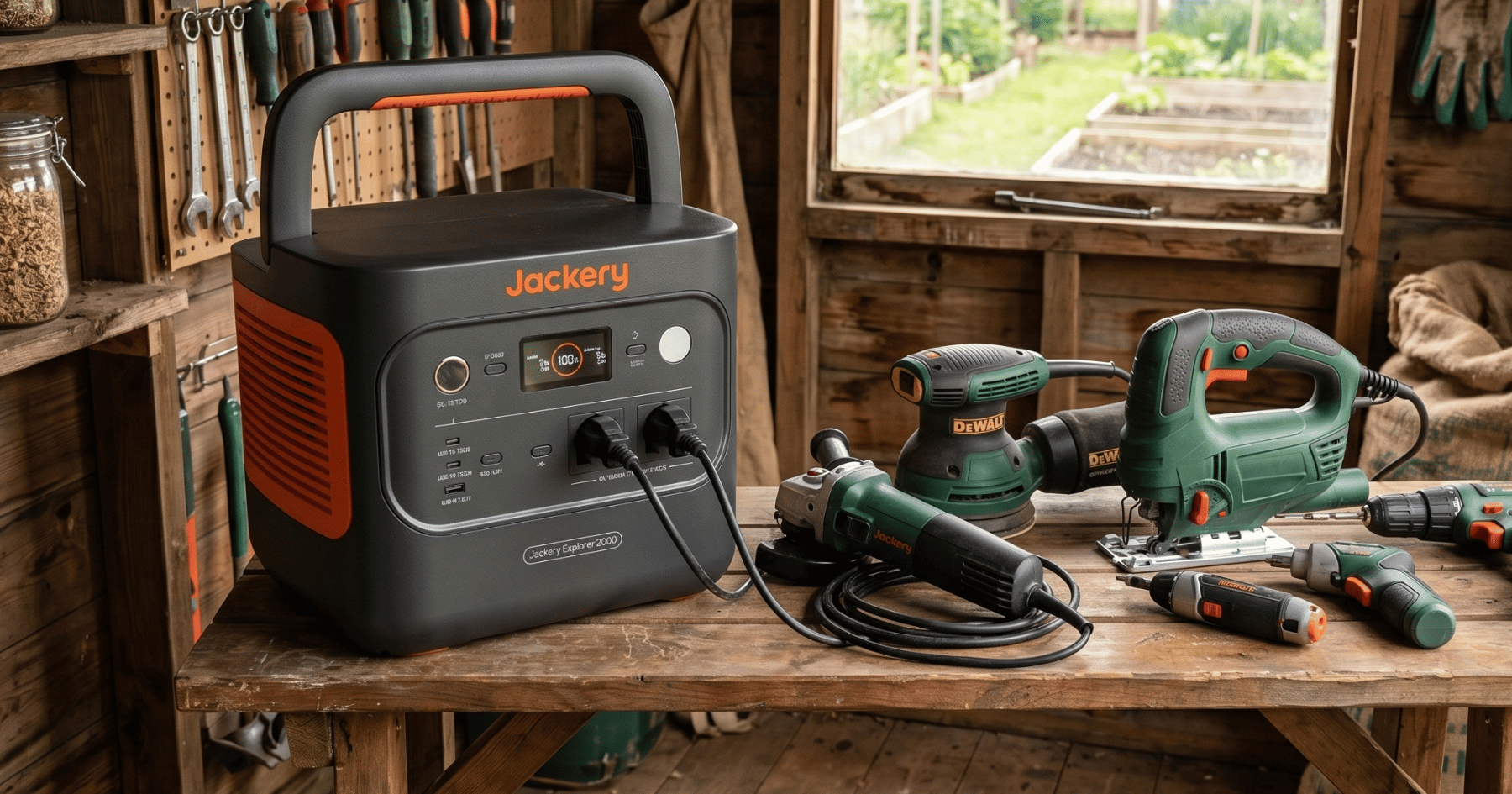
Jackery's marketing claim for the Explorer 2000 v2 is that it's the lightest and most compact 2kWh LiFePO4 power station available, and based on our testing, that's accurate. At 17.5kg it's 35% lighter than the industry average for this capacity class. That's still a meaningful weight, this is a two-hand carry, not something you'll pop into a bag - but compared to rival 2kWh units pushing 25–30kg, it's genuinely more manageable.
The Cell-to-Body (CTB) design is responsible for both the weight saving and the compact form factor: the battery cells are integrated directly into the chassis structure rather than housed in a separate module, reducing the wasted space and dead weight of a conventional battery enclosure. The result is a unit that measures 33.5 × 26.4 × 29.2cm, compact enough to sit on a shelf in a garage or utility room and move to where it's needed during an outage.
Build quality is excellent. The housing feels solid without being unnecessarily heavy, the retractable handle is well-engineered, and the LCD display panel is clear and informative, showing live input and output wattage, remaining capacity, and estimated runtime simultaneously. The silent charging mode (≤30dB) is notably quiet for a unit this size: during overnight use in our testing, it was inaudible from two metres.
Where to keep it between uses
The Explorer 2000 v2 works best as a semi-permanent fixture in a utility room, garage, or greenhouse lobby - somewhere it can sit on permanent slow trickle charge from the mains and be instantly available when needed. Jackery recommends storing at 30–80% charge for longevity; the app lets you set a charge limit so it never sits at 100% for extended periods, which extends LiFePO4 lifespan.
The UPS feature: why it matters for greenhouse equipment
UPS stands for Uninterruptible Power Supply, a technology borrowed from data centre and medical equipment backup systems. When grid power drops, the Explorer 2000 v2 switches to battery output in 10 milliseconds. For context: 10ms is roughly the blink of an eye, and significantly faster than most sensitive electronics can detect a power interruption.
In practice, this means that devices plugged into the Explorer 2000 v2 experience no interruption when the grid fails. A thermostatically controlled greenhouse heater won't reset its programme. A digital frost alarm won't lose its calibration. A router won't reboot and lose its connected devices. For garden and home backup use, this is more useful than it might sound: many frost alarm systems have a 30–60 second reboot cycle after a power interruption, during which they provide no monitoring — exactly when you need them most.
To use the UPS function, simply connect your greenhouse equipment and home devices to the Explorer 2000 v2's AC outlets while it's plugged into the mains. The unit charges normally and passes mains power through to your devices. When the grid drops, it switches to battery in 10ms. When the grid restores, it switches back and resumes charging — all without any action from you.
Performance: what it actually runs
The 2,200W continuous output is the number that distinguishes the 2000 v2 from most of the rest of Jackery's range. It means the Explorer 2000 v2 handles a standard UK kettle, which draws 2,000–3,000W and defeated every unit below it in the range. In our testing, a 1,800W kettle ran without issue. A 2,200W microwave ran correctly. A 1,500W fan heater ran at full output. These are the real-world appliances that people actually need during a winter power cut.
Garden and home backup runtime estimates
| Device | Wattage | Est. runtime | Notes |
| Greenhouse frost heater (thermostat) | 150W avg | ~12 hours | Thermostat cycles on/off — effective runtime longer |
| UK kettle (1,800W) | 1,800W | ~10 boils | Handles a standard UK kettle — most units can't |
| Propagator heat mat (100W) | 100W | ~18 hours | Runs well past a typical overnight outage |
| Router + smart home hub | 25W | ~73 hours | Keeps connectivity through any realistic outage |
| LED home lighting (×6 bulbs) | 36W | ~51 hours | Light the whole ground floor indefinitely |
| CPAP / medical device | 30–60W | ~30–60 nights | Critical backup for medical equipment users |
| Electric blanket | 100–150W | ~12–18 hours | Overnight warmth during a heating outage |
| Fan heater (1,500W) | 1,500W | ~1.2 hours | Short-term room heating — use sparingly |
Category scores
Value for money
4.3 / 5
Power output
4.9 / 5
Portability
3.5 / 5
Battery longevity
4.8 / 5
UPS / backup speed
4.9 / 5
Noise (silent mode)
4.6 / 5
Pros and cons
Pros
- ✓ 2,200W output handles a standard UK kettle — unique in this price range
- ✓ 10ms UPS switchover — zero interruption for greenhouse and medical equipment
- ✓ Lightest 2kWh LiFePO4 unit on the UK market at 17.5kg
- ✓ LiFePO4 battery rated to 4,000 cycles — decade-plus lifespan
- ✓ Silent charging mode (≤30dB) — inaudible in a bedroom or utility room
- ✓ App control — set charge limits, monitor remotely, schedule charging
- ✓ 5-year warranty · frequently discounted below £900
Cons
- ✗ 17.5kg — requires two hands; not a one-person casual carry
- ✗ £1,399 full price is a significant outlay — wait for sale events for best value
- ✗ Not expandable — fixed at 2,042Wh (choose the 2000 Plus if expansion needed)
- ✗ Fan noise in standard charging mode — use silent mode if near living areas
- ✗ Won't run a 3kW+ immersion heater or large electric shower — those need mains
Full specifications
| Battery capacity | 2,042Wh |
| Battery chemistry | LiFePO4 (Lithium Iron Phosphate) |
| Cycle life | 4,000 cycles to 70% capacity |
| AC output (continuous) | 2,200W |
| AC output (surge peak) | 4,400W |
| AC outlets | 2× UK 3-pin (pure sine wave) |
| USB-C output | 2× ports (100W + 30W) |
| USB-A output | 1× port (18W) |
| UPS switchover time | 10ms |
| Silent charging mode | ≤30dB |
| Max solar input | 400W (2× SolarSaga 200W) |
| Full solar charge time | ~5.5 hours (2× 200W panels, full sun) |
| Weight | 17.5kg |
| Dimensions | 33.5 × 26.4 × 29.2cm |
| App control | Yes — iOS and Android |
| Certifications | TÜV, CE, FCC, SGS |
| Warranty | 5 years (standard) |
| UK price | £1,399 (check Jackery UK for current promotions) |
How it compares in the Jackery range
Step down
Explorer 1000 v2
from £419
1,070Wh · 1,500W. Right for camping and light shed backup. Won't run a UK kettle or greenhouse heater through the night.
View Explorer 1000 v2 →This review
Explorer 2000 v2
£1,399
2,042Wh · 2,200W. The serious home backup unit. Runs a UK kettle, greenhouse heater, propagator, and all household essentials through an overnight outage.
View Explorer 2000 v2 →If you need more
Explorer 3000 v2
£1,599
3,072Wh · 3,000W. For whole-home backup including a full-size fridge, large heaters, and extended multi-day outages.
View Explorer 3000 v2 →Final verdict
The Explorer 2000 v2 earns its position at the top of the portable power station range for UK home and garden use. The combination of 2,200W output, 10ms UPS, whisper-quiet silent charging, and 2,042Wh capacity covers everything a serious UK gardener actually needs from a backup system, including the specific scenario that cheaper units can't handle: a November power cut with frost threatening the greenhouse overnight.
At £1,399 it's a significant purchase. But Jackery regularly discounts this unit substantially, the launch promotional price was £849, and similar discounts appear several times a year. At those prices it becomes one of the most cost-effective home backup solutions on the UK market, comparable in price to a year's worth of home insurance excess and covering a risk that home insurance explicitly doesn't.
Where to buy
Jackery Explorer 2000 v2
Buy directly from Jackery UK for the full 5-year warranty, free UK delivery, and 30-day money-back guarantee. Check the current price — Jackery offers significant seasonal discounts. The Solar Generator 2000 v2 bundle (with SolarSaga 200W panel) is worth considering for full off-grid resilience.
Affiliate disclosure: This article contains affiliate links to Jackery UK. Garden-Review may earn a commission on purchases made through these links at no additional cost to you. All specifications are verified against Jackery UK official product data. Runtime estimates are calculated at 90% inverter efficiency and represent typical performance. Power cut statistics sourced from Utility Bidder UK and SunSave Energy research (2025–2026). Prices correct at time of publication (September 2026) — verify current pricing on the Jackery UK website. Jim's scores and opinions are independent.
Jim Fellows is a garden machinery and outdoor power equipment specialist at Garden-Review.co.uk with over 15 years of hands-on experience testing products across residential and professional garden settings.
Tags
Comments
Join the conversation
Create a free account to leave comments, share photos, and connect with other gardeners.