
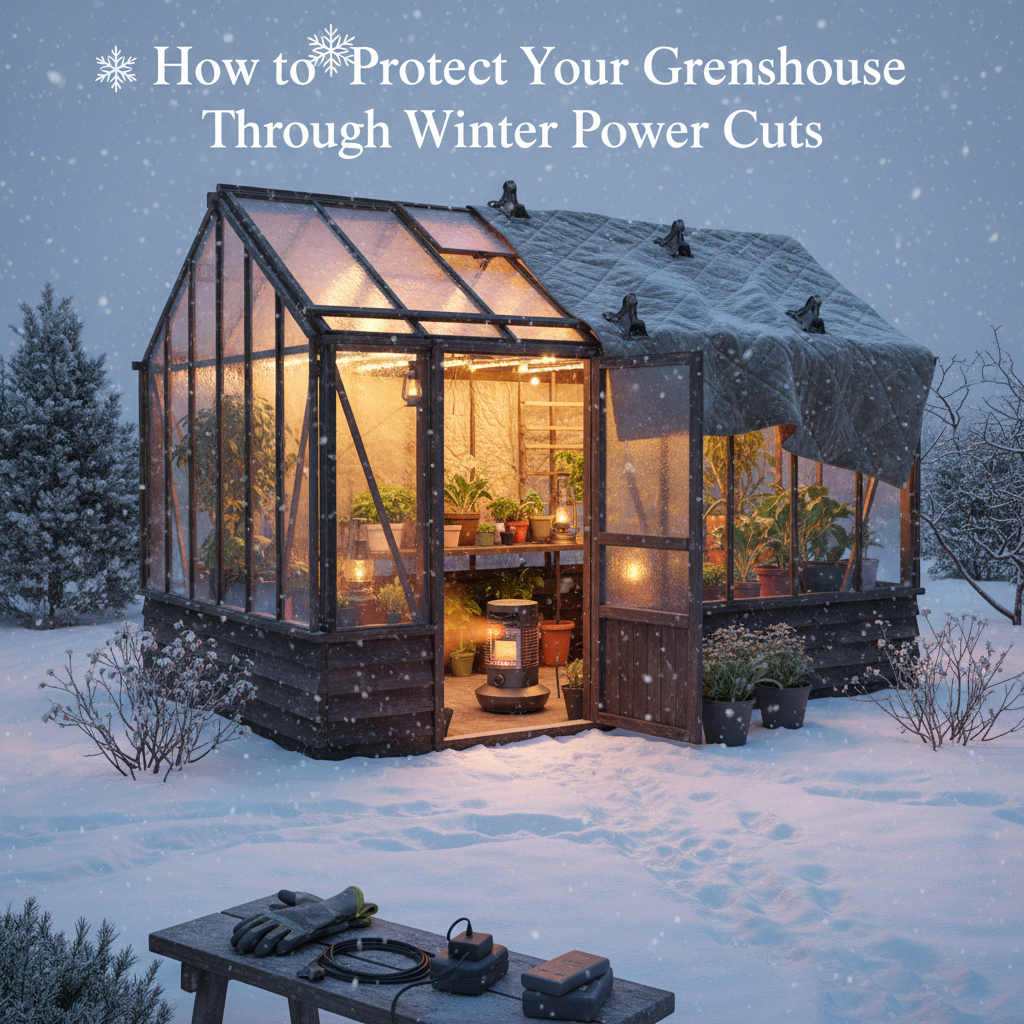
How to protect your greenhouse through winter power cuts
Key takeaways
- The wattage difference between a tube heater and a fan heater is dramatic — and it's the single most important number when choosing a backup power station.
- The calculation is straightforward once you know your heater's rated wattage and have an estimate of its duty cycle (how often the thermostat fires it on).
- There's a crucial difference between having a power station available and having it configured to switch automatically when the grid fails.
- The single most effective thing you can do before investing in a power station is to insulate your greenhouse properly.
Jim Fellows — Garden-Review, Outdoor Power Equipment Specialist
Greenhouse hea-ing data sourced from UK horticultural trade research · Runtime calculations verified at 90% inverter efficiency · Updated June 2026
Greenhouse winter power guide
A power cut on a frost night is the scenario every greenhouse gardener dreads — and in the UK it's not a remote possibility. The UK experienced around 25,000 unplanned power cuts in 2025, with the majority clustering in autumn and winter when storms bring down lines and demand peaks. A single overnight outage at -3°C can kill an entire season's overwintering plants. This guide explains how to calculate your greenhouse's backup power needs and which portable power station covers a full UK winter night.
A greenhouse is one of the most frost-vulnerable spaces on any UK property. Unlike the interior of a house — which retains heat well and stays liveable for many hours after heating fails — a greenhouse loses temperature rapidly once the heating stops, particularly in older single-pane glass structures. On a still -3°C night, an unheated greenhouse can drop to near-ambient within an hour of the power cutting. For citrus trees, overwintering pelargoniums, dahlia tubers in frost-free storage, or a propagation bench of seedlings, that's enough to cause irreversible damage.
The solution is straightforward: a portable power station charged and ready to keep your greenhouse heater running through the night if the grid fails. But the right unit depends entirely on your heater type and wattage — and those vary enormously. Here's how to calculate what you need and which Jackery model covers it.
Greenhouse heater types and their real power draw
The type of heater you're using determines everything. The wattage difference between a tube heater and a fan heater is dramatic — and it's the single most important number when choosing a backup power station.
| Heater type | Rated wattage | Avg draw (thermostat) | 8hr overnight draw | Notes |
| Electric tube heater | 60–120W | 60–120W | 480–960Wh | No thermostat — runs continuously. Low, steady warmth. Most efficient for overnight frost protection. |
| Electric fan heater (small, thermostat) | 750–1,000W | 150–300W avg | 1,200–2,400Wh | Thermostat cycles on/off. Average draw far lower than rated wattage on mild frost nights. |
| Electric fan heater (large, thermostat) | 2,000W | 300–600W avg | 2,400–4,800Wh | Heavier draw on hard frost nights (below -5°C). Requires Explorer 2000 v2 or larger for overnight. |
| Propagator heat mat | 60–120W | 60–120W | 480–960Wh | Runs continuously. Often paired with a greenhouse heater — stack the Wh requirements when calculating. |
Jim's recommendation: use a tube heater for backup scenarios
If you're specifically planning for power cut resilience, the most efficient approach is a thermostat-controlled electric tube heater (60–120W) as your primary greenhouse heating device. Its low, continuous wattage means even the Explorer 1000 v2 (1,070Wh) covers more than an overnight run — and a tube heater with a frost-stat is often all you need to keep a well-insulated 6×8 greenhouse above freezing on most UK winter nights.
How to calculate your greenhouse's backup power requirement
The calculation is straightforward once you know your heater's rated wattage and have an estimate of its duty cycle (how often the thermostat fires it on). Here's the method:
Find your heater's rated wattage
Check the label on the heater itself or its instruction booklet. If it shows amps (A) rather than watts, multiply by 230 — e.g. 5A × 230V = 1,150W. This is the peak wattage when the heater is actively heating.
Estimate the duty cycle
A thermostat-controlled heater doesn't run continuously — it fires when the temperature drops below the set point and switches off when it's reached. On a mild frost night (0°C to -3°C), a well-insulated 6×8 greenhouse typically has a duty cycle of 20–40% (heater runs for 20–40% of the time). On a hard frost night (-5°C or below), duty cycle can reach 60–80%.
Calculate overnight Wh draw
Multiply: rated wattage × duty cycle × hours. Example: 1,000W fan heater × 30% duty cycle × 8 hours = 2,400Wh. That's the energy you need your power station to provide. Add any other devices running simultaneously (propagator mat, frost alarm, etc.).
Add 20% safety margin
Power station capacity degrades slightly in cold conditions, and it's better to have headroom than to find the unit exhausted at 4am. Take your calculated Wh figure and multiply by 1.2 to get the minimum capacity you should be looking for in a unit.
Worked examples: common UK greenhouse setups
Setup A — Tube heater, 6×8 greenhouse
Heater: 120W tube heater (no thermostat, runs continuously)
Duration: 8 hours overnight
Total draw: 120W × 8hrs = 960Wh
+ 20% margin = 1,152Wh needed
✓ Covered by: Explorer 1000 v2 (1,070Wh)
Tight but sufficient for mild frost nights. Add a propagator mat and step up to the 2000 v2.
Setup B — Fan heater + propagator, 6×8
Heater: 1,000W fan heater, thermostat, 30% duty cycle
Propagator: 100W heat mat (continuous)
Heater draw: 1,000W × 0.3 × 8hrs = 2,400Wh
Propagator: 100W × 8hrs = 800Wh
Total + margin: 3,840Wh needed
⚠ Exceeds 2000 v2 (2,042Wh)
On mild nights (low duty cycle): 2000 v2 covers ~6.5 hrs. Consider switching to a tube heater for overnight backup to reduce draw.
Setup C — Optimised for backup (recommended)
Heater: 120W tube heater (continuous)
Propagator: 100W heat mat (continuous)
Frost alarm: 20W
Total: 240W × 8hrs = 1,920Wh
+ 20% margin = 2,304Wh needed
✓ Covered by: Explorer 2000 v2 (2,042Wh)
Covers a full 8-hour overnight with all three devices. The ideal combination of low-draw heater + power station backup.
Which Jackery model covers your greenhouse overnight?
| Model | Capacity | Max AC output | Covers overnight for... |
| Explorer 500 v2 | 512Wh | 500W | Tube heater (60W) for ~8 hrs. Not enough for a fan heater. Propagator mat only, or small shed frost protection. |
| Explorer 1000 v2 | 1,070Wh | 1,500W | Tube heater (120W) for ~8 hrs + propagator. Fan heater on mild nights at low duty cycle. Good for most 6×8 setups with a tube heater. |
| Explorer 2000 v2 ★ | 2,042Wh | 2,200W | Tube heater + propagator + frost alarm for full overnight. Fan heater (1kW, 30% duty) for 6+ hrs. Best all-round greenhouse backup unit. |
| Explorer 3000 v2 | 3,072Wh | 3,000W | 2kW fan heater for ~12 hrs at 30% duty. Large greenhouse + propagator bench + frost systems + home backup simultaneously. |
The right way to set up greenhouse power cut protection
There's a crucial difference between having a power station available and having it configured to switch automatically when the grid fails. The first approach means you notice the power cut, go to the greenhouse, and plug things in — by which point the temperature may already have dropped. The second means your greenhouse heater never stops.
The Explorer 1000 v2 and Explorer 2000 v2 both feature a 10ms UPS (Uninterruptible Power Supply) function. Here's how to use it for greenhouse protection:
Position the power station permanently in or near the greenhouse
Either in a weatherproof location inside the greenhouse itself, or in an adjacent shed with a cable run through. LiFePO4 batteries handle cold temperatures better than older lithium-ion chemistry, but performance degrades below 0°C — so inside the greenhouse (where it's warmer) is preferable to an unheated shed in deep winter.
Plug the power station into mains and keep it fully charged
In UPS mode, the unit stays connected to the mains and passes power through to the heater while keeping the battery topped up. Use the Jackery app to set an 80% charge limit for day-to-day storage, and override to 100% when a frost is forecast.
Plug your greenhouse heater and frost alarm into the power station's AC outlets
Not directly into the wall. The heater and frost alarm must be powered from the power station's outlets — which in turn draws from the mains while it's available, and seamlessly switches to battery when it isn't. This is the UPS function working exactly as designed.
Enable app notifications for low battery alerts
The Jackery app sends a notification when the battery drops below a threshold you set. Configure this to alert you at 30% remaining — giving you time to act (charge from another source, visit the greenhouse) before the battery is exhausted.
Insulate before you backup: cutting your power station's workload
The single most effective thing you can do before investing in a power station is to insulate your greenhouse properly. Horticultural bubble wrap reduces heat loss by 30–40%, which directly reduces the duty cycle of your heater and therefore the Wh your power station needs to provide.
A 6×8ft greenhouse insulated with bubble wrap on all walls and the roof, with doors and vents sealed before nightfall, stays 4–7°C warmer than an uninsulated equivalent on a cold night. That difference can mean the boundary between the heater cycling on 20% of the time vs 60% of the time — which halves or thirds your overnight power draw and potentially moves you down a tier in terms of which power station you need.
The practical sequence
1. Insulate with bubble wrap (under £20, cuts heat loss by 30–40%). 2. Install a thermostat-controlled tube heater if you don't already have one. 3. Calculate your overnight draw using the method above. 4. Choose your power station accordingly. Doing it in this order often means you can choose a smaller, cheaper unit than you'd otherwise need.
What to do right now if you don't have a power station yet
If the power cuts tonight and you don't have backup power, there are steps that can buy your plants several hours of protection:
- Close every vent, louver, and gap you can find immediately — heat escapes fastest through ventilation, and sealing it buys significant time.
- Drape horticultural fleece directly over vulnerable plants and seedlings — two layers adds 3–4°C of frost protection in still conditions.
- Bring the most vulnerable plants (citrus, tender tropicals, seedling trays) into the house if the outage looks prolonged.
- Fill large containers with hot water and place them among the plants — they act as heat sinks and release warmth as they cool.
- Check your Distribution Network Operator's outage map for an estimated restoration time, and prioritise your most vulnerable plants for emergency indoor relocation accordingly.
Frequently asked questions
Can I leave a power station in an unheated greenhouse all winter?
LiFePO4 batteries perform better than older lithium-ion in cold conditions, but their capacity reduces below 0°C and charging is not recommended below 0°C. If the greenhouse stays above freezing due to the heater, the power station is fine to leave there. In a deeply unheated space during a prolonged cold snap, bring it inside or into a frost-protected area to preserve its capacity and charging ability.
How do I know when a power cut is about to happen?
You don't — which is the entire point of a UPS configuration. Set it up so your greenhouse heater runs through the power station at all times, and the switchover is automatic. Alternatively, sign up for power outage alerts from your Distribution Network Operator (UKPN, Western Power, SP Energy Networks, etc.) — they send text alerts when planned and sometimes unplanned outages affect your postcode.
Does solar charging work in winter to top up the power station?
In winter (October–March), the SolarSaga panels generate 40–100Wh on a typical day — not enough to replace overnight draw from a heater, but useful as a supplementary daytime top-up between outages. Rely on mains charging as your primary source in winter and treat solar as a bonus. In spring and autumn (the main frost risk periods), solar output is significantly better at 200–350Wh per fair day.
What temperature do I need to maintain in my greenhouse over winter?
For frost-free overwintering of hardy plants (pelargoniums, fuchsias, tender perennials), set the thermostat to 2°C — just above freezing. For citrus trees and more tender plants, 5–7°C is recommended. For actively growing seedlings, 10°C or above. The lower the target temperature, the lower the heater's duty cycle and the less backup power you need — frost protection only (2°C) requires far less overnight energy than warm growing (10°C+).
Recommended greenhouse backup power stations
Both available from Jackery UK with free delivery, 5-year warranty, and 30-day money-back guarantee. Check current prices — Jackery offers significant seasonal discounts, particularly in autumn ahead of the frost season.
Affiliate disclosure: This article contains affiliate links to Jackery UK. Garden-Review may earn a commission on purchases made through these links at no additional cost to you. Greenhouse heating data sourced from UK horticultural trade research and verified against manufacturer specifications. Runtime estimates calculated at 90% inverter efficiency with a 20% safety margin — actual performance will vary by temperature, insulation quality, and heater duty cycle. Jim's editorial opinions are independent and unpaid.
Jim Fellows is a garden machinery and outdoor power equipment specialist at Garden-Review.co.uk with over 15 years of hands-on experience testing products across residential and professional garden settings.
Tags
Comments
Join the conversation
Create a free account to leave comments, share photos, and connect with other gardeners.