
Jackery Explorer 100D Review (2026): A 96Wh Laptop Power Station That Fits in Your Hand
Jackery Explorer 100D review: 96Wh LiFePO4, two 140W USB-C ports, 855g and carry-on friendly for £99. Who it suits, what owners say, and why it won't run garden tools.
Key takeaways
- It's Jackery's smallest "power station" to date: a 118.7 × 82.6 × 85.7mm cube with a fold-flat carry handle, weighing 855g.
- Everything — screen, the single DISPLAY button and all three ports — sits on one face, which is the right call for a unit that'll live in a rucksack or on a potting bench.
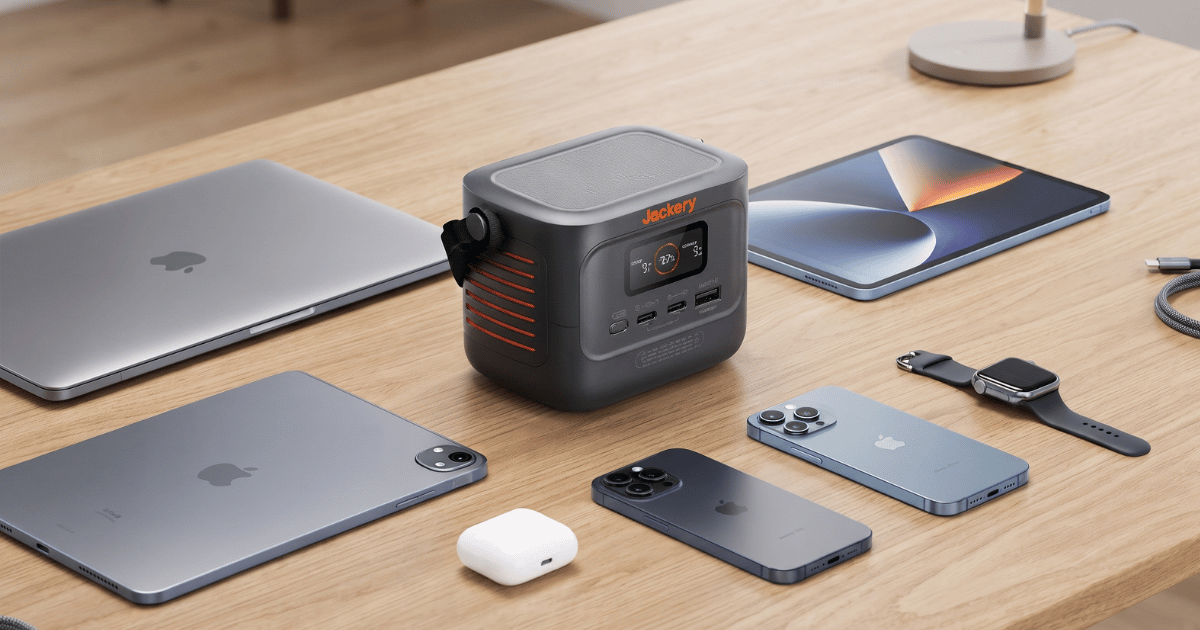
- Both USB-C ports will deliver up to 140W and support PD 3.1, PPS and Apple's AVS protocol, so a 14-inch MacBook Pro or a hungry Windows laptop will fast-charge rather than trickle.
- These are calculated estimates (about 82Wh usable), not timed tests.
- Jackery's UK page shows 4.9/5 from 77 reviews (69 five-star, 5 four-star, 3 three-star, no one- or two-star).
Our Rating
Jackery Explorer 100D Review
Mark Moore - Power Tools Specialist, Garden-Review
BAGMA Accredited Technician · 25+ years with outdoor power kit · Specs checked against Jackery UK, November 2026 · Owner feedback and independent hands-on reports reviewed
Quick answer
The Jackery Explorer 100D is a 96Wh, 855g USB-only power station with two 140W USB-C ports, LiFePO4 cells rated for 3,000 cycles and a £99 UK price (RRP £119). It's an excellent carry-on-legal laptop and phone battery for travel, allotment days and fishing trips — but it has no AC socket, so it won't run or recharge mains garden tools. Score: 4.3/5.
★ Mark's verdict · 4.3 / 5
Think of the 100D as a very good, very tough power bank rather than a small generator. The 140W USB-C ports are genuinely laptop-class, the LiFePO4 chemistry should outlast three or four ordinary power banks, and the screen tells you exactly what's going in and out. Knock off marks for the missing wall charger in the UK box and the 100W cap when you charge and discharge at the same time.
What's good
- Two full 140W USB-C ports (158W combined)
- LiFePO4 cells rated 3,000 cycles to 80%
- 96Wh — under the 100Wh airline cabin limit
- Informative display: watts in/out, runtime, battery health, temperature
- Solar (100W) and 12V/24V car input
What's not
- No AC outlet — no mains tools or tool-battery chargers
- Wall charger, car cable and solar adapter all sold separately
- Input and output both capped at 100W when used simultaneously
- 18W USB-A port is slow by today's standards
- Heavier and chunkier than a 25,000mAh power bank
What is the Jackery Explorer 100D?
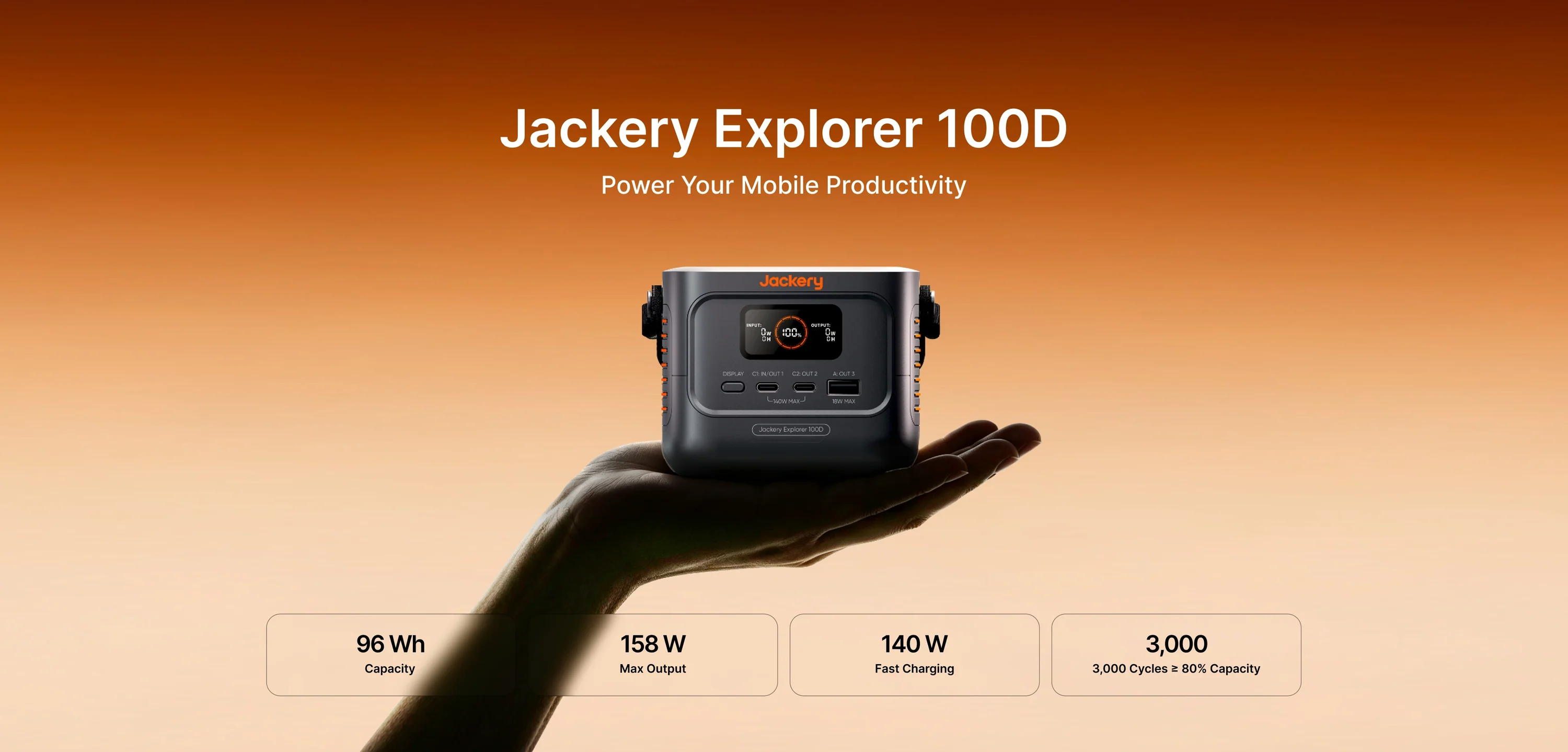
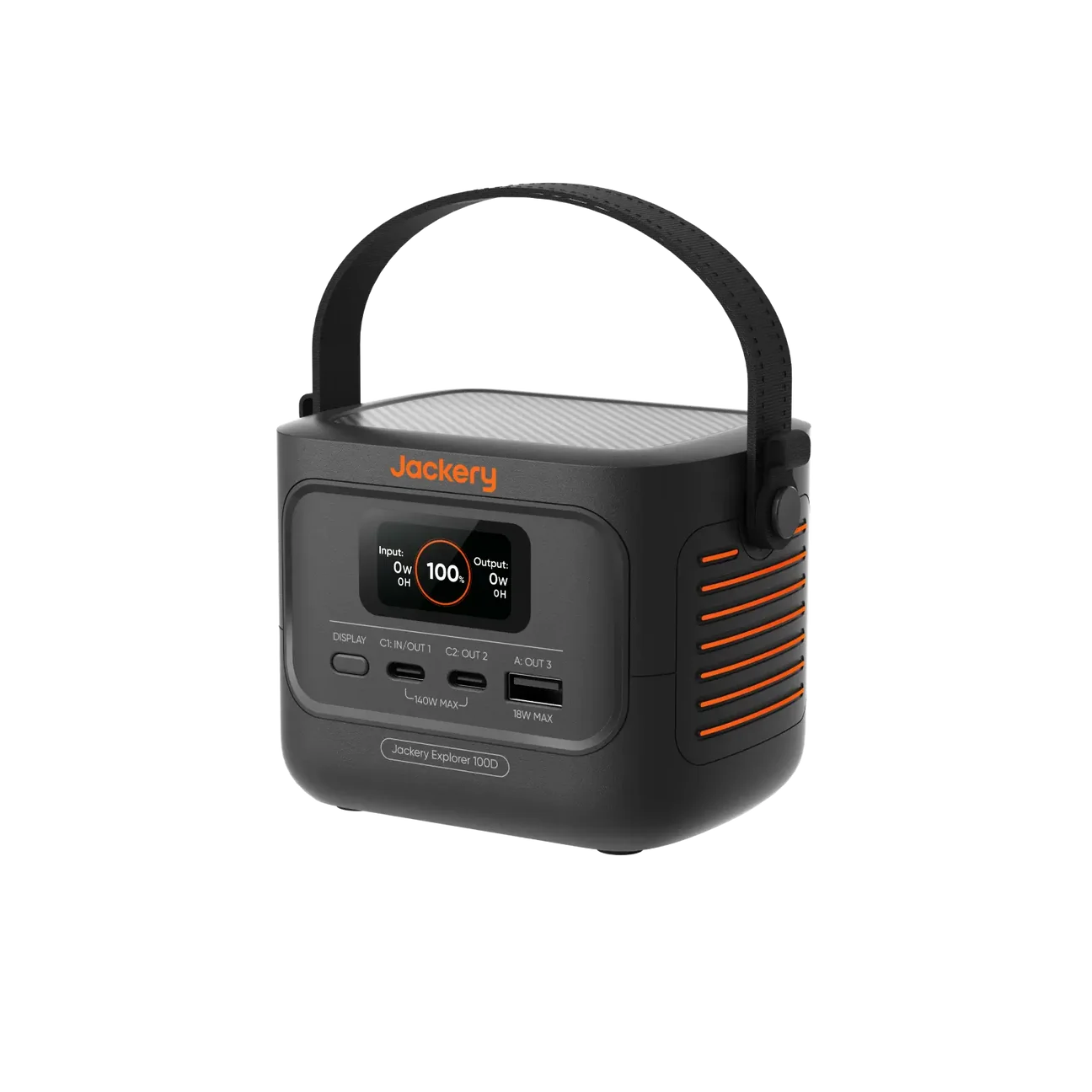
It's Jackery's smallest "power station" to date: a 118.7 × 82.6 × 85.7mm cube with a fold-flat carry handle, weighing 855g. Inside is a 96Wh (30,000mAh) lithium iron phosphate (LiFePO4) battery — the same safer, longer-lived chemistry Jackery uses in its big v2 units — feeding three outputs: two USB-C ports at up to 140W each and one 18W USB-A. Total output tops out at 158W.
What it doesn't have is an inverter. No three-pin socket, no 12V car-style output. That's the trade that makes it small, light and silent, and it's the single most important thing for a Garden-Review reader to understand before buying. If you were hoping to run a hedge trimmer, recharge a 40V mower battery or power a greenhouse heater, this is the wrong product — skip to the alternatives table further down.
Key specifications
| Capacity | 96Wh (5Ah @ 19.2V / ~30,000mAh) |
| Battery chemistry | LiFePO4 (LFP), 3,000 cycles to 80%+ |
| Max output | 158W combined |
| Outputs | USB-C1 140W (in/out) · USB-C2 140W (out) · USB-A 18W |
| AC / 12V output | None |
| Wall charging | USB-C up to 140W · 0–80% in ~1.7 hrs (Jackery figure) |
| Solar input | 10–30V, 5A, 100W max (via DC8020-to-USB-C adapter) |
| Car input | 12V/24V, 5A max (cable + adapter sold separately) |
| Operating temperature | Charge 0–45°C · Discharge −20 to 45°C |
| Weight / size | 855g · 118.7 × 82.6 × 85.7mm |
| In the box (UK) | Explorer 100D, one USB-C cable |
| Warranty | 2 years (extendable to 5 via Jackery UK) |
| UK price | £99 (RRP £119) at time of writing |
Buy the Jackery Explorer 100D at Jackery UK →
Build quality and design
Everything — screen, the single DISPLAY button and all three ports — sits on one face, which is the right call for a unit that'll live in a rucksack or on a potting bench. The handle doubles as a hook point, and Jackery's other accessories (shoulder strap, solar adapter) are designed around it. At roughly the size of a travel mug it won't vanish into a coat pocket; Gadget Flow's launch write-up made the same point, noting it really wants the main compartment of your bag.
From a workshop point of view, what I like is the lack of anything that moves. No inverter means no cooling fan to clog with grass dust or seize up after a winter in the shed, and no fan noise. The flip side is that there's nothing user-serviceable either — this is a sealed unit, so the 2-year warranty (and the optional extension) matters more than it would on a petrol generator where I can get parts.
 Buy the Jackery Explorer 100D at Jackery UK →
The display: the best bit for tinkerers
The TFT screen shows battery percentage plus input and output watts by default, and a press of the button cycles through per-port output, estimated runtime, battery health, cycle count and temperature. CleanTechnica's hands-on with a launch unit confirmed the per-port and health views work as described. For anyone who likes to know what's really going on — is my laptop pulling 65W or 100W? Is the solar panel actually delivering in this cloud? — that's far more useful than four green LEDs on a typical power bank.
One caveat from owners: the review summary on Jackery's UK page flags the display as dim in bright conditions. That's worth knowing if you'll mostly use it outdoors in summer, though some of those reviews relate to the older 100 Plus (see "What owners say" below).
Charging performance
Charging your devices
Both USB-C ports will deliver up to 140W and support PD 3.1, PPS and Apple's AVS protocol, so a 14-inch MacBook Pro or a hungry Windows laptop will fast-charge rather than trickle. Jackery claims around 50% on an iPhone 17 in about 21 minutes and a DJI Pocket 3 to half in 10 minutes, and says one full 100D is good for roughly one complete 14-inch MacBook Pro charge or four-plus phone charges. Those are manufacturer figures, but they're consistent with the maths: 96Wh at typical DC-to-DC losses leaves about 80–85Wh to put into your devices.
The 18W USB-A port is the weak link. It's fine for a head torch, earbuds or a trail camera, but owners mention slower USB charging as their main gripe. For small wearables there's a low-power mode (hold DISPLAY for three seconds) so the unit doesn't switch off when a watch or earbuds stop drawing enough current to register.
Recharging the 100D
Jackery quotes 0–80% in about 1.7 hours from a 140W USB-C wall charger. In CleanTechnica's hands-on, a unit that arrived at 30% reached full in about an hour, and the reviewer was able to charge a phone and another power bank from it at the same time — so pass-through charging does work on the 100D.
There are two catches. First, Jackery's FAQ states that when you charge from a 140W PD charger and power devices at the same time, both input and output are limited to 100W. Fine for a phone and a laptop; less fine if you were planning to fast-charge two laptops off it while it sits on the mains. Second, the UK box contains only the unit and a USB-C cable. You'll need your own high-wattage USB-C charger — any decent 100W+ PD laptop charger you already own will do — or Jackery's GaN charger, which is sold separately.
Solar and car charging
Solar input is up to 100W via a DC8020-to-USB-C adapter. Jackery's 40W panel includes that adapter; with the SolarSaga 100W you'll need to buy it (£26.90). In real British weather, expect a 100W panel to deliver well under its rating — on a bright spring day at the allotment, 60–70W is a realistic working figure, which would still take the 100D from empty to most of the way full in under two hours. Car charging uses a 12V/24V cable plus the same adapter; Gear Diary's launch report cites just over three hours to 80% from a 12V socket.
Buy the Jackery Explorer 100D at Jackery UK →
Estimated runtimes for outdoor and garden kit
These are calculated estimates (about 82Wh usable), not timed tests. Real figures will vary with temperature, cable quality and how hard the device is working.
| Device | Typical draw / battery | Estimated result |
|---|---|---|
| Smartphone | ~15–20Wh battery | 4–5 full charges |
| 13–14" laptop | 50–70Wh battery | ~1–1.5 full charges |
| USB LED shed / greenhouse light | 5W | ~16 hours |
| USB desk fan (summer greenhouse work) | 4–6W | ~14–20 hours |
| Bluetooth speaker | ~10–20Wh battery | 4–8 recharges |
| Wildlife / trail camera (USB-powered) | ~1–2W average | Roughly 2–3 days continuous |
| USB-C-charging small tool batteries (some 12V/USB pruning shear and screwdriver packs) | ~20–40Wh | 2–4 recharges, if the pack charges by USB-C |
| 18V/40V garden tool batteries with mains chargers | Needs AC | Not possible — no AC outlet |
What owners and early reviewers say
Jackery's UK page shows 4.9/5 from 77 reviews (69 five-star, 5 four-star, 3 three-star, no one- or two-star). Treat that number carefully: the page groups in reviews from related products, and several are clearly about the older Explorer 100 Plus or Explorer 100. That's still useful — it's the same form factor and design family — but it isn't 77 verdicts on the 100D specifically.
The themes that keep coming up:
- Real-world capacity. One owner reports charging an iPad twice and a phone three times, plus a speaker, from one charge — in line with what the maths predicts.
- Air travel. Another owner says they've taken theirs on Ryanair several times without problems, which matters to anyone flying to a holiday or a garden show.
- Outdoors and off-grid. Reviewers describe it as small enough for a day-out rucksack, and one pairs it with the SolarSaga 100W panel to stay topped up.
- Charger upgrades. A 100 Plus owner notes that buying Jackery's GaN wall charger made recharging much faster — a hint that the charger you use matters a lot.
- Complaints. The recurring negatives are slower USB charging (the USB-A port especially) and a display that's hard to read in strong sunlight.
Among the press, the most sceptical take came from Gadget Flow, whose writer said he won't believe Jackery's eight-year lifespan claim until owners have put a few winters on the units. I agree. LiFePO4 is a proven chemistry and 3,000 cycles is a realistic rating for it, but the electronics around the cells are what usually fail first, and nobody has two winters of data on this model yet.
Buy the Jackery Explorer 100D at Jackery UK →
Who is it for — and who should look elsewhere?
Buy it if you…
- Work from a laptop at the allotment, shed or on the road
- Fly and want one cabin-legal battery for laptop and phone
- Run USB lights, fans, cameras or trail cams away from the mains
- Want a battery that should outlive several cheap power banks
Look elsewhere if you…
- Need to run or recharge mains-powered garden tools
- Want power-cut backup for a fridge, router or heater
- Only charge a phone — a pocket power bank is cheaper and lighter
Explorer 100D vs the alternatives
| Explorer 100D | Explorer 100 Plus | Explorer 240 v2 | |
|---|---|---|---|
| Capacity | 96Wh | 99Wh | 256Wh |
| Max output | 158W (2 × 140W USB-C) | 128W | 300W incl. UK AC socket |
| AC outlet | No | No | Yes |
| Cycle rating | 3,000 (Jackery claims 50% more than 100 Plus) | ~2,000 (implied by Jackery's comparison) | LFP |
| Weight | 855g | Heavier and larger than the 100D (per Jackery) | ~3.5kg |
| Best for | Laptops, travel, day trips | Phones and tablets | Shed, small mains tools, tool chargers |
If you need a three-pin socket at the bottom of the garden, read our Jackery Explorer 500 v2 review or the full Jackery buying guide. For running cordless and corded kit off-grid, see running power tools in your garden without mains electricity, and for weekends away, our best Jackery power stations for UK camping.
Mark's tips for getting the most from it
- Use a 100W+ USB-C PD charger and a cable rated for it. A 60W cable will quietly throttle both charging and output.
- Don't charge it in a frozen shed. It will discharge down to −20°C, but charging stops below 0°C. Bring it indoors to recharge in winter.
- Plug laptops into USB-C1 or C2, not USB-A. Save the 18W port for lights and earbuds.
- Register it and consider the extended warranty. It's a sealed unit with no parts you can replace, so warranty cover is your only repair route.
- Check your airline. 96Wh is under the usual 100Wh cabin limit, but it must go in hand luggage, not the hold.
Final verdict · 4.3 / 5
For £99, the Explorer 100D is one of the most sensible portable batteries you can buy if your kit charges over USB-C. Two proper 140W ports, a long-life LiFePO4 pack and a genuinely useful display put it a step above ordinary power banks. Just be clear about what it is: a laptop-and-gadget battery for the allotment, the bag and the plane — not a power station for garden tools. If that's what you need, it's an easy recommendation.
Buy the Jackery Explorer 100D at Jackery UK →Price and stock checked at Jackery UK on 20 November 2026 and may change. Garden-Review may earn a commission from purchases made through links on this page.
Frequently Asked Questions
Does the Jackery Explorer 100D have a plug socket?
Can I take the Explorer 100D on a plane?
Does it come with a charger?
Can it charge devices while it is charging?
Can I charge it with a solar panel?
Will it charge my cordless garden tool batteries?
How long will the battery last?
Tags
Comments
Join the conversation
Create a free account to leave comments, share photos, and connect with other gardeners.
Related Articles
Jackery Explorer 2000 v2 review: serious home backup for UK gardeners

Jackery Solar Generator 1000 v2 review: camping, caravanning and the allotment

Best Jackery portable power stations for UK camping 2025: tested and ranked
Best Jackery camping power stations 2026: compare 240 v2, 500 v2, 1000 v2 and 2000 v2 for UK camping trips.

Are Hyundai Lawn Mowers Any Good? An Honest UK Verdict (2026)
Are Hyundai lawn mowers any good? Honest UK verdict on build, value, warranty and which model to buy for your lawn size in 2026.
Power Up Your Garden: Why a Portable Power Station Is the Ultimate Outdoor Companion
Discover how a portable power station can transform your garden — from evening entertaining to off-grid greenhouses. We review the best options for UK gardeners in 2026.
Are Hyundai Generators Any Good? An Honest UK Verdict (2026)
A no-nonsense UK verdict on Hyundai generators — value, warranty, reliability and the best models for home backup, caravans and trade use.