
Best Wildlife Camera Traps for UK Gardens 2026
Find out what visits your garden after dark. We compare 20 wildlife camera traps for UK gardens, from WiFi and solar trail cams to a hedgehog-house camera, plus where to put them and the specs that actually matter.
Key takeaways
- Specifications as stated in manufacturer listings, October 2026.
- WiFi trail cameras create their own local hotspot (or use Bluetooth) so you can browse and download clips on your phone without opening the camera and pulling the SD card.
- A small solar panel trickle-charges the built-in battery, so you rarely need to touch the camera.
- These record to an SD card that you swap or read on a computer.
- Simple, no-frills cameras for trying out camera trapping before spending more.
- Best overall: GardePro E8P Max
- Best without WiFi: GardePro A3S
- Best long-range WiFi: GardePro E8 2.0 Pro
- Best solar-powered: CEYOMUR 4K Solar Wildlife Camera
- Best for hedgehog houses: PeekWild Solar Hedgehog House Camera
- Best for remote spots (4G): ZEISS Secacam 5
Most of the wildlife in a British garden turns up while you're asleep. Hedgehogs on their nightly rounds, foxes checking the bins, badgers, wood mice, muntjac on the edge of town and the odd tawny owl: a wildlife camera trap shows you what's really using your garden, and it's one of the most rewarding bits of kit you can buy for under £100.
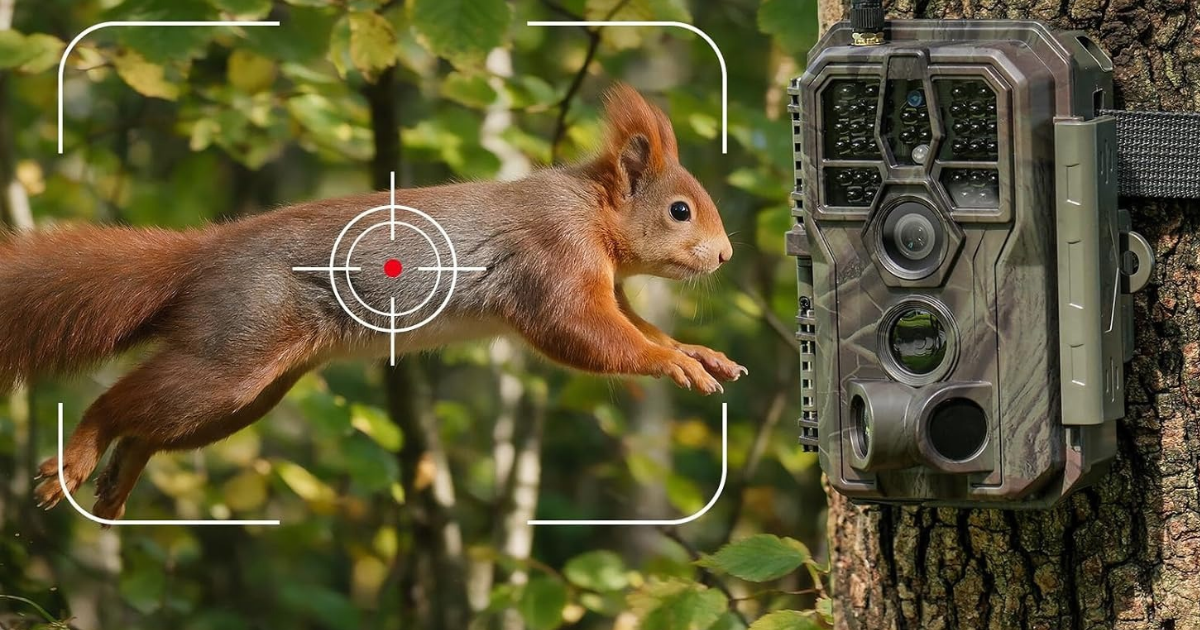
A camera trap (or trail camera) sits outdoors, waits for a passive infrared (PIR) sensor to detect a warm moving body, then records photos or video, switching to infrared at night. Below are the 20 models we looked at, grouped by how they're powered and how you get footage off them, followed by a buying guide and setup tips.
Wildlife cameras compared
| Camera | Video | Night vision | Power | Remote access |
|---|---|---|---|---|
| GardePro E8P Max | Not stated | No-glow | 8,000mAh rechargeable | WiFi app |
| GardePro E8 2.0 Pro | 4K | Not stated | 7,800mAh removable | WiFi up to 165ft |
| GardePro E6 | 1296p | Not stated | Not stated | WiFi + Bluetooth |
| Meidase P300 Pro | Not stated | 940nm no-glow, 30m | 7,800mAh | WiFi up to 50m |
| Sovonix | 1080p | Not stated | Not stated | WiFi + Bluetooth |
| CEYOMUR Solar | 4K | 40 IR LEDs | Solar + 5,200mAh | WiFi 6 |
| MAXDONE Solar | 4K | Not stated | Solar + 6,000mAh | WiFi + Bluetooth |
| WOLFANG Solar | 4K | Not stated | Solar + 2,500mAh (+AA) | Not stated |
| XTU Solar | 4K | Not stated | Solar / 2,600mAh / AA / DC | Not stated |
| Misstech Solar | 4K | f/1.6 lens | Solar + rechargeable | Not stated |
| GardePro A3S | 1296p | Sony Starvis sensor | Not stated | No (SD card) |
| MAXDONE 4K | 4K | Not stated | Not stated | No (2in LCD) |
| WOLFANG 48MP | 4K | 940nm no-glow | Not stated | No |
| iZEEKER | Not stated | 940nm no-glow | Not stated | No |
| Faunpeak | 4K | Low-glow | Not stated | Not stated |
| ZEISS Secacam 5 | HD | Not stated | Batteries (pre-fitted) | 4G mobile |
| PeekWild Hedgehog | HD | Yes | Solar + rechargeable | 2.4GHz WiFi live stream |
| EMEBAY | 1080p | Not stated | Not stated | No (LCD) |
| EfforPrac 12MP | Not stated | 940nm no-glow | Not stated | No (2in screen) |
| zalati PR3000 | 1080p | 34 IR LEDs | Not stated | No |
Specifications as stated in manufacturer listings, October 2026. "Not stated" means the listing summary we reviewed doesn't give the figure.
Best WiFi wildlife cameras (check footage from your phone)
WiFi trail cameras create their own local hotspot (or use Bluetooth) so you can browse and download clips on your phone without opening the camera and pulling the SD card. They don't connect to your home broadband: you need to be within range of the camera itself, typically 15–50m. No monthly fees are involved.
1. GardePro E8P Max – Best overall
The E8P Max solves the two most annoying things about trail cameras: batteries and SD cards. An 8,000mAh rechargeable battery, charged by USB-C, replaces a tray of disposable AAs, and GardePro says it holds up well in low temperatures, which matters on frosty nights. A built-in 32GB memory chip removes SD card compatibility problems, and loop recording overwrites the oldest clips so it never stops when full.
Night-time footage uses no-glow infrared, which hedgehogs, foxes and badgers can't see, and the 0.1s trigger is among the fastest here. Add WiFi for checking clips from the kitchen, and it's the most complete garden package in this list.
Good for: set-and-forget garden monitoring. Watch out for: built-in storage can't be expanded by swapping cards.
2. GardePro E8 2.0 Pro – Best long-range WiFi
GardePro's flagship records 4K and claims a local WiFi range of up to 165ft (about 50m), more than double the roughly 50ft typical of many trail cameras. That means you can put it at the bottom of a long garden or by the compost heap and still connect from the house. The 7,800mAh battery is rated for around 500 charge cycles and is removable, so you can swap in a charged spare (sold separately) rather than bringing the camera indoors.
Good for: long gardens and allotments. Watch out for: spare battery costs extra.
3. GardePro E6 WiFi Wildlife Camera
The E6 is GardePro's more affordable WiFi model, using low-power WiFi and Bluetooth with a free app and no subscription. A built-in antenna helps keep the connection stable, and a wide 110° view angle covers more of a lawn or border than most cameras here, recording at 1296p or 1080p. The listing doesn't specify the power source or night-vision type, so check those on the product page.
Good for: WiFi convenience at a lower price. Watch out for: power and IR details not stated.
4. Meidase P300 Pro
The Meidase is built around discreet night use: 940nm no-glow infrared with no visible red light, automatic adjustment of infrared brightness to avoid washed-out close-ups, and up to 30m of night-vision range. A 7,800mAh battery, dual antennas for a WiFi range of up to 50m, and an IP66 weatherproof rating round it out, and a 64GB SD card is included so it works straight from the box.
Good for: clear night footage without disturbing animals. Watch out for: 30m IR reach is more than a garden needs; close-range exposure is what counts.
5. Sovonix WiFi Trail Camera
A WiFi and Bluetooth camera that works with the TrailCam Go app. It records 1080p at 30fps in H.264, which keeps files small and plays back on a phone without conversion, and claims a 0.1s trigger. It's a straightforward option if you mainly want to preview clips on your phone.
Good for: simple app-based viewing. Watch out for: 1080p rather than 4K; power details not stated.
Best solar-powered wildlife cameras
A small solar panel trickle-charges the built-in battery, so you rarely need to touch the camera. Bear in mind UK winter daylight is short and weak, so place the panel where it gets open sky, and expect the battery to do more of the work from November to February.
6. CEYOMUR 4K Solar Wildlife Camera – Best solar-powered
The CEYOMUR combines the most flexible power setup with WiFi. A 5,200mAh built-in battery is topped up by a solar panel on top, can also charge by USB-C, and takes four AAs as a backup, so it should keep running even through a grey December. It records 4K video with 40 infrared LEDs for night shots and uses the newer WiFi 6 standard for a quicker, steadier connection. A 64GB SD card is included.
Good for: leaving out all winter. Watch out for: IR type (no-glow or low-glow) not stated.
7. MAXDONE Solar Wildlife Camera
MAXDONE's solar model has the biggest battery of the solar group at 6,000mAh, charged by an integrated panel or USB-C. Low-power WiFi and Bluetooth link it to the free TrailCam GO app for previewing clips and photos. It records 4K video.
Good for: solar plus WiFi with a large battery. Watch out for: no AA backup mentioned.
8. WOLFANG Solar Wildlife Camera
A 4K solar camera with a fast 0.1s trigger and an IP66 weatherproof rating. Its built-in battery is smaller at 2,500mAh, but an optional four-AA backup pack extends standby time. No WiFi is mentioned, so expect to retrieve footage from the SD card.
Good for: fast-moving visitors. Watch out for: smaller battery for UK winters.
9. XTU 4K Solar Wildlife Camera
The XTU offers the most ways to stay powered of any camera here: solar panel, 2,600mAh built-in battery, USB-C charging, four AA batteries or a DC power socket. If you have an outdoor power supply near a shed, the DC option means it can run indefinitely. It records 4K video with sound.
Good for: flexible power, including mains via DC. Watch out for: no WiFi mentioned.
10. Misstech 4K Solar Trail Camera
The Misstech's standout spec is an f/1.6 wide-aperture lens, which lets in more light at dawn, dusk and night, exactly when garden mammals are most active. It pairs a 0.1s trigger with a five-frame burst mode for fast visitors, and runs on a solar-charged built-in battery.
Good for: low-light dusk and dawn footage. Watch out for: battery capacity not stated.
Best standard wildlife cameras (SD card, no WiFi)
These record to an SD card that you swap or read on a computer. No app, no pairing, and usually the best value for money.
11. GardePro A3S – Best without WiFi
The A3S uses a Sony Starvis image sensor, a low-light sensor family that's a meaningful step up for night footage, behind a quality optical lens. It records 1296p at 20fps or 1080p at 30fps with sound, and H.264 encoding cuts file sizes by around 80% compared with older MJPEG cameras, so an SD card lasts far longer. Separate day and night overexposure control helps prevent the bleached-out faces you often get when an animal walks right up to the lens.
Good for: quality footage without app fuss. Watch out for: no remote access.
12. MAXDONE 4K Wildlife Camera with LCD Screen
A 2in colour screen lets you line up the shot and review clips on the spot, which makes positioning much easier than guessing. It records 4K, has a 0.2s trigger and five-shot burst, and a 120° PIR detection zone reaching up to 65ft (about 20m) so it picks up animals crossing the frame early.
Good for: easy aiming and on-the-spot review. Watch out for: power and IR type not stated.
13. WOLFANG 4K Wildlife Camera (No-Glow)
This WOLFANG uses 940nm no-glow infrared LEDs (the listing quotes both 36 and 38) to film silently in black and white at night, so animals behave naturally. It records 4K, and a flip cover protects the control panel with a sealed battery compartment for weatherproofing.
Good for: discreet night filming. Watch out for: no-glow IR gives a shorter, darker night image than low-glow.
14. iZEEKER No-Glow Wildlife Camera
An easy, garden-focused camera with 940nm no-glow infrared, a 0.2s trigger, three-shot burst and a microphone for sound. It loop-records over old footage once the card is full, and the simple menus and included strap make it a good first trail camera.
Good for: beginners. Watch out for: video resolution not stated.
15. Faunpeak 4K Wildlife Camera
A 4K camera with low-glow infrared, which gives a brighter, longer-reaching night image than no-glow at the cost of a faint red glow some animals may notice. It has a 0.2s trigger and an IP66 rating.
Good for: brighter night footage. Watch out for: faint visible glow.
Best budget wildlife cameras
Simple, no-frills cameras for trying out camera trapping before spending more.
16. zalati PR3000 Trail Camera
Full HD 1080p video, 34 infrared LEDs for night shots, a 0.3–0.6s trigger and detection up to 20m. A no-nonsense entry point.
Good for: a first camera trap. Watch out for: slower trigger may miss quick visitors.
17. EfforPrac 12MP Hunting Camera
Refreshingly, this one quotes a modest 12MP. It has 940nm no-glow infrared, a 15m detection range, an IP66 rating, operation from -20°C to 70°C, and a 2in screen for setup. Its 0.8s trigger is the slowest here, so it suits slow animals like hedgehogs better than foxes crossing quickly.
Good for: hedgehog feeding stations. Watch out for: slow trigger.
18. EMEBAY Hunting Camera
A 1080p camera with an IP66 waterproof rating and a built-in LCD screen for reviewing captures. The listing is light on detail, so check the trigger speed and infrared type before buying.
Good for: basic monitoring. Watch out for: limited specs.
Specialist cameras
19. PeekWild Solar Hedgehog House Camera – Best for hedgehog houses
Unlike every other camera here, the PeekWild is built to sit inside a hedgehog house, so you can watch nesting and hibernation rather than just comings and goings. It connects over 2.4GHz WiFi, the band most home routers support and which reaches furthest into a garden, and live-streams to your phone. An external solar panel on a 185cm cable charges the built-in battery, so there's no mains cable to run.
Good for: watching inside a hedgehog house. Watch out for: needs your home WiFi to reach the house. Don't open an occupied house to fit it during hibernation.
20. ZEISS Secacam 5 (4G) – Best for remote spots
From the respected optics maker ZEISS, the Secacam 5 uses a 4G roaming SIM to send photos and videos straight to your phone from anywhere with mobile signal, not just within WiFi range. Batteries, SD card and SIM come pre-installed. It's overkill for a typical back garden, but ideal for an allotment, a smallholding or a second property. Check the ongoing data plan costs before buying.
Good for: allotments and remote land. Watch out for: mobile data costs.
How to choose a wildlife camera: buying guide
1. No-glow vs low-glow infrared
At night, trail cameras light the scene with infrared. No-glow (940nm) is invisible to people and to most mammals, so animals behave naturally, but the night image is darker with a shorter reach. Low-glow (850nm) gives a brighter, clearer picture but shows a faint red glow on the camera. In a typical garden, where animals are within 5m, no-glow is usually the better choice.
2. Trigger speed
This is the delay between the sensor detecting movement and the camera recording. Foxes and cats cross a frame in a second; hedgehogs dawdle. Look for 0.1–0.3s for an all-rounder. Slower cameras (0.6–0.8s) are fine aimed at a feeding station where animals stop.
3. Power
Disposable AAs drain quickly in cold weather. If you use them, choose lithium AAs, which cope much better in frost than alkaline. Large rechargeable batteries (6,000–8,000mAh) or solar models save money and hassle over a winter.
4. Getting footage off the camera
SD-only cameras are cheapest. WiFi/Bluetooth models let you browse clips on your phone within range of the camera, with no fees. 4G models send footage anywhere but need a data plan. Only the PeekWild here joins your home WiFi for live streaming.
5. Weatherproofing
Look for IP66 or better. British weather means driving rain, so also check the battery and card compartments seal properly.
6. Video format
H.264 video (GardePro, Sovonix) makes much smaller files than older MJPEG, so your card holds far more clips and they play straight on a phone.
How to set up a camera trap in your garden
- Go low for hedgehogs. Mount the camera about 30–50cm off the ground, angled slightly down, 1–2m from where you expect them, such as a feeding station, a gap under a fence, or a hedgehog house entrance.
- Follow the paths. Foxes and badgers use the same routes nightly. Look for flattened grass, gaps under hedges and muddy prints.
- Avoid false triggers. Point the camera away from swaying branches and direct sun, both of which can set off the sensor and fill your card with empty clips.
- Mind the neighbours. Aim the camera at your own garden. If it captures a neighbour's property or the street, the ICO's guidance on domestic CCTV means data protection rules can apply.
- Don't disturb protected species. Badgers and their setts are protected by law, and so are bats and nesting birds. Watch from a distance and never interfere with a sett or nest to get a shot.
- Best Bird Feeders & Hedgehog Houses for UK Gardens 2026
- Best Heated Bird Baths & Bird Bath De-Icers UK 2026
- How to Deter Grey Squirrels in Your Garden
- Slug and Snail Control UK: Hedgehog-Friendly Methods
Product details are taken from manufacturer and retailer listings and were correct to the best of our knowledge on 15 October 2026. Prices, stock and specifications change, so check the live listing before you buy.
Frequently Asked Questions: Wildlife cameras
What animals will a garden camera trap pick up in the UK?
Do wildlife cameras work through a window?
Will a trail camera scare hedgehogs or foxes?
Do WiFi trail cameras need a subscription?
How long do trail camera batteries last?
Is it legal to film wildlife in my garden?
Tags
Comments
Join the conversation
Create a free account to leave comments, share photos, and connect with other gardeners.