
JCB Tools Water Pump Buying Guide 2026
JCB petrol water pumps compared: WP50 vs WP80 vs WP80T. Flow, head, solids handling & prices - find the right pump for your job.
Key takeaways
- Quick Answer: JCB's petrol water pump range covers three models.
- JCB Tools (manufactured under licence by Genpower Ltd i n Pembrokeshire - see all our JCB Tools reviews ) keeps its water pump line-up deliberately simple: three open-frame petrol pumps built around one engine platform.
- This is the single most important question, and the one buyers most often get wrong.
- The entry point, and at 25kg the most portable pump in the range.
- Fill with 600ml of SAE30 or 15W40 before the first pull - running dry will destroy the engine and void the 3-year warranty.
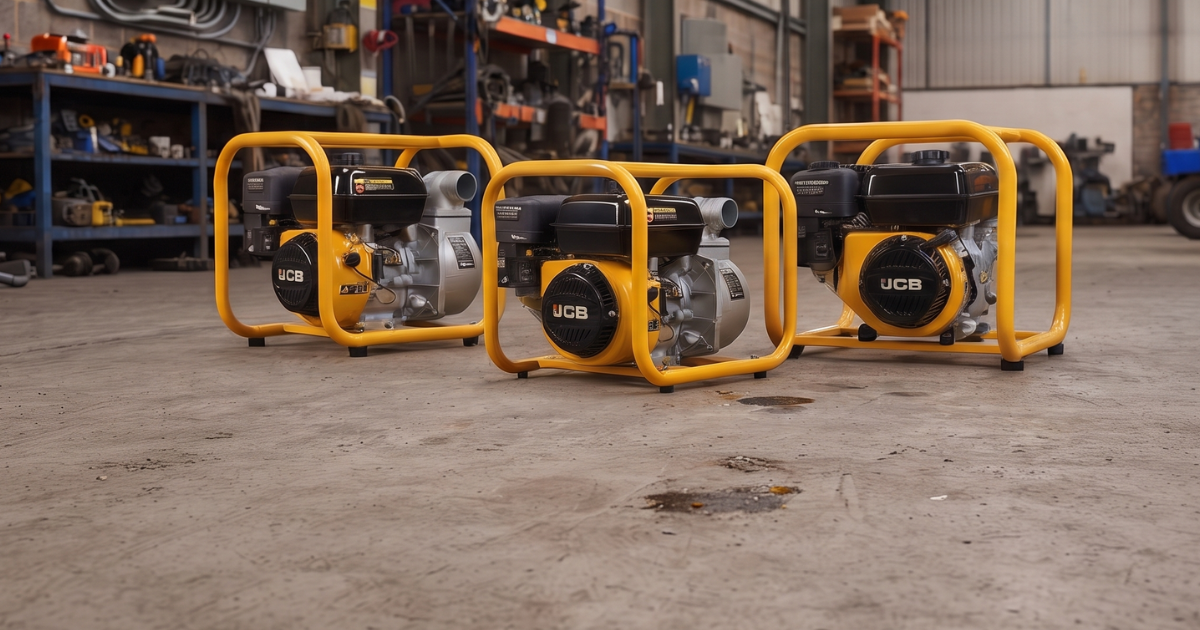
JCB Petrol Water Pumps Buying Guide: WP50 vs WP80 vs WP80T (2026)
Quick Answer: JCB's petrol water pump range covers three models. The JCB-WP50 is a 2-inch clean water pump moving 466 litres per minute - the pick for irrigation and lighter dewatering. The JCB-WP80 steps up to a 3-inch connection and 966 L/min for serious site dewatering. The JCB-WP80T is the trash pump: 1,000 L/min and the ability to pass solids up to 25.4mm, making it the only one of the three suited to genuinely dirty water.
All three share the same 7.5hp 224cc 4-stroke JCB engine, recoil start, cast iron impeller and 3-year platinum warranty.
The JCB Water Pump Range at a Glance
JCB Tools (manufactured under licence by Genpower Ltd in Pembrokeshire - see all our JCB Tools reviews) keeps its water pump line-up deliberately simple: three open-frame petrol pumps built around one engine platform.
That shared 224cc single-cylinder OHV air-cooled unit means servicing, oil (SAE30 or 15W40, 600ml) and fuel requirements (E10 unleaded, 3.6-litre tank, roughly 2 hours of runtime) are identical across the range. What separates the models is port size, flow rate and - crucially - how dirty the water can be.
| Spec | JCB-WP50 | JCB-WP80 | JCB-WP80T |
|---|---|---|---|
| Type | Clean water | Clean water | Trash / dirty water |
| Inlet / outlet | 2″ / 50mm | 3″ / 80mm | 3″ / 80mm |
| Max flow | 466 L/min (28 m³/h) | 966 L/min (58 m³/h) | 1,000 L/min (60 m³/h) |
| Total head | 32m | 28m | 25m |
| Suction lift | 7m | 7m | 7m |
| Max solids | 5mm | 5mm | 25.4mm (1″) |
| Net weight | 25kg | 27kg | 35kg |
| Price (inc. VAT) | £199.99 | £214.99 | £259.99 |
First, Answer These Three Questions
1. How dirty is the water?
This is the single most important question, and the one buyers most often get wrong. The WP50 and WP80 are clean water pumps that tolerate solids up to 5mm - fine for pond water, storm run-off and lightly silty water. But water from a flooded excavation, a slurry-edged ditch or a storm-hit cellar routinely carries gravel, twigs and debris well over 5mm. Push that through a clean water pump and you risk a jammed or damaged impeller. The WP80T trash pump exists precisely for this: its wider internal passages swallow solids up to 25.4mm - just over an inch. If in doubt about water quality, the trash pump is the safe buy.
2. How much water, how fast?
For site dewatering, calculate (or estimate) the inflow rate first, then choose a pump that comfortably exceeds it - otherwise you are bailing a boat with a hole in it. The WP50's 466 L/min is ample for irrigation transfer and emptying a domestic pond or flooded garage. The 80mm pumps effectively double that: 966–1,000 L/min is proper contractor territory, shifting around 58–60 cubic metres per hour at zero head.
3. How high does the water need to travel?
Quoted flow rates are at zero head; flow falls as lift increases. Interestingly, the smaller WP50 posts the best total head of the range at 32m, against 28m for the WP80 and 25m for the WP80T. If your job is pushing water a long way uphill - hillside irrigation, say - rather than moving huge volume, the WP50 is genuinely the better tool. All three share a 7-metre maximum suction lift, the practical ceiling for any surface pump.
Which JCB Water Pump Should You Buy?
JCB-WP50 — Best for Irrigation & Lighter Dewatering (£199.99)
The entry point, and at 25kg the most portable pump in the range. Choose it for garden and smallholding irrigation, water transfer from tanks and butts, pond emptying and occasional flood clean-up where the water is reasonably clean. Its class-leading 32m total head also makes it the range's best climber. The 2-inch ports are the limiting factor: it simply cannot match the volume of its bigger siblings.
Read our full JCB-WP50 review.
JCB-WP80 — Best for High-Volume Clean Water (£214.99)
The main site dewatering pump. For just £15 over the WP50 you more than double the flow to 966 L/min through 3-inch ports, while keeping the weight to a manageable 27kg. It is the value pick of the range for contractors, farmers and anyone regularly moving large volumes of clean-to-mildly-contaminated water. The same 5mm solids limit as the WP50 applies, so it is not a substitute for a trash pump. Note: at the time of writing this model is showing as sold out at jcb-tools.co.uk, so check availability.
Read our full JCB-WP80 review.
JCB-WP80T — Best for Dirty Water & Flood Response (£259.99)
The trash pump, and the one to buy if your water contains anything you cannot see through. 1,000 L/min, 25.4mm solids handling and the same bombproof open-frame build make it the tool for flooded excavations, muddy site water, storm debris and agricultural slurry-adjacent jobs. The trade-offs: it is the heaviest of the three at 35kg, has the lowest total head at 25m, and carries a £45–£60 premium over the clean water pumps. Worth every penny if you actually need it.
Read our full JCB-WP80T review.
Setup Essentials Before First Use
All three pumps ship without oil in the sump. Fill with 600ml of SAE30 or 15W40 before the first pull - running dry will destroy the engine and void the 3-year warranty. Each model has a low-oil warning system as a backstop, but do not rely on it. A few more essentials worth knowing:
- Always fit a strainer to the suction hose. Even the trash pump has limits, and a strainer is the cheapest impeller insurance you will ever buy.
- Prime the pump casing with water before starting. These are self-priming once wetted, but never run any of them dry.
- Fuel discipline matters with E10. JCB recommends E10 (95 RON) with a stabiliser, used within 30 days. E10 attracts moisture and can damage the fuel system if left in the tank beyond four weeks — drain and run the carb dry before storage.
- These are loud. All three are rated at 104dB, so ear protection is a must for anyone working nearby.
The bottom line: buy the WP50 for irrigation and portability, the WP80 for maximum clean-water volume per pound, and the WP80T whenever the water is dirty - or might be. Read our full expert reviews of the JCB-WP50, JCB-WP80 and JCB-WP80T, browse all our water pump reviews, or see our full JCB Tools coverage.
By Jim Fellows, Garden Machinery Specialist · Updated July 2026
How we review: this guide is based on detailed research of manufacturer specifications, product manuals and owner feedback as well as hands-on expert testing. Garden Review may earn a commission from links on this page, at no cost to you.
Frequently Asked Questions: JCB Water Pump Guide
What is the difference between the JCB-WP80 and the JCB-WP80T?
Can I use a clean water pump for flood water?
What engine do JCB petrol water pumps use?
How long will a JCB water pump run on a tank of fuel?
Are JCB water pumps made by JCB?
Comments
Join the conversation
Create a free account to leave comments, share photos, and connect with other gardeners.