
Hyundai 5-in-1 Garden Multi-Tools Explained: What the 5 Attachments Actually Do (UK Buyer's Guide 2026)
A 5-in-1 garden multi-tool combines a strimmer, brushcutter, hedge trimmer, pole pruner and extension shaft on one petrol or battery powerhead - letting you replace five separate machines with a single unit that costs a fraction of buying each tool individually. Attachments swap in under two minutes via a quick-release collar, and the single engine or battery does all the work.
Key takeaways
- A rotating nylon cord head cuts through grass that your mower can't reach - along fence lines, around tree bases, on slopes, and into corners.
- The choice between petrol and battery is the most important decision you'll make, and the "battery is always better" narrative popular in gardening media doesn't hold in every situation.
- Multi-tool manufacturers publish CC figures and voltage ratings without always explaining what they mean in practice.
- A 52cc petrol multi-tool with fuel, a heavy attachment (pole saw + extension), and the shoulder harness can approach 10–11kg.
- The right 5-in-1 depends primarily on your garden size and whether petrol or battery suits your working style — the thresholds in Section 3 are the best starting point.
In This Guide
1. The 5 Attachments - What Each One Does
Every 5-in-1 multi-tool ships with five core pieces of kit. Here's an honest breakdown of each, with the real use cases that most product pages gloss over.
Attachment 1: Grass Trimmer (Strimmer)
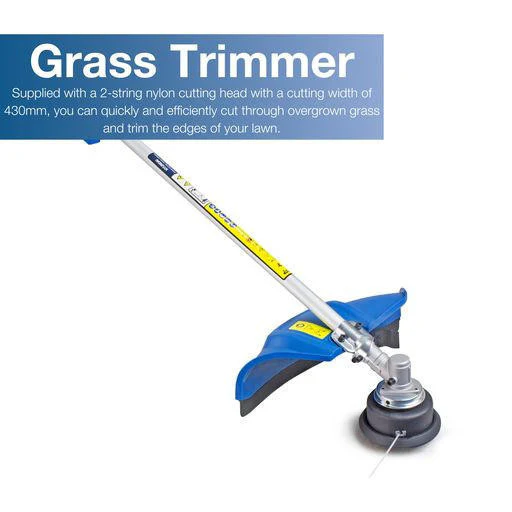
The attachment most people will reach for first. A rotating nylon cord head cuts through grass that your mower can't reach - along fence lines, around tree bases, on slopes, and into corners. On the Hyundai HYMT5200X-1, the head is a bump-feed design with a 430mm cutting width and a two-string nylon head, meaning you tap the head on the ground to release more cord without stopping the engine. Two-string heads cut faster and more cleanly than single-line alternatives. When you'd use it: Weekly lawn edge maintenance, clearing under hedges, trimming around obstacles. This is the workhorse attachment - expect to use it more than all the others combined.
| Specification | Detail |
|---|---|
| Cutting Width | 430mm |
| Head Type | 2-string nylon, bump-feed |
| Line Diameter | 2.4–2.5mm |
| Max Speed | 6,525 RPM |
Attachment 2: Brushcutter
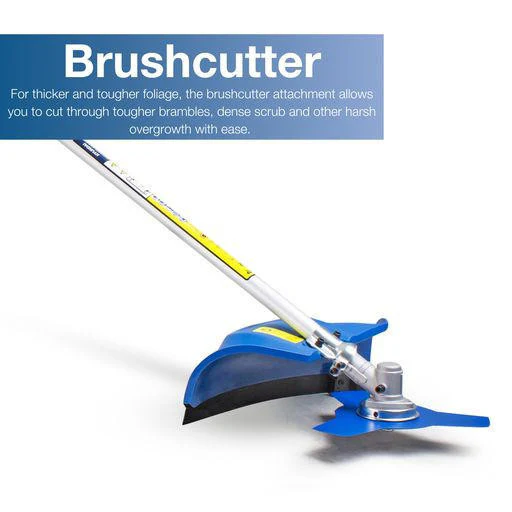
Where the grass trimmer uses nylon cord, the brushcutter uses a solid 3-tooth steel blade — and the difference is enormous on tough material. Brambles, woody scrub, dock plants, nettles thicker than your thumb, coarse rushes: all of these will snap nylon cord in seconds but barely slow a brushcutter blade. The Hyundai's 255mm steel blade runs at up to 6,900 RPM, giving it real bite on dense vegetation. When you'd use it: Reclaiming overgrown areas, clearing rough ground, cutting back encroaching scrub along fences or field edges. This is the attachment that separates a capable multi-tool from a lightweight trimmer.
⚠ Safety First
Always fit the blade guard and wear leg protection when using the brushcutter. A steel blade at 6,900 RPM will throw debris with force. No exceptions - this is not optional.
| Specification | Detail |
|---|---|
| Blade Width | 255mm |
| Blade Type | 3-tooth steel |
| Max Speed | 6,900 RPM |
Attachment 3: Hedge Trimmer
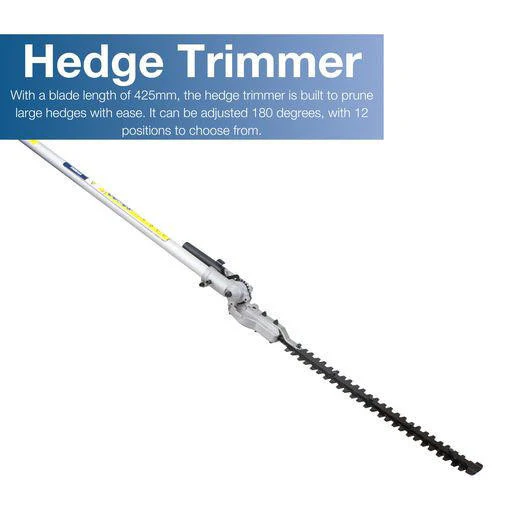
A dual-action reciprocating blade that cuts cleanly in both directions, giving a much neater finish than single-action blades. The HYMT5200X-1's 425mm blade handles up to 24mm branch thickness - fine for most established hedges including beech, privet, box, and leylandii. The head rotates through 180° in 12 locked positions with a double safety lock, which matters more than people expect: being able to angle the blade for sloping tops and vertical sides without repositioning your whole body saves real effort and produces a more professional finish.
When you'd use it: Late spring and late summer hedge-trimming sessions. Also handy for shaping ornamental shrubs — the angling feature lets you create flat tops and tapered sides that look properly done.
| Specification | Detail |
|---|---|
| Blade Length | 425mm |
| Cutting Capacity | 24mm |
| Tooth Spacing | 20mm |
| Head Rotation | 180° / 12 positions, double safety lock |
| Blade Type | Dual-action reciprocating |
| Max Speed | 1,550 RPM |
Attachment 4: Pole Saw (Pruner)
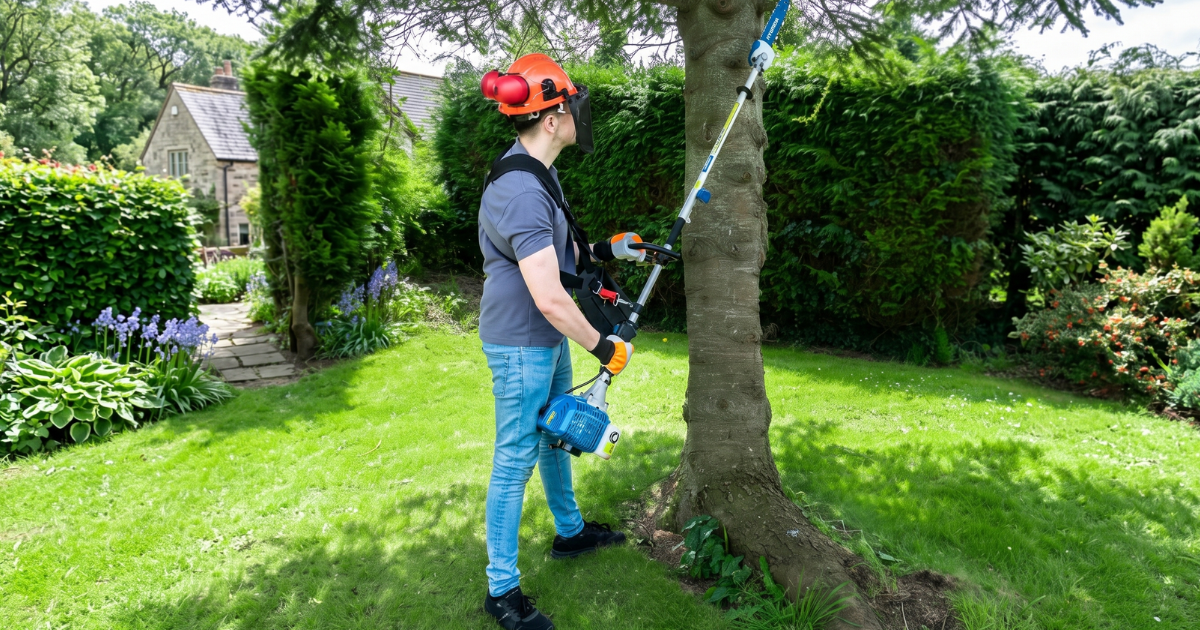
A small chainsaw bar on the end of the pole shaft - genuinely the attachment that most impresses garden owners when they first use it properly. The HYMT5200X-1 carries a 10" (295mm) bar with automatic chain lubrication, which keeps wear down without any manual oiling fuss. It'll handle branches up to around 200–220mm diameter comfortably. When combined with the extension shaft, you reach up to 4 metres - well above head height - which means pruning overhanging branches and cutting dead wood from tall hedgerows without a ladder.
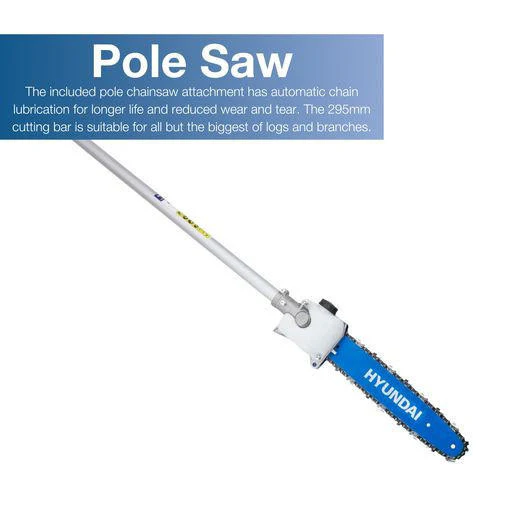
When you'd use it: Winter and early spring pruning, removing dead limbs, reducing the spread of overhanging trees. If you have mature fruit trees, this attachment alone justifies the price of the whole machine.
⚠ Working at Height — Never Stand Below a Cut
Always stand to one side of the cutting line so falling branches cannot hit you. Even a 3-inch limb at 4 metres falls with serious force. This is the most important safety rule for pole saw use.
| Specification | Detail |
|---|---|
| Bar Length | 10" / 295mm |
| Chain Lubrication | Automatic oil pump |
| Chain Speed | 20 m/s |
| Max Reach (with shaft) | 4 metres |
Attachment 5: Extension Shaft
Technically not a cutting attachment but a reach multiplier - an 800mm section that connects between the powerhead and any attachment via the same quick-release collar system. In combination with the pole saw, it turns a ground-level pruner into a 4-metre aerial saw. With the hedge trimmer, it lets you top tall hedges from the ground without a platform or ladder. The shaft adds weight (factor in another 500–700g), so use it selectively rather than fitting it by default.
When you'd use it: Any task above 2.5 metres - tall hedge tops, high branch pruning, cutting back trees that overhang paths or driveways. A genuine safety upgrade over working from ladders.
| Specification | Detail |
|---|---|
| Additional Reach | 800mm |
| Total Working Height | Up to 4 metres |
| Connection | Quick-release collar (same as all attachments) |
2. Petrol vs Battery 5-in-1s — Comparison
The choice between petrol and battery is the most important decision you'll make, and the "battery is always better" narrative popular in gardening media doesn't hold in every situation. Here's an honest comparison.
| Factor | Petrol (e.g. 52cc) | Battery (40V–80V) |
|---|---|---|
| Raw Power | ✓✓ Best-in-class. 52cc handles any residential task including dense scrub and thick hedge. | ◑ 40V adequate for routine tasks; 80V+ matches petrol for most work. Premium cost. |
| Runtime | ✓✓ Unlimited — refuel in 60 seconds. 1.2L tank = 45–90 min depending on load. | ◑ 40–90 min per charge. Spare batteries add cost and weight. |
| Instant Start | ✗ Recoil start — 2–4 pulls when warm, more when cold. Choke required when cold. | ✓✓ Button start. Ready in under a second. |
| Maintenance | ✗ Annual service: air filter, spark plug, fuel system. Two-stroke fuel mixing required. | ✓ Minimal. Blade/cord maintenance only. No fuel to mix or store. |
| Noise | ✗ ~95–100dB. Ear protection required. Not suitable early morning in close-packed housing. | ✓ ~75–85dB. Noticeably quieter. Better for urban gardens. |
| Weight | ◑ Heavier engine — 7–9kg assembled. Manageable with harness. | ✓ Typically 4–7kg with battery. Easier for extended use. |
| Entry Price (5-in-1) | ✓✓ £160–£300 for capable petrol multi-tools. Excellent value. | ◑ £250–£500+ for battery with comparable power and quality. |
| Running Cost | ◑ Fuel + oil ongoing. ~£3–4 per full tank. | ✓ Electricity only. Pennies per charge. |
| Best For | Large plots, heavy scrub clearance, all-day use, rural settings. | Medium gardens, suburban use, users who dislike engine maintenance. |
3. CC / Voltage Buying Thresholds by Garden Size
Multi-tool manufacturers publish CC figures and voltage ratings without always explaining what they mean in practice. Here's a plain-English guide to matching the spec to your garden.
Small Garden
Under ¼ Acre
- Petrol: 25–28cc sufficient
- Battery: 36V–40V adequate
- Mostly grass trimming and light hedge work
- Brushcutter rarely needed
- Prioritise lightness over power
Best pick: 26cc petrol or 40V battery
Medium Garden
¼ to ¾ Acre
- Petrol: 40–52cc recommended
- Battery: 56V–60V recommended
- Mixed tasks: trimming, hedge, occasional scrub
- Pole pruner attachment earns its keep
- Harness essential for long sessions
Best pick: 52cc petrol or 56V battery
Large Garden / Rural
Over ¾ Acre
- Petrol: 50cc+ strongly recommended
- Battery: 80V platform or petrol preferred
- Scrub clearance, tall hedgerows, tree pruning
- Runtime critical — petrol wins here
- Full-day sessions common
Best pick: 52cc petrol with split shaft
A note on the 52cc class: The Hyundai HYMT5200X-1's 52cc EURO 5 engine sits squarely in the medium-to-large category. It's more power than a small suburban garden needs, but that headroom means the engine runs at lower revs for light tasks — extending its life and reducing fuel consumption. 52cc engines genuinely do produce usable power without screaming at maximum RPM.
4. Common Pitfalls — And How to Avoid Them
Multi-tools are excellent when bought and used correctly. Here are the four mistakes seen most often in practice, and how to sidestep each one.
Pitfall 1: Underestimating the Weight
A 52cc petrol multi-tool with fuel, a heavy attachment (pole saw + extension), and the shoulder harness can approach 10–11kg. That's manageable in 20-minute bursts but genuinely tiring over an hour. Always fit the double shoulder harness before you start — never carry the machine on one arm. The harness distributes weight across your torso and reduces fatigue dramatically. If you have joint or back concerns, or are smaller-framed, start with a 26cc or battery model.
Pitfall 2: Ignoring Vibration (HAV) Exposure
All petrol multi-tools produce hand-arm vibration. The UK's exposure limits are real: 2.5 m/s² action value and 5 m/s² limit value. For domestic use this is rarely a problem, but if you're using the machine for multi-hour sessions, use anti-vibration gloves and take regular breaks. The Hyundai's EURO 5 engine is well-balanced, but no 52cc two-stroke is vibration-free. Your hands will tell you when it's time to stop.
Pitfall 3: Slow Attachment Swaps Ruining Your Rhythm
The quick-release collar system on modern multi-tools is genuinely quick — under 60 seconds with practice. But the first few swaps feel fiddly; after a dozen you'll do it without thinking. Make a habit of: (1) kill the engine first, (2) clean the splines with a brush before connecting, (3) check the collar click before restarting. Tools that don't fully seat cause vibration and wear. Keep the included hex keys and spanners in your kit bag at all times.
Pitfall 4: Getting the Two-Stroke Fuel Mix Wrong
This is the single most common cause of petrol multi-tool damage. The Hyundai requires unleaded petrol mixed with semi-synthetic 2-stroke oil at a 40:1 ratio - that's 25ml of oil per 1 litre of petrol. A measuring jug is included in the box, so use it.
⚠ Fuel Mix Rules — Never Break These
- Too little oil: engine seizure — the most expensive mistake possible
- Too much oil: plug fouling, power loss, excessive smoke
- Never use pure unleaded without 2-stroke oil mixed in
- Never use 4-stroke engine oil — wrong viscosity and additives
- Mix fresh fuel each season — old two-stroke mix goes off within 30 days and causes hard starting
5. Which Model Should You Buy?
The right 5-in-1 depends primarily on your garden size and whether petrol or battery suits your working style — the thresholds in Section 3 are the best starting point. For a head-to-head comparison of the leading models at every budget, our roundup covers the full category: Top 5 Garden Multi-Tools to Buy in the UK for 2026 →
If you've arrived here specifically researching the Hyundai HYMT5200X-1 - the 52cc petrol machine used as the reference example throughout this guide - our full hands-on review covers the complete specification, real-world performance notes,
and a detailed pros and cons breakdown: Hyundai HYMT5200X-1 Review →
At a Glance — Hyundai HYMT5200X-1
Engine
52cc EURO 5
Hedge Blade
425mm dual-action
Max Reach
4 metres
Price
£159.99
For our full verdict — including hands-on testing notes, complete specifications, and a detailed pros and cons breakdown — read our dedicated HYMT5200X-1 review.
6. Maintenance Guide
Keeping a two-stroke multi-tool in good condition is straightforward if you follow a regular schedule. Here's everything you need to know to get years of reliable service.
| Task | Frequency | Notes | Cost |
|---|---|---|---|
| Check air filter | Every 10 hours use | Tap clean or replace if clogged. A blocked air filter causes hard starting and poor power. In dusty conditions inspect more frequently. | ~£5–£8 |
| Clean spark plug | Every 25 hours / annually | Check gap (typically 0.6mm). Replace if electrode is worn or fouled. A fresh plug is the cheapest fix for a hard-starting two-stroke. | ~£3–£6 |
| Replace trimmer cord | Before each season | Fit fresh 2.4mm cord at the start of the season. Old or brittle cord snaps constantly, disrupting workflow and wasting time. | ~£3–£5 |
| Fuel system flush | End of season | Run the engine dry or use fuel stabiliser before storage. Stale two-stroke mix varnishes the carburettor and causes difficult starting the following season. | Nil / ~£5 |
| Clean splines and collar | Every 5–10 attachment swaps | Debris and grass sap accumulate in the attachment splines and prevent full seating. A brush and rag are sufficient. Fully seated connections are critical for safe operation. | Nil |
| Check pole saw chain tension | Before pole saw use | Chain should have very slight vertical play (1–2mm). A loose chain can derail; an overtight chain causes bar wear. The included spark plug spanner is used for chain tension adjustment. | Nil |
| Inspect brushcutter blade | Before each session | Inspect for cracks, chips, or bending. A damaged blade is a serious safety hazard — replace immediately. Never use a deformed blade at any speed. | ~£8–£15 |
| Annual full service | Annually | Replace spark plug, air filter, and fuel filter. Check all fasteners. Drain and replace stale fuel. Full UK Hyundai parts and servicing available direct. | ~£20–£35 |
This is an expert buyer's guide by Jim Fellows, Garden Expert at Garden-Review.co.uk. The Hyundai HYMT5200X-1 is used throughout as a reference example of the 52cc petrol class. For a complete product verdict, see our full HYMT5200X-1 review. For model comparisons across all budgets, see our top 5 multi-tools roundup. This article contains affiliate links — we may earn a commission if you purchase through these links, at no extra cost to you. Our editorial analysis is always independent.
7. Frequently Asked Questions
Is a 5-in-1 garden multi-tool worth it?
Can one person handle a 52cc multi-tool?
Petrol or battery for a 5-in-1 multi-tool?
How heavy is too heavy for a garden multi-tool?
What two-stroke oil should I use?
How long does the attachment swap take?
Tags
Comments
Join the conversation
Create a free account to leave comments, share photos, and connect with other gardeners.
Related Articles
Best Electric Leaf Blower Vacuums UK 2026
Find the best electric leaf blower vacuums in the UK for 2026, compared for power, value, bag size and performance.

Hyundai HY20CB 20v Cordless Leaf Blower Review
Hyundai HY20CB cordless leaf blower review: 200km/h power, 1.25kg, 25-min runtime. Is it worth £50.99? Jim Fellows tests the specs.

Hyundai 5-in-1 Multi Tool Review: HYMT5200X 52cc Petrol Tested
We tested the Hyundai HYMT5200X 52cc 5-in-1 petrol multi-tool: how each attachment performs, how heavy it really is, the 25:1 fuel mix, UK price and who should buy it.
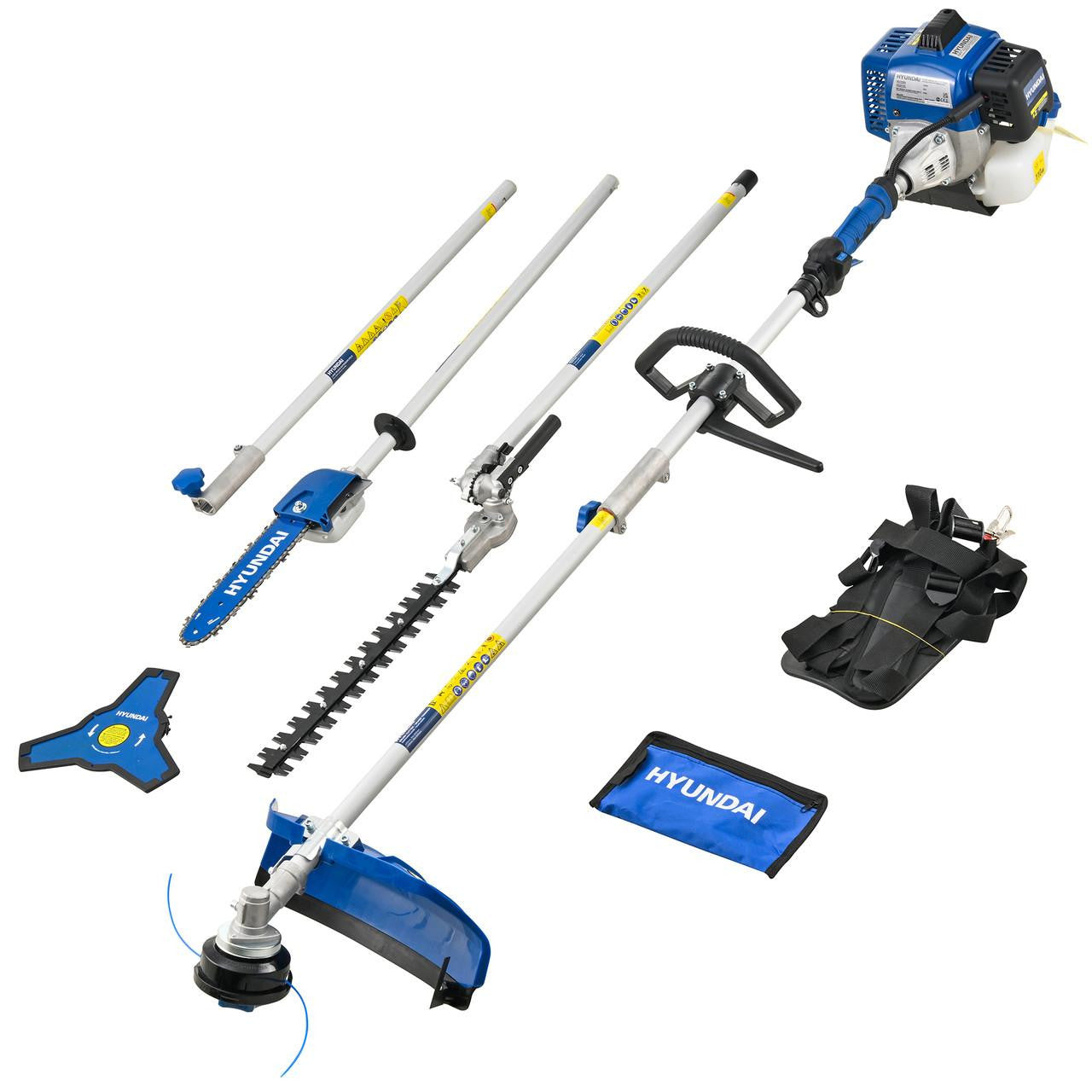
Hyundai HYMT5600X Multi-tool Review: Is This 56cc 5-in-1 Multi-Tool Worth £199?
A detailed UK review of the Hyundai HYMT5600X 56cc 5-in-1 petrol multi-tool: engine power, cutting performance, attachment swaps, real in-use weight, running costs and how it compares to the 52cc HYMT5200X-1.

Should I Vacuum Artificial Grass?
Discover Cleva’s award-winning Vacmaster & LawnMaster tools—top-rated vacuums, mowers & garden gear praised by expert reviewers.
Clarke CPCP1 2HP Petrol Compactor Plate Review
Clarke CPCP1 2HP petrol compactor plate review: 8200N centrifugal force, 200mm compaction depth, 50kg build, £453.59 RRP. Jim Fellows breaks down the specs for driveway and patio projects.